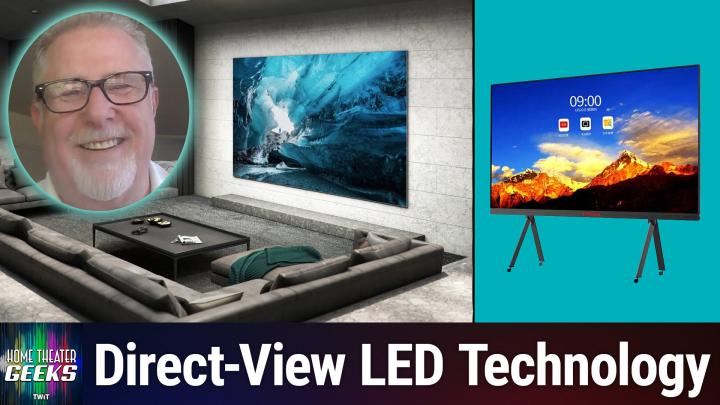
Home Theater Geeks 539 Transcript
Please be advised that this transcript is AI-generated and may not be word-for-word. Time codes refer to the approximate times in the ad-free version of the show.
Scott Wilkinson [00:00:00]:
In this episode of Home Theater Geeks, I chat with industry consultant Ted Romanowitz about the world of Direct View led. So stay tuned.
Ted Romanowitz [00:00:14]:
Podcasts you love from people you trust. This is Twit.
Scott Wilkinson [00:00:30]:
Hey there, Scott Wilkinson here, the home theater geek. In this episode, I'm honored to have as my guest Ted Romanowitz, principal consultant at Future Source Consulting. Hey, Ted, welcome to the show.
Ted Romanowitz [00:00:45]:
Hey, great to be here, Scott. Thanks so much.
Scott Wilkinson [00:00:47]:
Thank you. We're going to be talking about Direct View led, essentially video wall type displays, which we've seen from for a number of years at CES and other shows, and I just wanted to sort of talk about that. And you're the guy who follows it at Future Source Consulting?
Ted Romanowitz [00:01:10]:
That's correct. My industry nickname is LED Ted.
Scott Wilkinson [00:01:16]:
LED Ted. I like that.
Ted Romanowitz [00:01:18]:
I don't know why it might be. I've been doing led for about 15 years. I mentioned to you earlier that I was the first product manager for LED at Planar. Our contract manufacturer. Layard bought the company because we were doing pretty good job and have worked at Christie. And now I'm at Future Source Consulting, helping a lot of different brands with their strategy and go to market.
Scott Wilkinson [00:01:47]:
Well, in this show we're going to talk specifically about home theater applications. These products, these giant direct view LED walls, have many applications in commercial signage and automotive displays, even smaller displays like AR glasses, that sort of thing. But, but I'm. This is. This show's called Home Theater Geeks. So we want to talk about home theater here, so let's dig right in. So let's start with what the heck is Direct View led, sometimes called dvled, sometimes called microled, although I think that's pretty confusing given the backlight technologies that are starting to come out. But we're going to call it DVLED for this particular show.
Scott Wilkinson [00:02:40]:
So give us a little background of what that means. Exactly.
Ted Romanowitz [00:02:45]:
It's really simple. It's a direct view because you're looking straight at the individual LEDs. It's immersive display. So all of the light is emitted by the LEDs themselves. They don't need any backlighting or any filters or anything of the sort. You're looking straight at individual red, blue, green pixels. And it's really evolved over. You know, it's LED has been around for 20 or 30 years, but again in the last sort of decade, decade and a half, it's really taken off mostly in commercial displays and digital signage.
Ted Romanowitz [00:03:26]:
But now it's really starting to come into the home, which is really exciting.
Scott Wilkinson [00:03:32]:
Yeah. Now up until now, and probably a little bit into the future. When we talk about coming into the home, we're not talking cheap, are we?
Ted Romanowitz [00:03:44]:
Not yet. Not yet, Scott. We're going to get there, I promise you. But, you know, first of all, I think one of the things to talk about is the differences in terms of image quality with direct view led. It has, you know, broader color space, Cinema, you know, P3 color, it's very high brightness with peak brightness over 3,000 nits
Scott Wilkinson [00:04:12]:
or more in some cases or more.
Ted Romanowitz [00:04:15]:
The contrast ratios are incredible. Sometimes up to a million to one contrast ratio, there's just, you know, wider viewing angle. There's hundreds of benefits. The number one thing is that, you know, unlike a LCD or OLED display, that has a shortened lifetime, meaning 30 to 50,000 hours. That's still a lot for a home.
Scott Wilkinson [00:04:44]:
Yeah.
Ted Romanowitz [00:04:45]:
Direct view LED can run a 24. 7 operation for up to 100,000 hours to have brightness. This is, you know, if you ran it 24 hours a day, then that's more than 11 years. Right. No one's going to run it 24. Seven in their home.
Scott Wilkinson [00:05:05]:
Right.
Ted Romanowitz [00:05:05]:
But, you know, it could last you 15 or 20 years. So when you. Scott, when you talk about the price, you have to put a little asterisk there and say, well, you know, if you do the total cost of ownership, you know, LEDs will be very affordable in the coming years.
Scott Wilkinson [00:05:27]:
Well, these LEDs are often called micro LEDs, and that refers to the size of the LED itself. I have one graphic that I found that sort of illustrates this, which talks about two different things. The actual size of the LED and what's called pixel pitch. So take us through that a little bit.
Ted Romanowitz [00:05:50]:
Simply defined pixel pitch is the distance measured from the center of one pixel to the adjacent horizontally and vertically.
Scott Wilkinson [00:06:01]:
Mm.
Ted Romanowitz [00:06:02]:
That really corresponds to the. The retina distance, as Steve Jobs called it. Right. The. The optimal viewing distance. So if you take point, you know, 1 millimeter, just so it's easier. Right. 1 millimeter times 8 is 8ft viewing distance, which is pretty far for a home.
Ted Romanowitz [00:06:26]:
But when you get down to 0.5 millimeter LED, which is coming right, then you're. That's basically essentially the same as an OLED or a LCD backlit tv. So the microled piece refers to the mic, the individual red, blue, green sub pixels, and that is the measure of the individual sub pixel being less than 100 microns by 100 microns. It's gone far beyond that now because a lot of popular microled is something like 20 by 40 microns, each individual sub pixel.
Scott Wilkinson [00:07:09]:
Wow.
Ted Romanowitz [00:07:10]:
What happens, Scott, the reason why people need to care about this is that leaves a lot of distance available between the sub pixels. And as you kind of refer to in this diagram, they have ultra black coatings. And that is what helps improve the contrast ratio.
Scott Wilkinson [00:07:33]:
Right.
Ted Romanowitz [00:07:34]:
And makes it so, so beautiful to watch.
Scott Wilkinson [00:07:38]:
Yes. And I totally agree. In the standard LCD and figure B led, rather, here in figure B, the, the pixels, the red, green and blue together are quite a bit bigger. They may have the same pixel pitch, but they occupy more of the space allotted to each pixel. And when they're smaller, I think, will you agree with this that when they're smaller, as in the micro LED case, there's more of the black around them and that improves the contrast.
Ted Romanowitz [00:08:12]:
That is 100% correct.
Scott Wilkinson [00:08:14]:
Okay, good. Well, then it's really relatively simple. Simpler, in fact, than an LCD TV which has an LCD layer and color filters and a backlight and maybe a quantum dot enhancement film. There's. It's very complicated.
Ted Romanowitz [00:08:33]:
Well, and then, I mean, just to talk about the backlighting technology just for a second, you know, we went through initially very few zones of backlight in an L, you know, LCD display.
Scott Wilkinson [00:08:48]:
Right.
Ted Romanowitz [00:08:48]:
And they've gotten more and more zones. Right. Like 50, 100, 200 or thousands even. Well, because now they switched from a sing, like a single white LED to smaller mini lead or micro lead.
Scott Wilkinson [00:09:09]:
Yep.
Ted Romanowitz [00:09:09]:
Right. So mini lead is 200 microns or less, mini lead is 100 micron, or microLED is 100 microns. So you can conceivably do thousands, tens of thousands of zones.
Scott Wilkinson [00:09:23]:
Right.
Ted Romanowitz [00:09:23]:
So that's going to enhance the LCD experience. But you still have that light filtered by the, you know, by the overlays.
Scott Wilkinson [00:09:36]:
Right. By the color filters and the LCD layer and losing a lot of light. It's very inefficient.
Ted Romanowitz [00:09:42]:
And the quantum dot overlay to improve the, the, the color space.
Scott Wilkinson [00:09:53]:
Yes.
Ted Romanowitz [00:09:53]:
Again, that's using energy and reducing light emission. So again, this is where DV led, direct view LED really adds value.
Scott Wilkinson [00:10:08]:
Now, I mentioned earlier that the displays that are DV LED are very expensive. Why is that so far?
Ted Romanowitz [00:10:21]:
So far. Do we want to switch to that one graphic I had with.
Scott Wilkinson [00:10:26]:
Sure, sure. Let's, let's look at graphic number two. There we go.
Ted Romanowitz [00:10:29]:
Yeah. Let's talk about it from a technology transition.
Scott Wilkinson [00:10:33]:
Yeah.
Ted Romanowitz [00:10:33]:
And we're not going to cover the older LED technologies. Right. But these are the ones over the past sort of 15 years that have taken off. So SMD surface mount device LED means there's a red, blue and green pixel inside a single package, which is great. And that's accelerated our industry for the last decade and a half. The problem is you have to pick in place every one of those. And for a 4K display, that's $8.2 million, 8.2 million transfers. And you have the cost additionally of packaging each.
Ted Romanowitz [00:11:19]:
So you make the individual sub dot sub pixels, you put them together, then you package them, then you then you pick and place onto a pcb. This is why it's so expensive. What a lot of Chinese makers have done is said, well, we'll put 2 or 4 or 8 or 16 pixels in a single package. That still has the packaging cost, but it reduces the picks and places.
Scott Wilkinson [00:11:50]:
Right.
Ted Romanowitz [00:11:51]:
And that can either be imd, which is sort of mini LED or standard led. There's a newer variant called MIP microled in package and this is sub 100 micron pixels inside of a package. But again, you're still picking and placing.
Scott Wilkinson [00:12:11]:
And by picking and placing, let's just make sure we understand that there's a robot arm, I think, that goes and picks up one of these packages and moves it over to the substrate where it's going to go and places it 100% right.
Ted Romanowitz [00:12:26]:
And then the solder, the bonding is load and they're attached and it's, it's not done manually. But even with the robot time, you know, to, to do module boards or a complete cabinet takes hours of machine time. And these factories, Scott, are just immense. It's really intriguing to go there and visit, but what's happened is we're transitioning from the technologies packaged that have created this industry to new variants called unpackaged. And so what unpackaged does, it skips a step in that the individual pixels, sub pixels, are not packaged together, they're individually transferred to the substrate. If it's a pcb, we call that chip on board. If it's a Glass or TFT backplane, we call that chip on glass. Not only are you skipping the packaging step, but a lot of Chinese companies, Taiwanese, Korean companies are using new mass transfer capabilities where you're transferring not one pixel, but thousands, two, three, five thousand at a time.
Ted Romanowitz [00:13:51]:
So it's very efficient in terms of throughput. And these are the things, Scott. This whole idea is going to transform the industry and bring down the average selling prices from the hundreds of thousands like you've seen.
Scott Wilkinson [00:14:08]:
Yep.
Ted Romanowitz [00:14:09]:
Down to eventually something that you and I can afford.
Scott Wilkinson [00:14:16]:
Mere mortals.
Ted Romanowitz [00:14:18]:
Mere mortals, you're right.
Scott Wilkinson [00:14:20]:
Yeah. So I mean like TVs you know, high end OLEDs and LCD TVs today are in the 3, 4, 5, six thousand dollar range. Yes, roughly. I mean you can get them for more than that if you go up to the 98 inches or whatever. But yeah.
Ted Romanowitz [00:14:37]:
Yep.
Scott Wilkinson [00:14:38]:
You're saying that eventually direct view LED could get down to that level.
Ted Romanowitz [00:14:43]:
Absolutely. So a couple of big things here. You know, the price will come down to the point within the next five years or so. You know, we'll certainly be in that. We're on the verge right now of being in the $40,000 range. The ASPs are eroding 30% year over year with chip on board. As more and more manufacturing capacity comes online, that's going to continue to drop to the point where by the early part of the2030s, we're not that far away.
Scott Wilkinson [00:15:19]:
No, we're not.
Ted Romanowitz [00:15:22]:
Right. Scarily scary.
Scott Wilkinson [00:15:23]:
Yeah.
Ted Romanowitz [00:15:24]:
See it in that same. Once it hits 40,000, you'll see it start showing up at some of the high end cedia retailers. Right. Specialty high end custom executive homes.
Scott Wilkinson [00:15:39]:
Yep.
Ted Romanowitz [00:15:40]:
What's happening beyond that is once it hits around 4,000, you'll start showing. It will start showing up at you know, like the magnolia part of Best Buy. You know, it'll show up online at Costco. You can't go and see it in the store. Store, but you can order it online, those kinds of things. So if you've kind of fast forward, let's say to the middle of the decade, it will certainly be, you know, in the $2,500 range, which is what I paid for, you know, a very beautiful 83 inch OLED a couple years ago. And for me that was my, my pain threshold. Others, you know, it might be 40,000, others it might be 1500.
Ted Romanowitz [00:16:34]:
We've actually modeled the adoption of television technologies at a price point. And so we've forecasted microled over the years, as price comes down, you just see that hockey stick growth of volumes.
Scott Wilkinson [00:16:52]:
Yeah.
Ted Romanowitz [00:16:53]:
So you know, 10 years from now it'll be in Best Buy, it'll be in Costco and maybe even Walmart and Target, you know, those kind of more broader market big box stores.
Scott Wilkinson [00:17:07]:
Sure, sure. One issue that a lot of people have with these direct view LED video walls, these really big ones even not so big, is that they are composed of tiles.
Ted Romanowitz [00:17:22]:
Yes.
Scott Wilkinson [00:17:23]:
So the tiles are, let's say roughly a foot square or so, maybe a foot and a half. And you put a bunch of them together and you can make a video wall of almost any size or shape.
Ted Romanowitz [00:17:37]:
Yes.
Scott Wilkinson [00:17:38]:
You can which is great because I don't know if you remember this. Many, many years ago, Panasonic introduced 103 inch plasma, I think. And it was. And the whole scuttlebutt around the press corps was, well, how do you get it into a house? You know, you have to drop it in with a crane before you put the roof on or something like that. And the same thing with these big, giant video walls. But the solution, of course, is that they're made up of these little relatively small tiles and you stick them together and you have a controller that, that makes the image go across many of them. The problem is under certain conditions, in certain lighting, with certain content, you can see the boundaries between the tiles. And I don't know about you, but being a home theater geek, that is distracting.
Scott Wilkinson [00:18:34]:
Is there some solution to that problem?
Ted Romanowitz [00:18:37]:
There is. And when installed properly, direct view LED is seamless. You can't tell from one cabinet to the other. And typically the building block is a 27 inch diagonal. The good thing is that the industry has been built on this 27 inch cabinet. So you could create any kind of custom size to fit to a space, or you could hit, hit a specific resolution with these building blocks. And typically when you do that, it comes in and pallets and you have to unwrap everything. And the whole process to install it is rather complex.
Ted Romanowitz [00:19:20]:
It usually takes two or three installers maybe a couple days to install a display that's, let's say 136 or 150 inch diagonal. And I've done. There's a lot of Pro AV dealers that have kind of bridged the gap because the Cedia members haven't adopted them broadly yet. So there's been these Pro AV integrators that have hit into the custom market. You know, I've done a massive 3/4 of a million dollar wall as a product manager into a custom space spec home that was $100 million in Bel Air. There was a smaller wall done in Davis, California. So there is that market. But it's a very lengthy process to install it.
Ted Romanowitz [00:20:13]:
The new trend is called all in one, which is more like a television. And the difference is that it's still relatively modular where there's a back plane and then they just kind of bolt on different sections and tie it all together with cables. So instead of it taking, you know, two men, two days or three days to install, you can do 110, 130 inch display, two people, two hours. And you're right, Scott, it does have the benefit of you don't have to, you know, take out a patio door or something to be able to get it in the building. Right, right. You know, again, with my 83 inch OLED, I was sweating bullets. You know, with Lori and I doing the, the installation at home, it's so heavy and it's awkward to install a TV that big. We got it done in knock on wood.
Ted Romanowitz [00:21:18]:
We didn't break anything. But there was some, some prayers said in between the process. But the all in one is no longer custom. It's. You buy a standard size, you know,
Scott Wilkinson [00:21:33]:
they're typically like a regular TV.
Ted Romanowitz [00:21:35]:
It is. Right. You either would buy a full HD or a 4K version and depending on the pixel pitch would give you the dimensional size. And then the pixel pitch and dimensional size dictates the price. It's that simple. So you get everything integrated, you get everything. It's super easy to install. And with the new chip on board and chip on glass technologies that have improved and lower power, you can install it on a single, you know, 15amp, 110 volt circuit in your house.
Ted Romanowitz [00:22:14]:
It's not a problem. So that's a huge, huge development.
Scott Wilkinson [00:22:19]:
You mentioned resolution. Yeah, 4k full HD. I mean, depending on a couple of factors in particular the pixel size and the pixel pitch, you can get whatever, almost whatever resolution you want. I'm a little surprised that some of these larger displays are still only HD 1080p, not 4K.
Ted Romanowitz [00:22:47]:
Right.
Scott Wilkinson [00:22:49]:
So that depends again on the, on the pixel pitch, how far away, how far apart they are.
Ted Romanowitz [00:22:55]:
Yes.
Scott Wilkinson [00:22:56]:
And the size of the pixel themselves.
Ted Romanowitz [00:22:58]:
Right, yeah. And you know, full disclosure, I work for a British consulting firm. Right. And so when you and I talk about this, Scott, they're across the pond, cringing. Right. Because you and I are talking, I'm talking an 83 inch OLED. Right. And well, 100 inch or whatever, 130 inch.
Ted Romanowitz [00:23:22]:
America, you know, a lot of American homes can accommodate that kind of display size compared to a lot of European homes and especially Asian homes.
Scott Wilkinson [00:23:34]:
Which can't.
Ted Romanowitz [00:23:35]:
Which can't. And so this is the problem is the, the gating factor is pixel density.
Scott Wilkinson [00:23:44]:
Right.
Ted Romanowitz [00:23:45]:
And with individual packaged LED LEDs, you know, you get to an 0303 package. Oh. You know, and that you can only really effectively do like 0.7 or point. Yeah, basically 0.7 millimeter pixel pitch. With a packaged LED, you have to shift to package list to get that increased pixel density so that you can do a 65 inch full HD direct view LED TV set.
Scott Wilkinson [00:24:21]:
Can, can you can you get a 65 inch 4K direct view LED set.
Ted Romanowitz [00:24:27]:
Oh, it's, it's possible. It's just pixel density is possible. Price per pixel is still not quite there, Scott, but it's coming down, as
Scott Wilkinson [00:24:39]:
you say, you know. Well, let's look into the next decade.
Ted Romanowitz [00:24:43]:
Yeah, the end of this decade. It'll get interesting. Next decade is going to be very, very interesting.
Scott Wilkinson [00:24:52]:
Well, I have a feeling I know what my next TV is going to be. I like you have an OLED 77 inch, not 83, but still, it's for my money, the best relatively affordable consumer display technology available. Qd, OLED in particular, but OLED generally. But this one I think is going to surpass it when we get to those levels you're talking about.
Ted Romanowitz [00:25:17]:
Absolutely. There's no doubt in my mind that there'll be this transition. But you look at like ces, Scott. I mean, that was a great segue earlier in the show because you're seeing huge brands, Samsung, lg, Hisense, tcl that are really focused in on these backlights. So they're not giving up on LCD panels. And matter of fact, they're spending a lot of R and D dollars to make them better. So you've got mini LED backlights, you've got micro LED backlights, you have RGB backlight. So instead of all of the color conversion done on the LCD panel, the backlighting is three color and minimizes, reduces is the better way of saying.
Ted Romanowitz [00:26:10]:
It reduces the requirement for the panel to do that color conversion. Therefore you're saving energy.
Scott Wilkinson [00:26:20]:
True. But on the other hand, even RGB led backlit LCD TVs say that 10 times fast require color filters.
Ted Romanowitz [00:26:35]:
Yes.
Scott Wilkinson [00:26:36]:
In the LCD panel. So you are losing some, some energy efficiency there at least.
Ted Romanowitz [00:26:43]:
Yeah. And if you use quantum dots, that's more power.
Scott Wilkinson [00:26:49]:
Right? Certainly more luminance. Well, and, and you're not using more power. You're sending the blue light from the backlight or the, even the. Well, with RGB LED backlights, you don't need quantum dots. It's only, it's only with blue light, blue backlight that you do.
Ted Romanowitz [00:27:10]:
But you can also use quantum dots to enhance an RGB lcd.
Scott Wilkinson [00:27:18]:
Oh, that's interesting.
Ted Romanowitz [00:27:19]:
To expand the color space because, you know, a lot of LCDs are just like NTSC 1987 I believe is the standard. Right. But now, you know, DCI P3 is a really popular, you know, color gamut. Color gamut, yeah. And so all of the content. Well, let's talk about content creation just for a Second.
Scott Wilkinson [00:27:50]:
Sure.
Ted Romanowitz [00:27:51]:
Allow me a segue.
Scott Wilkinson [00:27:52]:
You bet.
Ted Romanowitz [00:27:54]:
So, you know, a lot of the films are being produced in Cinema Color REC 2020. So the cameras are capturing that color space, but when they're brought into production, post production, they're still manipulated and rec 20 mastered in 2020. But when they're transmitted to the theaters, the cinemas, they're only transmitted in DCI
Scott Wilkinson [00:28:25]:
P3, which is a smaller gamut than 2020.
Ted Romanowitz [00:28:29]:
It is. And how much your eye can really capture and distinguish is absolutely dependent on each individual. But the whole idea is P3 is a great color space and there's a lot of LCD or LED displays now that can hit sort of 97%, 98% maybe of. Yeah. Now there's some limits to the sub pixels and blue's a problem. And that's a whole other hour conversation.
Scott Wilkinson [00:29:06]:
Yeah, right.
Ted Romanowitz [00:29:07]:
Another point I did want to make is a lot of people don't realize this now, but the studios in Post are rendering this, this content and editing it on direct view LED displays.
Scott Wilkinson [00:29:22]:
Oh, really?
Ted Romanowitz [00:29:23]:
No longer projectors. And when they do the show dailies for all the content, you know, creators
Scott Wilkinson [00:29:31]:
and the editors, as they're shooting the content as. Yeah, at the end of the day. Yeah.
Ted Romanowitz [00:29:37]:
And while they're doing post.
Scott Wilkinson [00:29:39]:
Yeah.
Ted Romanowitz [00:29:39]:
They're doing the dailies on LCD screen or on LED screens. Pardon me, LED screens.
Scott Wilkinson [00:29:45]:
Yes.
Ted Romanowitz [00:29:46]:
So that's, that's a huge factor because if you look forward, you know, right now there's in the world, there's probably, let's say a couple hundred cinemas, not entire multiplexes, but individual screens in the world that are direct view led.
Scott Wilkinson [00:30:06]:
Yes.
Ted Romanowitz [00:30:07]:
And this is something that, you know, the studios, the chains, the cinema chains have to innovate, they have to draw people in. And having a better screen technology is absolutely vital. So I think within the next couple years you'll start to see more and more cinemas adopt direct view. Not across the multiplex, but one or two theaters within that are a premium experience. You know, like you would, you know, you pay for IMAX or something.
Scott Wilkinson [00:30:45]:
Sure, sure. You then pay for, for seeing it on this kind of screen. As long as you can market it in a way that consumers understand and say, hey, this, this is worth paying extra money for. Well, one other question before we get to products and you just inspired me to ask it. Do direct view LED screens have the capability or the potential for displaying a wider color gamut? Can they get. Well, they can't get all the way to 2020 because that's single wavelength primaries which only lasers can do. LEDs can't do it.
Ted Romanowitz [00:31:21]:
That is correct. It's, it's a problem and people are addressing it. But it's not going to be a short term, not anytime soon. Now you can again possibly use quantum dots to expand the space. But when you see marketing terms like REC 2020 on a LEDV LED screen at CES, what you're really seeing, Scott, is well, it's 75%. It's not, you know, like, come on, give it to us. Right. 97% of P3.
Ted Romanowitz [00:32:07]:
Let's say that's P3. That's close enough for government work.
Scott Wilkinson [00:32:11]:
Sure.
Ted Romanowitz [00:32:11]:
But you know, I don't think I
Scott Wilkinson [00:32:12]:
could see the difference between 97 and 100% of P3.
Ted Romanowitz [00:32:16]:
No, no, you, nor could I. Yeah, nor could I. But yeah, and I, I think the other big trend for DV LED in the home is a lot of these big consumer brands that also have commercial AV divisions have I think an advantage because they have a lot of the consumer facing capabilities that you need to broadly market something like, you know, the integrated image processing, the upscaling, the, the operating systems, the, you know, the remote controls, all these different kinds of things that the content is king. Right. App stores, the art galleries. Right, right. Gaming hubs, these are all things that are going to be immensely important as is support for advanced HDR like HDR 10 plus, Dolby Vision, Dolby Audio, maybe even someday IMAX. I mean, wouldn't that be cool, Scott,
Scott Wilkinson [00:33:32]:
man, have an IMAX theater in your house. Could be. Well, that leads us directly into, I wanted to look at a few examples that are, that are available now. And the OG of this whole category for the home anyway is Samsung's the Wall. I remember seeing this at ces, I don't know, six or seven or at least years ago. And they have, since you know, marketed it more and more to consumers at a variety of sizes. The first one was, I don't know, 164 inches or something huge. They're down to I think 89 inches.
Ted Romanowitz [00:34:19]:
That is correct. Yeah. I think there's also a 78 inch something like that roughly. But you know, the Wall is chip on board technology.
Scott Wilkinson [00:34:33]:
Oh, interesting. They've already, already gone to that technology.
Ted Romanowitz [00:34:37]:
Yep, yep. And they also have a microled chip on glass version that they've been showing at CES for how many years? Four years. And they're now have sufficient capacity that they're selling it on a limited basis still, but still they're selling it globally. They first launched in Korea only, but again chip on glass is very expensive. It's more expensive than chip on board. But for the mass transfer and the Glass TFT backplane, eventually chip on glass will be less expensive.
Scott Wilkinson [00:35:23]:
Sure.
Ted Romanowitz [00:35:24]:
Than chip on board.
Scott Wilkinson [00:35:26]:
Right.
Ted Romanowitz [00:35:26]:
But Samsung's a great example.
Scott Wilkinson [00:35:29]:
Yeah, I, I saw, I was looking online, I saw 146 inch 4K version for a mere $220,000. The 110 inch is only 1080p, which we were talking about earlier, how the pixel pitch and pixel size sort of affect that. And it's only $70,000. So you know, we're still talking a lot of money. How about this? The 89 inch, the MS.1 is a hundred thousand dollars. That may be this, the new chip on glass technology since it's more expensive. I don't know.
Ted Romanowitz [00:36:09]:
But for you, Scott, I'm sure they'll work you a deal. 995.
Scott Wilkinson [00:36:15]:
There you go.
Ted Romanowitz [00:36:16]:
And then of course there's the, the, you know, good, you know, the Friday special. Right, right, right, right, right.
Scott Wilkinson [00:36:23]:
Black Friday. Black Friday special. Another one I wanted to mention was introduced at CES 2025 by Hisense. They announced something called the 136 MX, which is 136 inches as the model number implies and sells at Best Buy now for a mere hundred thousand dollars. Now have you seen this one, Ted?
Ted Romanowitz [00:36:56]:
You know, I have, Scott. I saw that at ces. I was there this year and it looked really good. I'm not sure of the underlying technology. I believe it's most likely chip on board technology, not the more advanced chip on glass.
Scott Wilkinson [00:37:16]:
The other one that I've seen for years is the Sony Crystal led, which I think Sony markets more toward commercial applications than consumer, right?
Ted Romanowitz [00:37:29]:
Yes, that's correct. And of course, you know, with crystal LED that goes way back. It does probably almost a decade. Trying to think of the. Exactly when they were really the pioneers first to market with microled technology. But being first to market, they struggled a lot with their technology. Now with the C and the B series, it's a lot more stable and commercialized. I would fully expect that Sony will do a consumer TV based on this technology.
Ted Romanowitz [00:38:07]:
And of course, you know, everyone has heard about their alliance with tcl.
Scott Wilkinson [00:38:13]:
Yep.
Ted Romanowitz [00:38:13]:
Which I think is quite unique in that it brings all of the brand awareness, all of the relationship, the channel strength of Sony plus their strength in the consumer, you know, like the image processing and those, those capabilities and their content store. Right, Sony pictures.
Scott Wilkinson [00:38:39]:
Yeah, exactly.
Ted Romanowitz [00:38:40]:
Everything like the art and the, all the different things. So I think that's going to be, you Know really help Sony get to the next level. Having a partner that's really, really an expert on the manufacturing supply chain and highly, highly integrated. Yeah, I think over the long term that will make them more and more of a player.
Scott Wilkinson [00:39:02]:
Yep, agreed. LG has one called the Magnet M A G N I T which is kind of interesting. Also seems to be intended more for business applications. Although I saw a couple things online that said it, you know that it had been or could be installed in a luxury home cinema.
Ted Romanowitz [00:39:23]:
Yes, they're definitely going after consumer homes and I think they have two versions. They have the Magnet all in one which is a chip on board technology. And then at Infocom, my gosh, this has been two or three weeks since Infocom. It's a blur Scott. It's a blur.
Scott Wilkinson [00:39:50]:
Yeah, I get, I get that for sure.
Ted Romanowitz [00:39:52]:
In the couple weeks since Infocom, you know they're, they've shown a chip on glass version there of the Magnet that looked just absolutely stunning. And the difference like let again let me kind of be geeky if I can please from the, from the supply chain side because like I mentioned I go to SID Display week. I go to Touch Taiwan, I go to all these across Korea, Taiwan, China. I've been to hundreds and hundreds of factories. What's happening is there were thousands of companies that did SMD. Now only about 3 or 400 of those are effectively still making module boards. There's only about somewhere between 15 and 20 companies that are making chip on board. It's much more difficult to understand and master the technology and invest in the equipment and get the yields up with a quality that you need.
Ted Romanowitz [00:40:57]:
So there'll be 15 to 20 providers of COP and probably five to seven only that'll do chip on glass. So what this means is that more or less the display just like lcd, right? More or less. There's a very limited supply chain and everybody's panels look more or less the same. That's where you know, companies like Samsung, lg, Sony, you know, hisense and TCL have to find ways to differentiate and add consumer based features like know we keep talking about, right. The image processing, the app stores, the content, those kinds of things. The gaming hubs, these things to improve the user experience are immensely, immensely important. Otherwise you're just a commodity.
Scott Wilkinson [00:41:58]:
Right. And at this point it's still a luxury item and will be for a while.
Ted Romanowitz [00:42:06]:
For a while. We're getting there.
Scott Wilkinson [00:42:08]:
I mean we're getting there.
Ted Romanowitz [00:42:09]:
It's again you're, you're starting to see the CD like you Know, the CDA partners are starting to see a lot of this at their show in Denver and the fall, whenever that is right. It's starting to show up there. And you've already had Pro AV integrators doing homes for a decade. So there's momentum there, there's experience. And again, if you look at this technology transition, the pixel density, the price per pixel plus the all in one plus the kind of CE functionality, those all three things kind of merge together. ASPs drop and we're off to the races.
Scott Wilkinson [00:42:58]:
Let's look at another example from your old company, Planar. They have been in the, in the direct view LED business for quite a while as well. And this I believe is called the Direct Light, something like that. It's series of, of products. You know, 163 inch TV in your house. That sounds good to me.
Ted Romanowitz [00:43:29]:
Yeah, I think I top out at about, you know, somewhere in the 120s for what I can fit into my room. But yeah, you know, it has to be 4k exactly at future source. You know, three or four years ago when I was head of Pro Displays, most of the LCD panels being sold were just full HD. Now it's 80% or more are full HD. That's one of the minimum requirements is that we have to get the pixel density and the price per pixel down to make it realistically affordable in a size that fits in your home.
Scott Wilkinson [00:44:16]:
Well, true, I, I totally agree with that and I am surprised to see this picture here. 109 inch at 1080p. Who's gonna buy 109 inch display and only get 1080p? I mean it doesn't make a lot of sense to me in a commercial application. Sure.
Ted Romanowitz [00:44:38]:
But in a, Absolutely.
Scott Wilkinson [00:44:40]:
In a critical home cinema environment, I, I don't see, see that, that you
Ted Romanowitz [00:44:46]:
know this line, Direct Light covers for them both commercial and consumer. And so I think they're cross pollinating and getting different varieties for different applications. But you're right. Well I say that too Scott. And I mean it's still rather hard to find 4K content on you know, you know, the streaming platforms like you know, prime and Netflix and you know, the, the many, many others.
Scott Wilkinson [00:45:18]:
I, well there's, there's a Fair amount of 4k con, what they call UHD but right, right.
Ted Romanowitz [00:45:27]:
Like I have YouTube TV and I'm getting 4k TV in. It's beautiful. But again I'm not a lot, most of the shows aren't, you know, available. But, but knock on wood, the World's cup has been. And that's been marvelous.
Scott Wilkinson [00:45:46]:
Oh yeah, I haven't been, I'm not a sports guy, so I haven't really been watching it. But if they're broadcasting the World cup in 4K, that's cool.
Ted Romanowitz [00:45:56]:
Yes.
Scott Wilkinson [00:45:57]:
Is it HDR too?
Ted Romanowitz [00:46:00]:
I believe so, yeah.
Scott Wilkinson [00:46:01]:
Oh man, then that would be awesome.
Ted Romanowitz [00:46:04]:
Yeah, I would agree. But you know, I think kind of looking forward, you know, there's just so much opportunity and the market is in this shift. I don't think, you know, it's going to take some time to grow and evolve and again, the price per pixel and the pixel density are critical factors. But you know, eventually this is going to happen. The, in the meantime, the big LCD panel companies aren't just sitting by and doing nothing. Right. They're enhancing their LCD panels with, you know, mini led, microled RGB backlighting. You know, OLED is beautiful experience but you know, OLED has a very, very limited supply chain and I'm wondering, I, you know, no brand would admit this, but I'm wondering if some of these big brands are shifting over to the rgb, mini lead and micro LED to get away from a limited supply chain of oled.
Scott Wilkinson [00:47:11]:
Oh, that's interesting.
Ted Romanowitz [00:47:12]:
More of a supply. No, that's just supposition.
Scott Wilkinson [00:47:15]:
That's just you speculating. I get it, I get it. But you're an expert in the field, so one should take your speculation somewhat seriously.
Ted Romanowitz [00:47:23]:
Wow, thank you. So kind.
Scott Wilkinson [00:47:26]:
Okay, one more example from a company I hadn't heard of before. I assume they're Chinese, called Sin Star, C I N S T A R, which I assume is Chinese. They have two series. One the CTV series which we see here, which is an all in one, as you were talking about before.
Ted Romanowitz [00:47:49]:
Yep. Synstar, I believe, is a Chinese company and like so many other companies in Shenzhen or Shanghai or some in Beijing, they're looking for places to sell their displays outside of China because the domestic market is so challenged. But this is a great example and the question is, you know, from a consumer perspective, are you going to trust, you know, and pay so much money to a company that you've never heard of? You're not sure of the support level and the local, you know, availability to talk to somebody.
Scott Wilkinson [00:48:32]:
Sure.
Ted Romanowitz [00:48:32]:
In your time zone. So that's where, Scott, I'm really predicting that, you know, more of the consumer electronics companies, once this gets to broad market, they're going to have the strongest position because of their brand reputation and promise to deliver great products at a decent price and highly supported.
Scott Wilkinson [00:48:57]:
Yeah.
Ted Romanowitz [00:48:58]:
With again that whole ecosystem that, you know, smaller companies just aren't able to support.
Scott Wilkinson [00:49:06]:
Right. Which. This would be one of them. An unknown company. I just, I just wanted to show it because it's a, it's a pictorial example of, of an all in one. You know, it's on a stand and it's, it's like a tv.
Ted Romanowitz [00:49:22]:
It is, Absolutely.
Scott Wilkinson [00:49:25]:
And then they had one other example that I wouldn't wanted to show, which is a wall mount. The pixel pitch of the previous one, the lowest, the smallest, was 0.93 millimeter. This one gets down to 0.78 millimeter. So it's a higher pixel density.
Ted Romanowitz [00:49:42]:
Yep. And the chip on glass from LG at Infocom was 0.78 millimeters too.
Scott Wilkinson [00:49:50]:
There you go. So this may be that technology.
Ted Romanowitz [00:49:52]:
It may be, or it could be chip on board. But you know, again, it's that pixel density that gets you a 4K display that'll fit within a reasonable space.
Scott Wilkinson [00:50:05]:
Yes.
Ted Romanowitz [00:50:06]:
I assume this is in your own home theater in your home?
Scott Wilkinson [00:50:13]:
I wish.
Ted Romanowitz [00:50:14]:
Yeah, me too. Me too. Yeah, I love the tiered seating, but
Scott Wilkinson [00:50:19]:
yes, that seating is, is really nice. I wanted to end with this picture because it's such a cool room.
Ted Romanowitz [00:50:25]:
Yes, yes. Anyway, by the way, when I told my daughter who's studying abroad in Spain this summer, I told her that I was going to be on the Home Theater Geeks. And she goes, oh my God, dad, that's the perfect place. You were meant to be on Home Theater Geeks. From the mouth of my own babe.
Scott Wilkinson [00:50:45]:
Oh, man, that is so cool. Thank you so much for relaying that information. Yes, thank you so much for being here on the show. I really appreciate it. Your expertise is, is well earned and well respected and I really, really appreciate it.
Ted Romanowitz [00:51:01]:
Anytime, Scott. I'm always here for you guys.
Scott Wilkinson [00:51:03]:
Thanks so much. That's Ted Romanowitz, a principal consultant at Future Source Consulting with a vast knowledge base of dvled. Ted, where can people find you online?
Ted Romanowitz [00:51:17]:
It's really easy. I'm on LinkedIn. That's a great place. You can also contact me through Future Source Consulting that has a presence on LinkedIn or via our website, which is www.futuresource-consulting.com.
Scott Wilkinson [00:51:38]:
great, great. Well, thanks again for being here.
Ted Romanowitz [00:51:41]:
Thank you so much.
Scott Wilkinson [00:51:44]:
So I hope you learned something from that. I know I did. If you have a question for me, send it on along to htgwit TV and I'll answer as many as I can right here on the show. And if you have a home theater, you're proud of. Send me some pics. I'd love to see them, and maybe we'll get you on the show to talk about it. Until next time, geek out,