Home Theater Geeks 547 Transcript
Please be advised that this transcript is AI-generated and may not be word-for-word. Time codes refer to the approximate times in the ad-free version of the show.
Scott Wilkinson [00:00:00]:
In this episode of Home Theater Geeks, I profile a home theater installed in a senior living community, so stay tuned. Podcasts you love from people you trust.
Joe Klusnick [00:00:16]:
This is TWiT.
Scott Wilkinson [00:00:21]:
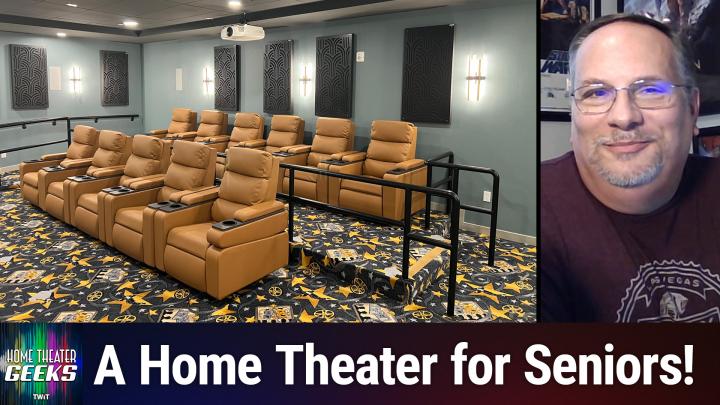
Hey there, Scott Wilkinson here, the Home Theater In this episode, I'm going to profile a cinema home theater in a senior living community. And to help me talk about it is Joe Klusnik, who was already featured in Home Theater Geeks with his own home theater back in episode 517. But he was also involved in this project, so he's, uh, he's coming on the show to Help us understand what has happened here. Hey, Joe, welcome back.
Joe Klusnick [00:01:05]:
Thanks for having me back. Good to see you again.
Scott Wilkinson [00:01:07]:
Good to see you too, as always. So, um, tell us a little bit about this, uh, this project that you've been working on.
Joe Klusnick [00:01:17]:
Yeah, for a number of years now I've been doing projects in assisted living communities installing cinemas, uh, for folks that are going to be living in the assisted living community, and it's been something that's really helped to have the community stand apart from the competition and really bring a great way for folks living there to be entertained.
Scott Wilkinson [00:01:40]:
Yeah, I would totally agree that that's, that's a really important thing to have for folks who are living in such a community, may not be able to get out to the theater, do need cognitive stimulation, might also stimulate old memories, you know, especially if they show old movies which they might have seen in their youth. So I think it's a fabulous idea.
Joe Klusnick [00:02:06]:
Yeah, so this particular project we're going to talk about today was in the Santa Cruz area. It's a theater—
Scott Wilkinson [00:02:13]:
Where I live, as a matter of fact.
Joe Klusnick [00:02:15]:
Yeah, system that we installed working both with the general contractor, the interior decorator, and I was the designer and installer for theater. This particular room up on the second floor in the facility, it was a 31-foot-long room by about an 18-foot-deep room. And they brought me in pretty early on the project, so we were able to contribute a lot to how the room was going to be laid out and set up, determined locations that all of the equipment we were going to install would work the best, figured out everything from the sight lines in the room Easy access in and out of the room, lighting control, HVAC for the room. So we really had a strong foundation to maximize performance.
Scott Wilkinson [00:03:06]:
So let's get into it. We have some pictures that you sent. Thank you so much for that. And we're looking at the framing here before the drywall went up. Anything of note here, or is this pretty standard build?
Joe Klusnick [00:03:19]:
Yeah, so this is a, you know, wood frame construction. And all of the— both the interior and the exterior walls were all done in OSB as well as drywall to help kind of minimize sound leakage. Fortunately, this room had hallways on 2 sides, had a storage room on another side, an elevator bank not too far away. So really was kind of isolated within the facility itself, and that helped out.
Scott Wilkinson [00:03:44]:
I think the next picture shows a little more detail in the ceiling.
Joe Klusnick [00:03:49]:
Yep. So we're up here on the 2nd floor, and then some of these pictures I took from my own personal records. I would know where power was run, where data cables were going, right, where we had to look out for sprinkler systems, things like that within the structure.
Scott Wilkinson [00:04:02]:
Right. Um, and, uh, then once the drywall was up, uh, we, we— the next sequence of pictures that we have, uh, show, uh, the carpet, the paint. It's, it's getting close to done. Uh, let's take a look at that.
Joe Klusnick [00:04:21]:
Yeah, so this is, um, yeah, about midway through the install. Typically I had to go down a couple of different times. One, I would go down early on in that, you know, pre-construction phase, mark out all of the wiring locations that we needed everything to run to, mark out the speaker locations, determine where screen was going to go. Uh, talk about power for the equipment rack as well as where the projector will be mounted. And what you see here is, uh, pre-furniture, a lot of patchwork still being done in drywall, but the in-wall speakers have been put in. So this is the left and right visible. They're covered with protective covers. The center's behind the screen.
Joe Klusnick [00:05:02]:
The screen's been hung up. So this is, you know, like I said, Pretty early in the actual install. The general contractor is responsible for running all the wires. I come in and do all of the trim out, uh, once the room is completed.
Scott Wilkinson [00:05:15]:
Mm-hmm.
Joe Klusnick [00:05:15]:
Uh, like I mentioned, I worked with the interior designer to determine, uh, colors in the room. You know, we wanted to keep it dark, make sure lighting was going to work well in that room. You can see there's multiple HVAC supplies and returns around the room, but this is— yeah, The riser was something that was really important. So as I mentioned, in an assisted living facility like this, you have folks on walkers, wheelchairs, those kind of things. So we needed to make sure that it was easy for them to get in and out of the room and up to that second level of seating. So that's why we did the ramp there at the far end. And then you can see we put in 2 of the subwoofers. They're wrapped up in plastic at the far end.
Joe Klusnick [00:05:56]:
And then we would come back a little while later after furniture comes in. We'll see that in a little bit.
Scott Wilkinson [00:06:00]:
This, uh, the ceiling is black, which I think is great, um, but the walls are a little on the light side. Was that, uh, the designer who decided to do that?
Joe Klusnick [00:06:11]:
It was. And, you know, uh, fortunately it was a fairly neutral color, so, uh, once lighting was down, really didn't cause any issues with any kind of color or anything like that.
Scott Wilkinson [00:06:21]:
Um, what's the size of the screen?
Joe Klusnick [00:06:23]:
So that's a 120-inch screen. Um, You know, I'd love to go even larger. We had room for it, but the challenge when you're doing something like this is always trying to balance out light output on the projector, cost of going to a bigger projector to be able to do a larger screen. But this is an acoustically transparent screen, so we really try and offer a lot of value when we do a system like this to, you know, select components that will maximize performance but keep the budget very reasonable.
Scott Wilkinson [00:06:53]:
Yeah, I believe this is a Silver Ticket screen, am I correct?
Joe Klusnick [00:06:57]:
Correct, acoustically transparent Silver Ticket. This is very much off-the-shelf kind of stuff you can get.
Scott Wilkinson [00:07:03]:
Yeah, okay, here's the equipment rack being installed. This is a Middle Atlantic equipment rack, right?
Joe Klusnick [00:07:11]:
Correct, we are always using the equipment racks just because it makes everything easy to get in and out. The nice thing with getting involved early in the project, we can recommend locations for equipment, uh, have all the wiring pulled exactly to where we need it to be, specify what kind of cabinets, what size dimensions. So in one of these cabinets, the equipment rack slides right in. Right next to it, there's a subwoofer that you can't see yet. We'll see later on.
Scott Wilkinson [00:07:36]:
Mm-hmm.
Joe Klusnick [00:07:36]:
Um, power is run to this location. Uh, the fire alarm trigger turnoff is run to this location. So by, like I said, working with the architects, getting everything drawn out in advance, you know, this is a lot different than, you know, a typical retrofit type of project, being involved early just makes everything go much more smoothly.
Scott Wilkinson [00:07:56]:
Sure. And I think we have a couple of pictures of the in-wall, uh, installation here. Here's one of them.
Joe Klusnick [00:08:02]:
Yeah, so like I said, they, uh, were responsible for, uh, cutting all the holes for me. Uh, had a little bit of challenge with some of the brackets that weren't installed entirely correctly. We overcame that, uh, as the project went along. Fortunately, in a construction site like this, you've got mudders, drywallers, painters that are on hand all the time, so it makes a lot easier to patch any issues that you run into.
Scott Wilkinson [00:08:26]:
I think the next picture shows, uh, how you protected the speakers once they were in.
Joe Klusnick [00:08:31]:
Yeah, so these are all Klipsch speakers, in-walls. Uh, as you can see, that bracket should be behind the drywall. It was on the face. We took care of that later on. But the, uh, yeah, the covers were put in place so that as they were continuing to do painting and move anything around, those are entirely protected, uh, until we put the grills on, right?
Scott Wilkinson [00:08:52]:
And as you said, those are Klipsch Pro-25RQ LCR speakers, and you just did use the same speakers all around, right?
Joe Klusnick [00:09:00]:
7 identical speakers. We were looking for something with, you know, pretty high efficiency. Uh, we're gonna be driving these off of a Denon receiver, but we wanted something that would give good coverage for the entire listening room. Nice thing about these is the horns are angleable, so the left and rights, we're able to toe those in a little bit Um, side speakers, we're able to angle those towards the audience. Um, but yeah, you know, great speaker to work with, uh, good output.
Scott Wilkinson [00:09:26]:
I love this note on there, do not damage.
Joe Klusnick [00:09:31]:
So my wife actually came down and helped me with this project to give me an extra set of hands, so that's some of her handiwork.
Scott Wilkinson [00:09:38]:
Ah, excellent, wonderful. Can't be too careful with that sort of thing. Um, next we have a few pictures of the acoustic treatments, which were from Gick Acoustics, right?
Joe Klusnick [00:09:48]:
Correct. So this is further on. We've gotten all of the panels up. I think this was our second day down there. You can see the projector has now been hung. All of the cabinets are kind of getting ready to be closed up. We used 12 identical Gick panels around the room for both absorption as well as some diffusion with the scatter plates on there. And this really helps to set the mood in the room.
Joe Klusnick [00:10:13]:
You know, working with the interior decorator, we showed them in advance what we were thinking of, what the design was going to be. They selected that very busy carpet that you see on the floor. Don't ever set your tools down on that carpet. You'll never find them again. But yeah, so acoustic treatments being installed around the room to really just kind of tame down some of the reflections. And I'll point out something interesting. Being involved early with this project, they originally thought the screen would be at the far end of the room. And I was trying to explain to them, this— that's not going to work for your risers, your seating.
Joe Klusnick [00:10:47]:
You're going to have 3, 4 rows. We ended up rotating the entire room 90 degrees and got a much better result.
Scott Wilkinson [00:10:53]:
Sure, sure. Well, particularly in this case— I mean, normally, yes, the screen would be at one end of the room's longest dimension, but that didn't work here.
Joe Klusnick [00:11:03]:
When you're trying to fit this many people as well as to have the riser on the ramp, yeah, that just— it wouldn't have worked otherwise for us.
Scott Wilkinson [00:11:11]:
Right, exactly. So here's another view of it. Um, I like the look of those, uh, Gick acoustic panels. They're pretty nice. There you can see the projector also again there.
Joe Klusnick [00:11:24]:
Yeah, uh, they give kind of a nice Art Deco feel to the room. Mhm.
Scott Wilkinson [00:11:30]:
The— and then next we have the finish room, some finish room photos. Uh, let's take a look at those. Here we have the seats in here. What are, what are these seats?
Joe Klusnick [00:11:40]:
Yeah, this is Irwin seating. Uh, I worked with the interior designer to find something, and these came out beautifully. Um, they're all individual seats, so you'll see dual cup holders on all of these. And this is more of a recliner seat, but the feet don't come up on these. And the reason being is we didn't want any kind of tripping hazard or anything like that. So there's room in that front row to put, you know, someone with a wheelchair or a walker at either end. So yeah, really, really comfortable seats. I spent several hours in there as we were updating software and calibrating and everything else.
Joe Klusnick [00:12:15]:
They were fantastic. And we were actually doing this really close to the opening of the facility, so we were having folks come in and poke their head in and take a quick look and see what we were doing. Everybody that came by saw this as a highlight of the facility.
Scott Wilkinson [00:12:29]:
Hmm.
Joe Klusnick [00:12:30]:
All the family members, you know, were stopping by and saying, yeah, well, come back and watch movies here, you know, once mom or dad moves in. So, uh, really, it's a great memory point. It's a strong selling point on the tour, uh, and it's a great place for everyone to be able to get together. It's a really nice, uh, communal space, very focused on viewing that, you know, a lot of other parts of the facility— rec rooms, arts and crafts, those kind of things— you don't always want a TV going. You want something like this so that you can really have dedicated, focused viewing for, uh, people who want to get together and enjoy watching entertainment.
Scott Wilkinson [00:13:07]:
Yeah, yeah, that's great. Just great. Um, the next picture I think, uh, shows— oh, there's the projector. It's an Epson 4010, I believe, right?
Joe Klusnick [00:13:16]:
Yep, Epson 4010. Uh, it's a nice, you know, um, 4K shifter type of a projector. Uh, good output from it, uh, easy to work with, motorized, uh, you know, lens zoom and focus and all of that. So easy to get calibrated into place that's, you know, hung off of a ceiling mount. So yeah, HDMI cable run up to that. I'm able to specify that when we're doing the install, we need a future pipe run from the equipment rack location, making sure we have power up there. Uh, you know, makes the pulling the wires and everything else really simple and straightforward.
Scott Wilkinson [00:13:51]:
What HDMI did you use? Because that's a fair distance from that projector down to the equipment rack.
Joe Klusnick [00:13:56]:
Yeah, it's a Monoprice, uh, 30-foot, I think they're Ruby series or something like that. So again, trying to get something that performs well but provides a lot of value for the money being spent.
Scott Wilkinson [00:14:06]:
Yeah, um, a 30-foot HDMI cable with 4K content, uh, is, shall we say, iffy.
Joe Klusnick [00:14:15]:
Well, well, and we're, we're, we're not always running 4K, right? So, well, true, a lot of times folks are bringing in Uh, DVDs, Blu-ray. Very rarely are they going to, you know, play 4K. We are also offering streaming on this, and it can adapt down to whatever it needs to be. But yeah, no, no dropout problems or anything like that.
Scott Wilkinson [00:14:34]:
Excellent, excellent. Uh, going back to the pictures, here's the equipment rack, and I wanted to mention this a little bit. Uh, you have the Denon receiver. It's an X3800, I think.
Joe Klusnick [00:14:44]:
Yeah, and I've been using the Denons in these type of projects for years. I love the 3800. Um, it's got, you know, excellent, uh, calibration with Audyssey. It's got the 4 subwoofer outputs for the 4 independent subwoofer locations. Um, it's, you know, very easy to set up and configure these days, uh, with all of its, uh, kind of step-through, walkthrough type of, uh, setup. But yeah, it's, it's really kind of a dream receiver.
Scott Wilkinson [00:15:11]:
And you have a Panasonic, uh, UHD Blu-ray player.
Joe Klusnick [00:15:15]:
Yeah, it's one of the 420 players. Um, works great for, like I said, you know, DVD, Blu-ray, UHD if they bring that in. A lot of times the older movies aren't even available, uh, on anything but DVD or Blu-ray.
Scott Wilkinson [00:15:29]:
Uh, right.
Joe Klusnick [00:15:29]:
And that's a great player. It's a workhorse, very reliable, very dependable. Uh, I've been using it.
Scott Wilkinson [00:15:34]:
Not terribly expensive.
Joe Klusnick [00:15:35]:
Decades. No, that's a $250, you know, player.
Scott Wilkinson [00:15:40]:
Yeah, yeah. And for streaming, uh, and we don't need anything that'll do Dolby Vision.
Joe Klusnick [00:15:46]:
Sorry, uh, Apple TV, Apple TV 4K, uh, hardwired.
Scott Wilkinson [00:15:51]:
Oh, the subwoofers. I wanted you to talk about the subwoofers.
Joe Klusnick [00:15:56]:
Yeah, so, uh, in this speaker— you can— sorry, in this picture you're able to see some of the acoustic treatments. This is in one of the far corners of the room. This is an SVS sealed box 1000 Pro. We use smaller subwoofers spread around the room. There's 4 of them, one in each corner of the room. Provides very even bass. We're not— this audience is not looking for huge explosions, right? We do want, you know, a nice foundation to the movie or music that we're listening to. So by using 4 of these, we're able to keep volume down, we're able to very evenly cover the entire room, and these have been bulletproof subwoofers.
Joe Klusnick [00:16:36]:
These are rock solid. You'll notice all of these are placed on the SVS absorption feet to minimize any kind of vibration into the cabinetry or the furniture or the floors. But, you know, just beautiful little subwoofers. The, the Denon makes it easy to get them all sounding good. These are all on the app, so I'm able to sit in the chair, bring volume levels up and down with the microphone. So yeah, really reliable, dependable. I've used dozens of these subwoofers.
Scott Wilkinson [00:17:06]:
That last picture, I must admit, concerned me a little bit in that, uh, the subwoofer is pretty tight in that cabinet, which can affect its sound. It—
Joe Klusnick [00:17:16]:
you're right, but that's kind of a compromise that we need to be willing to accept. Um, ideally we'd have them out, uh, on the floor, but then they become a little bit more of a tripping, kicking type of a hazard. Yeah, so these are behind grilles You can see these are acoustically transparent cabinets, but yeah, they are tucked in there. We could get some resonance out of there, but it hasn't really been an issue.
Scott Wilkinson [00:17:42]:
Yeah, okay. Well, again, you know, it's true one needs to make compromises here and there, and certainly in a case where you want to avoid tripping hazards and so on, and you can adjust for it to some degree, so I'm sure you did a great job.
Joe Klusnick [00:17:58]:
Uh, if you want to go back to the equipment rack.
Scott Wilkinson [00:18:01]:
Oh yeah.
Joe Klusnick [00:18:02]:
A couple of other things. At the very top, you'll see the fire alarm interface so that if that does go off, the equipment does shut down. Only thing that's plugged in for this rack is the CyberPower. That is a battery backup that we make sure, uh, anything that the networking as well as the remote control, those kind of things have battery backup so that if we do have any power glitches it's all taken care of. Um, you'll also see the Logitech Hub in there, uh, as well as AC Infinity for fan cooling, um, just to keep, you know, everything kind of running nominally.
Scott Wilkinson [00:18:38]:
Uh, you mentioned Logitech, and, uh, in, in the information you sent me, uh, you said you used a Harmony Ultimate with the Hub.
Joe Klusnick [00:18:48]:
Yeah, I, uh, I've used those remotes for years and years. I have Another couple dozen of them sitting over there in the closet.
Scott Wilkinson [00:18:55]:
Um, I was just wondering where you got it because they don't make them anymore.
Joe Klusnick [00:19:01]:
No, they don't make them, but they still work great. So, uh, yeah. Oh yeah, we, we repeat, we repeat a lot of the same kind of equipment. You know, we use a lot of the Epson projectors, the Denon receivers, the Panasonic Blu-rays, the Apple TVs. So I'm able to very quickly upload a program that I know is already bulletproof and works for that remote in that location with that particular selection of equipment and not really need to tweak it too much.
Scott Wilkinson [00:19:29]:
Yeah, fantastic. And so I asked you before, and I'm sorry I talked over you a little bit, what was the overall cost?
Joe Klusnick [00:19:38]:
What would you, what would you think? Install, labor, where would you put it?
Scott Wilkinson [00:19:42]:
Well, you already told me, so I'm just, I'm feeding it to you. I'm sorry.
Joe Klusnick [00:19:47]:
That's okay. It's, it's less than I spent for my JVC projector. So, uh, about $25,000 for the entire project installed for my portion of it. That's the screen, acoustic treatments, speakers, subwoofers, install, calibration, labor. That does not include seating, lighting, any of the construction of the room, but, uh, just for the equipment side of it.
Scott Wilkinson [00:20:12]:
You know, that is pretty darn good, I would say. And I would be willing to bet that the performance is surprisingly good.
Joe Klusnick [00:20:25]:
Very much so. You know, we put on Star Wars, um, one of the later movies, just to take a listen to it. I'll usually leave a couple of movies when I'm done just so that they have something to watch and start their library with, but was very impressed seeing the Millennium Falcon getting chased around by TIE fighters over the desert. Yeah, looked good, sounded good. And like I said, everybody who walked in, not necessarily— they weren't home theater enthusiasts, but they were people who would happily sit down and stay and watch the entire movie if I had let them.
Scott Wilkinson [00:21:00]:
One question just occurred to me. You didn't implement Atmos.
Joe Klusnick [00:21:06]:
No, and, and reason being 2 things. One, the audience there a lot of times may not— they're older generation and may not really appreciate the subtlety of Atmos. So I'm, you know, in an attempt to keep the cost at a very reasonable place, we don't do the in-ceiling speakers.
Scott Wilkinson [00:21:25]:
Okay, well, that makes sense. As we mentioned at the beginning, you know, having such a room in an senior living or assisted living facility is, uh, is a really good thing, uh, for a number of reasons. And one reason my wife mentioned to me that I thought was really good is that in, in an older population, maybe the vi— their vision is failing to some degree or their hearing is failing to some degree, and having a high-quality, uh, performance in a, in an audio-video system would be of benefit in that regard too. Because if you had, you know, a crappy display and funky speakers that were all distorted, it would, it would just sound terrible and look terrible, and it would not help these people appreciate what they're watching.
Joe Klusnick [00:22:15]:
Absolutely. Things like dialogue intelligibility, uh, hugely important. And that's why we're making sure that the room is acoustically treated, that speakers are placed in the right locations And, you know, not only is it important for them to be able to see and hear it the way they want to, that's not something they can do in a commercial theater anymore. One, it's, it's harder for folks as they get older to go out and go to the movies, but you can't adjust the volume up and down. You cannot optimize it for, you know, the, the audience that's in that room, uh, in a normal commercial theater. So that's why it's really important to have something like this. Additionally, it's great for Super Bowl parties, uh, watching the Oscars, uh, big sporting events, you know. And it gives a really a nice place for the community to get together and gather, not only watching broadcast and pre-recorded entertainment, movies, whatever, but also they'll have guest speakers come in, they'll do travel presentations and use the screen to do slideshows.
Joe Klusnick [00:23:15]:
They can share family photos off of an iPhone.
Scott Wilkinson [00:23:18]:
Oh, what a great idea!
Joe Klusnick [00:23:20]:
So there's just a lot you can do in a theater room like this that makes it a really big asset to that community.
Scott Wilkinson [00:23:29]:
Yeah, yeah. Well, this has been great. Thank you so much for sharing this with us. And you've got a couple more coming up this year, right?
Joe Klusnick [00:23:39]:
Yep. We have another project that's being wired right now that we've got I was racking equipment this weekend for that one. Um, you know, we can pre-rack everything, uh, make sure it's all tested here, all pre-configured, so it just speeds up the install process when we get down there. Um, yeah, something else I wanted to mention about the assisted living facility, you know, and this kind of goes back to COVID and that time, this can be a very, uh, health risk risk-averse type of a population. So being able to see movies with people that you're living with on a day-to-day basis, with the staff that works there, and not going out into a public where you're spreading a lot of different types of germs, where you're out around—
Scott Wilkinson [00:24:26]:
Exposed to a bunch of different kinds of germs.
Joe Klusnick [00:24:28]:
100%. So that, that's a big advantage with something like this, that they're, they're around that same safe environment that they're used to being.
Scott Wilkinson [00:24:39]:
Beautiful, beautiful. Well, again, thank you so much for, for sharing that with us.
Joe Klusnick [00:24:43]:
My pleasure.
Scott Wilkinson [00:24:44]:
Really appreciate it.
Joe Klusnick [00:24:46]:
Yeah. Oh, and Scott, if we get another one done close to you, I'll give you a call. We can go check it out.
Scott Wilkinson [00:24:51]:
Sure, sure. Actually, this one is so close to me, it's like literally a couple miles away. So if, if you happen to come back for like tuning it up or something, let me know and I'd love to come check it out.
Joe Klusnick [00:25:03]:
100%. Yeah, we got one coming, uh, in Santa Cruz, not far from the surfer statue.
Scott Wilkinson [00:25:08]:
Ah, the surfer statue. Excellent. Well, when you get that one done, let me know too, because that's literally just the other side of town, and, and this town is not very big. So that's fantastic. Joe, thank you so much.
Joe Klusnick [00:25:24]:
My pleasure.
Scott Wilkinson [00:25:25]:
So that is Joe Klusnik. He is, uh, Now an installer of home theaters in assisted living facilities, and it's righteous work if you ask me. So thanks so much, and that's going to be great for those residents, no question. Now if you have a question for me, send it on along to HTG@twit.tv, and I'll answer as many as I can right here on the show. And if you have a home theater you're proud of, send me some pics. I'd love to see them, and maybe we'll get you on the show to talk about it. Until next time, geek out! Geek out!