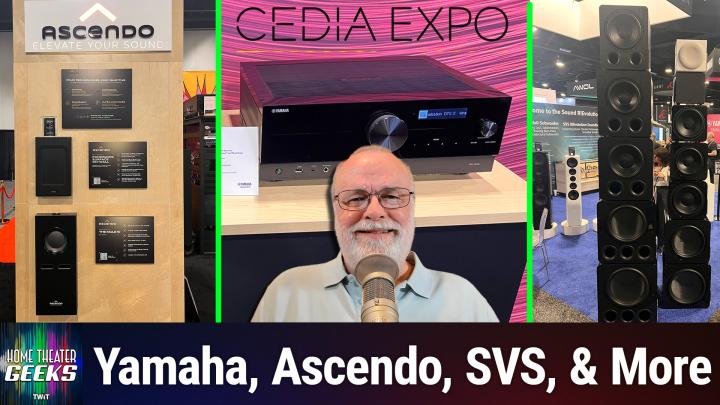
Home Theater Geeks 550 Transcript
Please be advised that this transcript is AI-generated and may not be word-for-word. Time codes refer to the approximate times in the ad-free version of the show.
Scott Wilkinson [00:00:01]:
In this episode of Home Theater Geeks, I continue my coverage of CEDIA Expo 2026 in part 2, audio products. So stay tuned.
Michael Heiss [00:00:15]:
Podcasts you love from people you trust. This is TWiT.
Scott Wilkinson [00:00:31]:
Hey there, Scott Wilkinson here, the Home Theater Geek. In this episode, I continue my coverage of CEDIA Expo 2026 with my good friends Mike Heiss, who is a journalist, an industry consultant, and a jolly good CEDIA fellow, and Joe Klusnik, who won the Home Theater of the Month a month or so ago in episode 517 and is a home theater designer uh, with CEDIA certification. And we shot— we looked at one of his, uh, theaters in episode 547. Hey, you guys, welcome back.
Michael Heiss [00:01:09]:
Hey, good to be here, Scott.
Joe Klusnick [00:01:10]:
Thanks for having me.
Scott Wilkinson [00:01:12]:
You bet, always happy to have you here. And since you guys attended and I did not, uh, I'm really happy to be getting the lowdown from you guys. So we are talking once again about CDIA Expo 2026, which happened in Denver at the Colorado Convention Center where the giant blue bear stands peering into the window. I always thought that was hilarious. Actually, one time I stopped at the gift shop in the convention center and bought a little one, a little model. I have it around here somewhere. Anyway, uh, in this episode we're going to talk about audio products. Last episode, last week, we talked about video products, and there were an awful lot of them.
Scott Wilkinson [00:02:01]:
And this time it's audio. So let us get into it. Let's start with AVRs and processors. And Yamaha had quite a few, uh, new products, I think, right, Mike?
Michael Heiss [00:02:16]:
They had one or two. And the AVR is an interesting category these days. It wasn't the same as it was years ago when I was cranking out 5 or 6 of them every year at Harman. It's definitely changed. And in fact, the Harman/Sound United/Samsung-owned brands were not there at all this year. Well, Harman had a room downstairs, but there were no Denon and Marantz, unfortunately. But Yama had a few, and, uh, there were a few other interesting things. The AVR world has gone up.
Michael Heiss [00:02:55]:
Yeah, there's that, that RX-A2A, and that ain't the AVRs that I used to be making, I'll tell you. It's, uh, you know, uh, quite, quite a change.
Scott Wilkinson [00:03:05]:
Yeah. Um, so yeah, here we see the front— oh, that— the front of the A2A and the back of the A4A. And the next picture has an A8A and an A6A. Joe, what'd you think about these? Did they play them at all, or was this a static display?
Joe Klusnick [00:03:26]:
Static display. I think, you know, what I really wanted to take a closer look at was just kind of the guts and the engineering on some of those receivers.
Scott Wilkinson [00:03:33]:
And they let you do it right here.
Michael Heiss [00:03:35]:
Yeah.
Joe Klusnick [00:03:35]:
They did have a pair of new units for more audio-only streaming around the house, and that was the live portion of the demo in Yamaha.
Scott Wilkinson [00:03:45]:
Ah, okay. Um, I don't think I got a picture of those, and I'm sorry to say, uh, the WXA-70A streaming amp and the WXC-70A, uh, streaming preamp, I guess, uh, I think are the things you're talking about, right?
Joe Klusnick [00:04:02]:
Correct. Yeah, one with the amplifier, one with just the outputs. Uh, but it's designed for, you know, multiple room, and it was a really, you know, nice sounding small piece. It's always kind of hard to judge sound quality on a very loud show floor.
Scott Wilkinson [00:04:14]:
Yeah, that's for sure.
Joe Klusnick [00:04:15]:
But, you know, I think they were $1,200 or so retail, uh, type of price for those units. And, you know, for the right customer, I think that they would have a great place.
Michael Heiss [00:04:23]:
But in fairness to AVRs, because, you know, once an AVR guy, always an AVR guy. Take the boy out of the AVR, but you can't take the AVR out of the boy. Um, you know, there were, uh, AVRs, albeit at a significantly higher price, but again, the kind of things that Joe would, would put in an installation. And there has been a trend, uh, with the CEDIA crowd over the last few years to use AVRs instead of a processor and just hook them up to bigger amps, uh, you know, mostly for the LCR. But Sony had 2 of their ES, uh, AVRs there. There were Anthem AVRs, there were Arcam AVRs. Uh, they did not have the JBL MA AVRs, uh, on display this year, but I'm led to believe by the folks there that that's actually been— that's the— this is not your father's AVR line. And it's, it's doing very well, showing that that's how you want to keep, you know, people that aren't boomers like me with AVRs.
Michael Heiss [00:05:24]:
Um, and, uh, who else had AVRs?
Joe Klusnick [00:05:27]:
Well, I'll tell you, in one of the sound rooms, one of the best sounding sound rooms in my opinion, was running off of a receiver. So that— we'll talk about that more in the next show.
Michael Heiss [00:05:36]:
Yeah, and I think the Emotiva guys, uh, had a receiver show.
Scott Wilkinson [00:05:39]:
Emotiva, yeah. Yeah, they actually had a processor. But, uh, I want— you mentioned Anthem. They had an MRX Slim, which, uh, I thought was interesting.
Michael Heiss [00:05:51]:
Well, again, that goes to that Dante, you know, AOIP AES67. You know, if that's a receiver, where do you fit them damn amps in there? You know, and, um, I should have taken a, uh, a rear panel shot of that. But, um, you know, there's a place for everything given what the— again, I defer to somebody who actually has to do this stuff. It depends on what the budget is and what the client wants.
Joe Klusnick [00:06:20]:
Yeah, and units like that, that's the kind of thing where in a multi-purpose room you can squeeze a lot of equipment behind a big flat panel. So, you know, units like that, source units as they continue to get smaller and smaller Um, there's a lot of manufacturers making racks specifically for wall mounting these kind of things behind the TV.
Scott Wilkinson [00:06:38]:
So yeah.
Michael Heiss [00:06:40]:
But there were— there was also, you know, the rebirth of the stereo receiver as a streaming unit. And, uh, which we saw in that—
Scott Wilkinson [00:06:50]:
yeah, which, which was the Yamaha example that Joe gave us a little earlier, right?
Michael Heiss [00:06:54]:
And Onkyo had one as well, and it sounded, you know, and again I made a lot of stereo receivers in my days, still do, uh, in another incarnation, and none of them looked like that, that's for sure.
Scott Wilkinson [00:07:07]:
That's a beautiful piece.
Michael Heiss [00:07:09]:
It is a— and it sounded very good with the Klipsch speakers, as you might imagine. But it's a way of keeping 2-channel alive, you know. It's the— remember, a receiver, when Dr. Harman invented the receiver, it was a preamp, an amp, and a tuner. in one chassis. There'd be no tuner in that box, but there'd be a lot of streaming. A lot of streaming. That's all.
Michael Heiss [00:07:33]:
That's today's tuner.
Joe Klusnick [00:07:35]:
Then, Mike, was that on the show floor or was that a hotel?
Michael Heiss [00:07:38]:
No, that was in the Hotel Teatro. That was— Onkyo was not on the, on the show floor this year.
Joe Klusnick [00:07:42]:
Gotcha.
Scott Wilkinson [00:07:44]:
Um, Arcam, I just want to mention, uh, did the AVA-15, uh, multi-channel AVR, I think, and we have a picture of that.
Michael Heiss [00:07:54]:
And, and again, I mean, that— I, I don't recall the price of that, but again, that shows a distinct evolution of the manufacturers understanding what the audience is and knowing what they need to do to appeal to a new audience. It's got a Class D amplifier. There are people out there, I'm sure, who will say If it ain't AB, I ain't being it. And, you know, and, you know, good for you. And then there's, there's something for everyone. But, you know, I, I, I didn't hear this one because that was a static display, but these things sound really, really good. I'm doing a lot of work in another incarnation with Class D stuff right now, and some of it is really amazing.
Scott Wilkinson [00:08:43]:
Yeah, yeah. Uh, you mentioned, uh, earlier— I don't know if it was on this episode or the last one— about Emotiva. Yeah, and they had one called the LXP-16, which is a processor, uh, doesn't have any amps in it. I didn't, didn't get a picture of it unfortunately, but, uh, it's, it's one that I just wanted to mention. Did either of you guys see it?
Michael Heiss [00:09:03]:
Hey, again, I did see it. I saw Big Dan, and, um, it was a static display, but, you know, uh, to their credit, the Emo folk have, uh, upped their game, and this is their first new line, and it's definitely a step-up line in a while. And, um, they're, they're almost all D2C, direct-to-consumer. But the fact that they're at CEDIA, you know, look out, Joe, they're, they're hunting, hunting for you. And, you know, there's, there's room for everybody.
Scott Wilkinson [00:09:35]:
Yeah. And Emotiva is, uh, what we might call more of a value-oriented line. It's not super high-end.
Michael Heiss [00:09:43]:
Well, that's what they're trying to do with these new LXP. There are 2. There's a 16 and I think an 11. And they're definitely trying— it's a totally new architecture for them and they're trying to move up class. And that is one of the reasons why, you know, they were at CEDIA for the 2nd year in a row.
Scott Wilkinson [00:10:04]:
Mm-hmm.
Joe Klusnick [00:10:05]:
Yeah, we saw the same thing with TCL. I mean, they started selling those in Walmart, so you couldn't—
Scott Wilkinson [00:10:10]:
right, right.
Joe Klusnick [00:10:10]:
For sure.
Scott Wilkinson [00:10:11]:
Right, right, right. Uh, well, let's move on to speakers. Uh, Joe, you sent me some pictures of a company I had never heard of before called Krix. K-R-I-X.
Joe Klusnick [00:10:26]:
Yeah, uh, company out of Australia. They've been around for 50 years.
Scott Wilkinson [00:10:31]:
50 years?
Joe Klusnick [00:10:32]:
Yeah, they started down there doing, uh, you know, cinema, uh, commercial cinema speaker applications, and have recently moved into the home theater space and bringing a lot of the technology and know-how from there. But they're, you know, built and manufactured in Australia, to the best of my understanding. But this is one of the— outside one of the sound rooms. Yeah.
Michael Heiss [00:10:55]:
And Cricks are not for kids.
Scott Wilkinson [00:11:00]:
I'm sorry. Oh man, Mike gets me every time. Okay.
Michael Heiss [00:11:07]:
I'm not keeping score this year, Scott.
Scott Wilkinson [00:11:09]:
Thank you. I appreciate that. I appreciate that. Okay, well, we're going to talk about the Crick's demo in the next episode, so we'll, we'll leave the, the impressions for then. And Mike, you sent me a picture, sort of a poster thing of Anthony Grimani's Reflect speaker, which isn't new at the show. He's had it now for a little while, but I love the concept. Tell us about it.
Michael Heiss [00:11:37]:
Well, and this actually, uh, my exposure to this came from an article that I did in the, uh, most recent issue of Hidden Wires, hiddenwires.co.uk. And I spoke to Anthony, who I've known for longer than either of us would care to say.
Scott Wilkinson [00:11:55]:
Exactly.
Michael Heiss [00:11:56]:
And the question is, in a world of DV— in a world of DVLED, as Don LaFontaine used to say— in a world of DVLED and 98-inch and larger flat panels, You don't be poking holes in those screens to put the speakers behind. So how do you get good imaging? And there are a number of different approaches. In Quantum Media, they put them above and below. Some people put them above and to the sides. But what Anthony has done— and he's changed the name again, for crying out loud— but this is best called a bouncy bouncy. It is a sound reflector and He did not have a live demo of it at Expo in Denver, but I did see it at a situation that he's got set up in beautiful downtown Burbank. And it sounds really, really good because he does know what he's doing. He does know what he's doing.
Michael Heiss [00:12:51]:
And he's got a great team. And it is a big problem. You know, you have to—
Scott Wilkinson [00:12:56]:
How do you get the center channel, the center channel where all the dialogue is, most of it, to come from the center of a solid, DVLED or giant LCD TV screen?
Michael Heiss [00:13:09]:
And the answer is with great difficulty and with a lot of DSP and with some very— and that's where the onus also goes to the Joe Klusniks of the world for them to plan it, position it properly, and, you know, make sure that everything works in concert with one another. And again, I have heard it. And dagnabbit, the sound came from the center of the screen. How'd he do that?
Joe Klusnick [00:13:41]:
Well, if we're not going to hang a projector from the ceiling, we got to put something up there, right?
Scott Wilkinson [00:13:45]:
No, no.
Michael Heiss [00:13:46]:
And honest to goodness, Joe, that's what it looks like. Or you can put it in acoustic, uh, transparent, you know, material covering it. But that's exactly what it looks like. And that was part of the, uh, the concept because exactly as you say, if somebody looks up and they say, oh, that's the projector. Well, it's not a projector, it's the sound projector.
Joe Klusnick [00:14:05]:
Sound projector.
Michael Heiss [00:14:06]:
Yeah, but it, it really did— again, it was not on display at CEDIA, but, uh, hats off to, uh, my buddy Anthony and fellow Lifetime Achievement Award winner. And, uh, it sounded pretty damn good.
Scott Wilkinson [00:14:21]:
I— this is one of the re— one of the few reasons I wish I still lived in Burbank, because I would want to go to hear that.
Michael Heiss [00:14:27]:
If, if you— next time you both come down here, we'll meet and have a, um, what is the pizza? What is that cockamamie?
Scott Wilkinson [00:14:36]:
Oh, the pizookie.
Michael Heiss [00:14:38]:
Pizookie. We'll have a pizookie and I'll have Anthony, uh, arrange a demo.
Scott Wilkinson [00:14:44]:
There you go. Okay, I, I'm, I'm on. Uh, now JBL announced some speakers and one of you sent me some pictures of it, 9 and 10. I don't know if these are new or not.
Joe Klusnick [00:14:56]:
So these were a static display below the main show floor. This was right across from Trinnov, and they were showing off some of the newer, uh, JBL Synthesis speakers. So they have upsized a lot of the previous versions of the JBLs, and they're offering both an in-wall and kind of an on-wall version of these. You know, one of the things I really loved were— was JBL Synthesis's demo, uh, from years past. And unfortunately that just didn't happen this year, but, uh, you know, at least you got to see some of their product on display.
Michael Heiss [00:15:30]:
I, I've heard those. They had an event over in Northridge, and surprisingly they let me in. And whatever. You were an old—
Scott Wilkinson [00:15:40]:
you're an old buddy of theirs. What do you mean?
Michael Heiss [00:15:41]:
I only worked there for 25 years.
Scott Wilkinson [00:15:44]:
Yeah, really?
Michael Heiss [00:15:45]:
But I have heard these. They're not in the Ergo Theater, in the big, big theater, but they're in some of the demo rooms. And, and I have to say, uh, uh, they sounded really good, Joe. These are— and they're also designed for in-wall, as you can see the way these are, are flush mounted. And they did sound as, as one would expect, you know, quite frankly, from JBL.
Scott Wilkinson [00:16:06]:
Really?
Michael Heiss [00:16:06]:
And they sounded really good. Oh, and they— I don't know if it was new, new but they also have a new totally homegrown synthesis processor.
Scott Wilkinson [00:16:17]:
Really?
Michael Heiss [00:16:17]:
So, um, you know, you got to come down and do a tour down here, Scott, because, you know, I do— you know, we'll fix you up with some demos.
Scott Wilkinson [00:16:25]:
There you go. Okay, I like it, I like it. Um, I think we mentioned earlier that Klipsch was there, and they are celebrating their 80th anniversary, for heaven's sakes. Um, I didn't— I don't have any photos of, of what they were doing. Did— were they doing anything, uh, showing?
Michael Heiss [00:16:44]:
They did, Joe. Did you make it over to their demo in the hotel?
Joe Klusnick [00:16:48]:
No, but I understand they were showing off some of their new Reference 3 speaker introductions.
Michael Heiss [00:16:52]:
They did, and they, as again, as one might expect, um, you know, sounded very good. And, and an anecdote that I think Scott— now this is an old man Paul Klipsch— they were handing out records, and I have to talk to their PR lady.
Scott Wilkinson [00:17:08]:
You mean like vinyl?
Michael Heiss [00:17:10]:
Like a vinyl. And it is a vinyl record. Excuse me. Paul Klipsch in the early '50s made mixtapes.
Scott Wilkinson [00:17:23]:
Yeah, man.
Michael Heiss [00:17:24]:
And this was before we all made mixtapes to give to our girlfriends on cassettes, because this was before cassettes. But honest to goodness, Paul Klipsch made mixtapes to have a variety of— I guess using like Ampex 300s and 350s or Magnachords to demo the speakers to himself. And they played a vinyl record through, uh, I believe it was an Onkyo, you know, because they're all in the same corporate umbrella now, um, through, uh, some Onkyo device, and it sounded— again, as one might expect, they did sound, uh, really, really good. But Paul Klipsch making a mixtape, that's great. I mean, I couldn't imagine— I couldn't imagine Dr. Harman making a mixtape. I work for Dr. Harman.
Scott Wilkinson [00:18:18]:
Yeah, yeah, yeah. Um, I want to mention Theory Audio. Uh, Paul Hales is a friend of mine, and he did, um, uh, pro audio and also theory audio, and I have always been super impressed with his stuff. Uh, Joe, did you get a chance to swing by there?
Joe Klusnick [00:18:38]:
I got close to it. You could hear it from the hallway.
Scott Wilkinson [00:18:43]:
Um, one, one announcement that caught my eye was, uh, he, he'd made something called the P9 pendant speaker. which I guess is a speaker that you hang from the ceiling.
Michael Heiss [00:18:54]:
I, I don't know if those are new because I didn't get to— I didn't get to see Theory this year either, but I did see them last year and it did strike me as one of the better demos at the show.
Scott Wilkinson [00:19:05]:
And he does great demos.
Michael Heiss [00:19:07]:
He gives good— the only problem with his demos is that they're 45 minutes long. I mean, yeah, and but they are— it— he gives good demo and I think they had the pendant speakers are a predecessor, and, and a lot of the stuff that he does is in the commercial industrial space, and I think that they were originally designed for that. But it— they, they really do sound good. They're good stuff.
Scott Wilkinson [00:19:33]:
Yeah.
Joe Klusnick [00:19:33]:
One of the things that was impressive was the, the use of the same driver complement in lots of different form factors. So you would see them as an in-wall, as a freestanding, as a pendant, and he could switch between all of these so that I agree, the demo was impressive. I did get a chance to check that out last year. I did hear this year's was a little bit longer.
Scott Wilkinson [00:19:53]:
Well, that is a problem at CEDIA because you have so much to see in 4 days. You think, oh, 4 days, I got plenty of time. No, you do not. A couple of, couple of other quick, quick mentions that we do have some photos of the Cabas Pearl Pellegrina. I just had to show a picture of this because it's so cool.
Michael Heiss [00:20:14]:
I think I went to school with her.
Joe Klusnick [00:20:17]:
I think I had a laugh at that last night.
Michael Heiss [00:20:20]:
She was the foreign exchange student.
Scott Wilkinson [00:20:22]:
She was the foreign exchange student, right? Pellegrina. Uh, I mean, the Cabasse speakers have had this spherical, uh, enclosure for a long time, uh, but it just looks cool.
Michael Heiss [00:20:37]:
Although, you know, not to jump ahead, if you didn't tell me that those were the Cabasse and I saw those What do you call it? I would think they were Diavole because I just have to have a time to say Diavole.
Scott Wilkinson [00:20:49]:
Diavole. And that's the next picture. Let's take a look at that.
Michael Heiss [00:20:52]:
Well, wait, wait, wait. One more. Can I do one more, Scott?
Scott Wilkinson [00:20:55]:
Ah, sure.
Michael Heiss [00:20:56]:
Are the rear channel speakers the kibosh cabooses?
Joe Klusnick [00:21:03]:
Oh, man.
Scott Wilkinson [00:21:09]:
I gotta tell you, he makes me laugh all the time, man. It's bad, but it's good. Uh, right. Oh, so, uh, Devialet, uh, did, uh, these speakers, uh, which are Dante-driven. So here we are back at Dante audio over IP, otherwise known as AES67. And they are also using spherical enclosures along with this soundbar, I guess is what that is.
Michael Heiss [00:21:39]:
Yeah, but I mean, that, that form factor is— they've been known with that form factor for quite a number of years.
Scott Wilkinson [00:21:46]:
Yeah.
Michael Heiss [00:21:48]:
And, you know, again, as Joe would say, you know, you're on the show floor, it's not enclosed, you're fighting the noise floor. Um, you know, you really— it's not fair to anybody to say that it sounds good, but I'll give them the benefit of the doubt that I've heard their speakers, uh, previously in enclosed environments, and they do sound good.
Scott Wilkinson [00:22:06]:
Yeah, yeah. Um, I wanted to mention thin on-wall speakers, which is actually what I have in my room from Anthony Gramani. Um, here we have the couple of Ascendo products. Uh, Joe, tell us about this.
Joe Klusnick [00:22:23]:
Yeah, so one of the big introductions they were talking a lot about was the Panoramic. So if you're looking at the photo, this was a large flat speaker, so very unconventional. This is not a cone-shaped— if you're familiar with their 28-inch subwoofer, this has a similar look, just scaled down. And what they were really touting about this was 180-degree sound field off of this, and, you know, 80 to 20 kilohertz. They used 8 or more of these in their surround sound setup as the sides and rears, and just—
Michael Heiss [00:22:58]:
And the ceilings.
Joe Klusnick [00:22:59]:
Yeah, and, and had a fantastic surround bubble, uh, from an audio standpoint.
Scott Wilkinson [00:23:06]:
And then the one below, the lower one there, is called the Mule 10.
Joe Klusnick [00:23:10]:
Yeah, so, um, Ascendo really believes in kind of segregating that sub-bass. So they have, you know, infrasonic woofers, they have subwoofers, they have what they call a kick woofer. And the nice thing about these are, you know, shallow mounting, uh, would work well possibly in-wall or behind fabric walls. So, you know, a lot of applications for this.
Michael Heiss [00:23:31]:
And again, one really needs to point out— and that's who it is, I'm looking on another screen— the technology that is not the same but that is similar to that panoramic. For those, you can't tell by looking at it, there is nothing vibrating there. That is a flat surface. There's no driver. There's no you know, cone, no anything. And if you remember the NXT flat panel speakers—
Scott Wilkinson [00:24:00]:
I do remember—
Michael Heiss [00:24:01]:
this is not the same but a similar technology as the old NXTs.
Scott Wilkinson [00:24:08]:
Yeah, they did—
Joe Klusnick [00:24:10]:
they didn't go into, uh, how these work or what's driving them, but, uh, like I said, impressive sounding.
Scott Wilkinson [00:24:16]:
Yeah. Wow. We're gonna get to the demos in the next episode. I also wanted to mention the Alcons IRP24 Slim 2-way speaker. Alcon specializes in ribbon tweeters. Here's a, just a picture of their booth. I think, Joe, you gave this one to me.
Joe Klusnick [00:24:36]:
Yeah, this was the next sound room over, so they were using those particular drivers you're talking about in their surround setup. And yeah, Alcon, very much known for this Pro Ribbon, supposed to be extremely robust, very durable, Uh, and I can tell you it's very dynamic sounding.
Scott Wilkinson [00:24:53]:
I have to tell you, uh, when I heard— last time I heard Alcons, it was, uh, some years ago at CEDIA, and I just thought that the, that the sound profile, the tone profile, was just very, very bright to the point of being harsh.
Joe Klusnick [00:25:10]:
Yeah, I— we can talk about it more next episode, but no, I didn't get that from it this time.
Scott Wilkinson [00:25:14]:
You didn't get that? Well, then they must have solved that problem. And I'm glad. That's good. Um, okay, a couple things about subs.
Michael Heiss [00:25:23]:
Oh wait, Scott, can we do one more speakers that's on your list?
Scott Wilkinson [00:25:26]:
Oh sure.
Michael Heiss [00:25:27]:
Origin.
Scott Wilkinson [00:25:29]:
Ah, Origin, of course.
Michael Heiss [00:25:31]:
They— this is the first time that the Origin folk had a kind of conventional size. I won't speak to the technology, but a conventional size floor-standing speakers. And as one might expect, they're, they're very, you know, they know what they're doing. They build a, a pretty amazing business. Uh, they looked good. Uh, I did not listen to them. Did you hear them, Joe?
Joe Klusnick [00:25:55]:
No, I, I went by there and they had a huge booth too.
Michael Heiss [00:25:58]:
I mean, they always do, a lot of, uh, floor space.
Joe Klusnick [00:26:01]:
But no, I didn't get a chance to check those out.
Scott Wilkinson [00:26:02]:
They're, they're very well known for architectural speakers, in-wall, in-ceiling.
Michael Heiss [00:26:07]:
Yes. And they were hinting like crazy at some behind-the-veil thing that I did not see nor sign the NDA, so I can't leak it because I don't know what it is, right? But these, um, uh, floor-standing speakers looked good, and I think that this shows that they are definitely looking to move beyond, uh, in-walls and, uh, architectural and, you know, outdoor speakers. Name to look for.
Scott Wilkinson [00:26:35]:
Yeah, name to look for. Cool. Origin Acoustics. Uh, Joe, you sent me a photo that I thought was great, uh, from SVS. And I know you're a fan of SVS, uh, subwoofers. So am I. Um, and here on the show floor, they just stacked them up. That's great.
Joe Klusnick [00:26:54]:
This is, this is hard to miss, and it's kind of, uh, you know, foundational. Every year I see this, and it keeps getting taller and taller. So these are, uh, ported and sealed subwoofers stacked, you know, floor to 10+ feet high, it seemed like, uh, going from their largest down to their smallest drivers. Um, but yeah, so it was a great way to show off their product.
Scott Wilkinson [00:27:14]:
Did they have anything new this year?
Joe Klusnick [00:27:16]:
They were talking a lot about their new soundbar. So it's a, um, soundbar with a subwoofer and then 2 wireless, uh, rear speakers, but I think that's, you know, a really strong direction that they're going to be going to offer a different type of product. They are also, with that particular one, you can also add a second SVS subwoofer to that system, so it's, you know, expandable type of a, great for, you know, living room. It's, they call it the soundbar for people who hate soundbars because it really is a higher-performing performing type of a unit.
Scott Wilkinson [00:27:54]:
Wow, wow.
Michael Heiss [00:27:55]:
They've come a long way from putting drivers in Sonotubes.
Scott Wilkinson [00:28:01]:
Yes.
Michael Heiss [00:28:02]:
No, they're, they're good guys.
Scott Wilkinson [00:28:04]:
They're, they're very good guys. And, um, and I really like their product.
Joe Klusnick [00:28:08]:
So, and their sound room, they really focused on, again, you know, a lot of value. So they had a— I think it was a 5.2.2, uh, surround setup That I think retail for the speakers is, you know, $13,000. So when you're comparing that to a lot of the, you know, 10x, uh, sound rooms from a price point standpoint, they're really trying to bring, uh, a higher performance to the masses.
Scott Wilkinson [00:28:37]:
Yeah, yeah, very good. A few others that I don't have pictures for, uh, Monitor Audio, uh, had a Creator Series of in-wall subs. Um, and Earthquake had one that was, uh, it's called the Thor V2 in-wall sub that fits between standard, um, studs in the wall. So it had to be size constrained. Uh, did either of you see any Earthquake?
Joe Klusnick [00:29:08]:
Saw the booth, didn't really spend any time there.
Michael Heiss [00:29:10]:
Yeah, same here.
Scott Wilkinson [00:29:11]:
Yeah, they also had something called the Mini-Me, uh, sub, which is a compact sub, 9-inch cube. Uh, 6.5-inch driver and 2 6.5-inch radiators that they claim goes down to 30 Hz, which for a 9-inch cube is pretty damn good. Um, and then finally I saw a thing about something called HyperSub Frontier Series, uh, F15, F21, F24, which I assume are the driver sizes. uh, with their own, uh, room optimization. So there was some stuff going on in subs, which was—
Michael Heiss [00:29:51]:
And there was the obligatory— I forget the brand— that one guy with the subs that you stand next to and they're bigger than you are, like a, an earth mover in a mining pit, tire size.
Scott Wilkinson [00:30:04]:
That's not Ascendo? No. Who, who is that?
Michael Heiss [00:30:06]:
No, there's one— there are one or two companies always have these you know, huge 7-foot-tall subs. Yeah, those guys, one of those guys. And also, and L-Acoustics was there, although not a sub, and they're the guys that just redid the Hollywood Bowl, uh, sound system again with a new version of line arrays and, you know, bringing the, uh, commercial system home.
Scott Wilkinson [00:30:32]:
Yeah, boy, I would— I really want— now I really want to go to the Hollywood Bowl because every time I used to go when I lived in LA The sound was terrible.
Michael Heiss [00:30:42]:
It is just— Apparently they finally— that's a tough, that's a tough room, if you will.
Scott Wilkinson [00:30:49]:
A tough room with it that's not a room.
Joe Klusnick [00:30:51]:
Yeah.
Michael Heiss [00:30:52]:
And, um, I did not go this year either, but everything I've read about it said that they finally found a way to conquer the unique, uh, issues of, of the bowl.
Scott Wilkinson [00:31:04]:
Yeah.
Michael Heiss [00:31:04]:
Yeah.
Scott Wilkinson [00:31:04]:
Well, I, I will come down to some concert for that for sure. I want to check that out. Okay, so there we have the audio portion of our program. And next up in the next episode, we will talk about the big demos and some of the overall trends that you guys saw there. And I really look forward to that. So for now, thank you so much for being here, Mike Heiss and Joe Klusnik.
Michael Heiss [00:31:33]:
Thank you.
Scott Wilkinson [00:31:34]:
who are my compatriots in arms and, and my eyes and ears at CEDIA. Thanks so much. Mike, where can people find you online?
Michael Heiss [00:31:43]:
Uh, michaelheiss.com, hiddenwires.co.uk, heiss.com, and tvtechnology.com.
Scott Wilkinson [00:31:51]:
You're all over the place.
Michael Heiss [00:31:52]:
Yeah, I'm telling you.
Scott Wilkinson [00:31:54]:
And Joe, how about you?
Joe Klusnick [00:31:56]:
You guys can hit me up on AVS Forum under JSKMDWK as a username.
Scott Wilkinson [00:32:02]:
Great, great. I look forward to hearing about what people send you messages about, and I know you'll help them when you can. So thanks a lot. Stay tuned for next week's show when we wrap up our CEDIA 2026 coverage. Now, if you have a question for me, send it along to HTG@twit.tv, and I'll answer as many as I can right here on the show. And if you have a home theater you're proud of, send me some pics. I'd love to see them, and maybe we'll get you on the show to talk about it. Until next time, geek out! Geek out!