Intelligent Machines 894 transcript
Please be advised that this transcript is AI-generated and may not be word-for-word. Time codes refer to the approximate times in the ad-free version of the show.
Jason Hiner [00:00:00]:
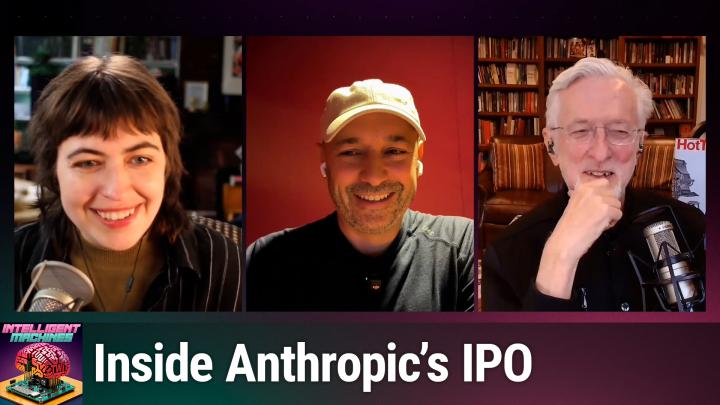
Hello and welcome to Intelligent Machines. This is Jason Heiner filling in for Leo Laporte, coming to you with Geoff Jarvis and Paris Martineau. Today we talk about Anthropic's IPO, Google's new high-end Gemini Carbon model, and Meta's data snafu. Coming up next on Intelligent Machines.
TWiT.tv [00:00:23]:
Podcasts you love.
TWiT.tv [00:00:25]:
From people you trust.
TWiT.tv [00:00:27]:
This is TWiT.
Jason Hiner [00:00:32]:
You're watching Intelligent Machines, episode number 894, recorded on Wednesday, October 28th, 2026. Ghosting Metamuse. Hello and welcome to Intelligent Machines. Another great episode here. I'm Jason Heiner filling in for Leo Laporte. Very excited to be here. There's so much to talk about, as there always is every week on, on this podcast. And of course, I've got wonderful co-hosts to help unpack all of the stories of the week.
Jason Hiner [00:01:07]:
Paris Martineau, welcome. Good to see you.
Paris Martineau [00:01:10]:
Hello. Lovely to have you taking the reins today.
Jason Hiner [00:01:15]:
Thank you for letting me sit in the big chair.
Paris Martineau [00:01:19]:
Yeah, I can't see the height of your chair, but I assume that it's immense and impressive.
Jason Hiner [00:01:24]:
It's big enough.
Paris Martineau [00:01:26]:
And that's all that matters.
Jason Hiner [00:01:27]:
Okay, right on. And of course, we have Jeff Jarvis from the Craig Newmark School. Thank you, Jeff. Good to see you.
Paris Martineau [00:01:36]:
Craig Newmark.
Jason Hiner [00:01:40]:
And of many other hats as well. You are an author and a professor and a commentator, podcaster, so many hats.
Jeff Jarvis [00:01:50]:
And, and if we may do a quick plug at the beginning, uh, a former critic, and I got my critic juices going again with Paris.
Paris Martineau [00:01:57]:
Indeed.
Jeff Jarvis [00:01:58]:
And Mikey Sargent. on our all spoilers out, everything you can see, everything we can say episode, extra episode. So you can all watch this. It's a club episode, but it's open to all.
Paris Martineau [00:02:11]:
Yeah, we— what we did is we did a podcast on You Can See Everything, the Nathan Fielder-Lowence Oppenheim documentary about Elizabeth Holmes. And me, Jeff, and Micah recorded, like he just said, a spoiler-filled episode. We really tried to, like, break it down from, like, a tech and media lens. And you can listen to all of it on the TWiT YouTube channel.
Jason Hiner [00:02:38]:
Very cool. All right. So don't miss that. That's a special treat.
Jeff Jarvis [00:02:43]:
You can also watch us do our Elizabeth Holm imitations.
Paris Martineau [00:02:45]:
I was gonna say, we all did also wear black turtlenecks and stare into the camera. And it's very funny to see people in the comments being like, how long did it take you to realize they're all wearing black turtlenecks? And I'm like, I'm shocked that it took you any time at all. It's pretty evident.
Jeff Jarvis [00:03:02]:
But— Thanks to both Anthony Nielsen and Micah Sargent for the extra duty on Sunday. Grateful for that.
Paris Martineau [00:03:09]:
Real shout out to Anthony, who Jeff and I just realized may or may not have seen You Can See Everything. And if the answer was may not, just got the entirety of it spoiled for him because we break it down act by act. If
Jeff Jarvis [00:03:21]:
you're still in the chat, Anthony, did we ruin it for you?
Paris Martineau [00:03:23]:
Hey, Anthony, I hope if we ruined it for you, you at least had fun.
Jeff Jarvis [00:03:29]:
We did go on so long he had to kick us out because—
Paris Martineau [00:03:32]:
Yeah, there definitely was a time where he was like, you actually have to leave now, which I guess is the sign of a good podcast.
Jeff Jarvis [00:03:38]:
Yes.
Jason Hiner [00:03:38]:
Yeah, for sure. For sure. I hope that you all are kicking me out by the end of this one and saying, oh no, time to get started, time to get rolling.
Jeff Jarvis [00:03:51]:
So I'll back to AI. Thank you for that interruption.
Jason Hiner [00:03:53]:
Back to our regularly scheduled programming, which of course is all the stories in AI. And there was a little story this week. that you all may have heard about, that Anthropic has filed to go public. So this is long anticipated, of course. And the story for most of 2026 has been the anticipation of the Anthropic and OpenAI IPOs. One of the big stories is Anthropic made it or is nearly there to ready to go public. And OpenAI has kicked the can down the road a little further till 2027. And the big story about that is also really the main story of the Anthropic IPO, which is that Anthropic is just a lot further ahead with enterprise customers where there's actually real money to be made.
Jason Hiner [00:04:47]:
And OpenAI up until 2026 had been playing a lot of different hands and had been doing many things and really been going down the road of being a consumer and consumer brand. And while they haven't ruled that out. They have pivoted pretty hard with Codex and with all of the things that they've been doing toward kind of chasing the enterprise money because that's where there is reliable revenue. And if you are a public company, you are under scrutiny at all times for the levels of revenue and revenue growth that you're producing. So OpenAI is just a little bit behind. They're clearly making some progress and there's a lot of professionals and organizations that, that really like Codex. And there's also been reports out this week that OpenAI is being very aggressive in pricing and is winning over some enterprises in that way.
Paris Martineau [00:05:47]:
Well, I know who they are hoping to maybe win over probably the most would be that, yeah, one thing we've learned from Anthropic kind of filing, it's like, or at least it's like proposed S-1 this week, is that 25% of the company's $16.3 billion in revenue comes from 5 customers. Yep. Just 5 customers make $16 billion in revenue. And Anthropic has said, like, there seemed to be some reporting out there from the Journal and other people who've talked to sources that say like, oh, Anthropic is not worried about losing those customers, which is kind of crazy, I guess. I guess if you're spending billions of dollars with one AI provider, you probably have a custom enterprise suite built out to where it would be burdensome and difficult for you to swap them out for OpenAI. But man, if you're OpenAI, you've got to be jonesing for those deals.
Jason Hiner [00:06:43]:
Yeah. And yeah, I think they're worried. If they say we're not worried, that means they're really worried because it's just a lot of money. And we can imagine who they are, like some of the biggest, you know, customers in the world. Those are like governments, banks, organizations, you know, largest companies in the world. So OpenAI is essentially just trying to win at any cost on price is what the reporting has been on that. But Anthropic, as we know in the enterprise, when you put all of your processes against a certain thing, it takes a long time to unwind it. Anthropic has been betting on the enterprise since the— since it really went live in 2023.
Jason Hiner [00:07:34]:
All of its focus has been around organizations, around societal change, around things like science. All of that's enterprise. And so they've been building around the enterprise and they've been becoming part of some of the largest enterprises in the world for a long time, which means those companies have built processes, to your point, you know, Paris, around, around that. They probably have very custom installations that doesn't get unwound easily. We even saw that with the US government when they said we're not— when they declared Anthropic a supply chain risk and an unprecedented move right in the spring. Well, it took them still like 6 months to stop using Anthropic.
Paris Martineau [00:08:18]:
Hard drug to quit.
Jason Hiner [00:08:20]:
Yes, exactly. And so, and there were so many interesting things
Paris Martineau [00:08:28]:
in this S-1. I mean, it was like a nearly 400-page document, like 94 pages of which were just risk factors, which, I mean, I'll get to in a second. But there were just—
Jeff Jarvis [00:08:37]:
Including extinction. But I mean,
Paris Martineau [00:08:39]:
including extinction, including stuff like, yeah, extinction of the human race. Little side comments like, oh, the potential for damages to be caused by our tools is so great that we think it dwarfs the capacity of all insurers combined to insure against. Whoopsie. But they're also kind of— Details such as— trying to remember where I saw it. Maybe this was something reported by the Journal— that basically Anthropic employees have, among other things, been pitched, like, working on these sort of scientific enterprise models to develop kind of scary bioweapon-esque technology, specifically with the purpose of, like, having scary pitches to give the US— not the US government or governments of some countries in order to compel them to sign contracts like this. And I didn't even realize when I was saying this earlier, but that $16.3 billion in revenue isn't a year's worth of revenue. That's the first 6 months of this year. So they're clearly just cleaning up with these sort of tactics.
Jeff Jarvis [00:09:47]:
The other number that got out there a lot was the $80 billion loss. But that's— yeah, that's frustrating because it's not really operating As it's been explained to me, that was trying to regularize investments like Amazon's when Amazon early days gave them a ton of compute and got reported up to 10% of the company and they had to book that differently. So I think it's a frustrating— what I've seen document, because it really— we don't really have a good sense of the ongoing year-end operating structure of it and what profit and loss looks like.
Jason Hiner [00:10:21]:
That's right, Jeff. So there have been— it's a good highlight because there have been a lot of confusing numbers about Anthropic's revenue throughout 2026. Mm-hmm. There was a report that, that they were actually profitable if you based on operations. But what they, but what they were unprofitable with is all the research going into building the next model. Right. That they are very much, you know, a cash machine at this point. They are generating tons and tons of cash, but they are investing to build out the future, to build out future models, to build out safety, to build out other parts of the business.
Jason Hiner [00:11:09]:
And of course, more than anything, to buy compute and so— and to secure future compute. And so To your point, it gets really tough to, to discern the numbers from here. And when we— when they actually go public, that's going to have to become much clearer because analysts are going to really grill them on that. Because, you know, these, these analysts and sort of funds, they, they want to have a very clear picture of the business and the directionality of the business. Right. In order to invest. for their large, you know, large chunks of money into— I
Paris Martineau [00:11:51]:
mean, so you've looked through these documents as well. What immediately, I guess, stood out to you as any red flags and like green flags? I think if you had to boil it down to like, are there any numbers that looked alarming or any numbers that looked quite impressive or good or unexpectedly so for Anthropic?
Jason Hiner [00:12:14]:
Yeah, thanks, Paris. You know, the biggest one, and we talked a little bit about it in the pre-show, to me was the compute numbers. You know, it's funny because Anthropic was playing it a little bit coy on compute. They were not signing like big giant deals. They were— that you heard. And now in some cases they were quietly. But if you remember last year, I'm sure you both remember very well at this time, OpenAI was really taking it on the chin for this, like $1 trillion in compute that they had secured when they had like single billions in revenue at the time. And so that made sense to no one, right? Like from a, from a just a pure optics standpoint.
Jason Hiner [00:12:59]:
And Anthropic did, I think, got spooked a little bit by, by that because that brought a lot of negative sentiment to OpenAI. And so they maybe weren't as aggressive in signing deals. And then if you, if you remember well, when Mythos was announced in the spring, they're like, yeah, but we're not really going to release it to anybody yet. And the narrative at the time was like, it's too dangerous to release, you know, in the, in the wild. But my understanding from sources in the industry was like they just didn't have the compute to run it, even if they, even if they wanted to. They just didn't have the compute. And if you remember, after they announced Mythos, they suddenly started signing huge deals with Amazon, with even SpaceX, and lots of others. They were— they secured more funding and they secured more compute.
Jason Hiner [00:13:55]:
So what worries me the most about the Anthropic filing, and I would love to get your all's, you know, take on this, as well, is that it's based on what could be a bit of a house of cards, which is all of this compute, this giant infrastructure buildout, which maybe we'll need all of that. But today it's all built on this idea that the world we have to project out, you know, whatever, 2, 3, 4, 5 years based on where the models and the compute is today. Well, a lot of that compute, we don't even have the power, right? Energy to run it. And so, um, so that's a concern. But it's also maybe the bigger concern is that it's based on these very inefficient models today, right? Like LLMs and, and the frontier LLMs are built on transformers, of course, and transformers are, are just notoriously inefficient. And so you could have what— and I would expect we will have 2 things happen that are going to make the compute story look very different. One is that the models are going to get a lot more efficient. We're already seeing this, like instead of using the latest frontier model.
Jason Hiner [00:15:10]:
You can use small language models, which are faster, smaller, cheaper, more accurate. You can use domain-specific models. You can use local models. The models themselves could get more efficient. And there's also alternatives to transformers, like from companies like Pathway and Inception and some of these other NeoLabs and things like Jev. And then OpenAI just released its sort of Jev competitor, as it were. But If these things, if the models get drastically more efficient, and then we also stop using the cloud and the data centers to run these things, and we are using more of our like local compute that we have on our machines, you know, Macs and Windows machines and phones that have NPUs in them, then all of this kind of cloud infrastructure thing looks a little different. No, it looks a lot different.
Jason Hiner [00:16:02]:
And so,
Paris Martineau [00:16:03]:
yeah, especially when like the numbers that we're seeing in there for what Anthropic is—
Jason Hiner [00:16:09]:
oh my God, agree—
Paris Martineau [00:16:10]:
has agreed to stuff like $500 to $750 billion. Yes. In like locked-in compute spending over the next 7 to 10 years. And so that means no matter what happens, even if everything goes right and we end up needing way less than that, Anthropic has to pay hundreds of billions of dollars over the next 7 to 10 years, even if it does not use any of it. Wow. which is— those are the sort of sums that would sink any normal company. But time and time again, Anthropic, like OpenAI, like everything in this segment of the AI race, is just operating kind of in a world of its own, with rules of its own that seem to not follow any of the normal patterns of logic in business.
Jeff Jarvis [00:16:55]:
Yeah, I think that you started the list of risks, Jason. I think, right. So So a lot of competition from other frontier companies who play leapfrog constantly. And you're never ahead for long. Google released Carbon today. And it's—
Jason Hiner [00:17:10]:
That's right.
Jeff Jarvis [00:17:11]:
We'll get to that, I presume, later. Yeah, it's going to compete on Mythos and so on and so forth. Then competition from open weight models from China and elsewhere that can do the great majority of the work most people will want to do with this. Then I think questions about whether or not hyperscaling is the model paradigm. I think there's going to be other ways we look at this. You're right, there's greater efficiency, which Jensen Huang talks about all the time. But I also think that there could be different, entirely different ways to look at AI that change this model. Then we still don't know, I don't think, the economic value of this in the marketplace.
Jeff Jarvis [00:17:53]:
I mean, yes, Microsoft said they're laying off, or pardon me, offering buyouts to 60,000 employees and blaming AI, but it ain't just AI. What value was AI really creating in the market? Then there's China, which is going to undercut American AI at every turn, I think. And, and so all those add up to me to— never mind this existential hoo-ha crap. Yeah, the real risk to them is a competitive marketplace risk where their business isn't really proven yet. 5 customers does not— they get laughed off of Shark Tank at that. And, uh, that's a joke.
Paris Martineau [00:18:29]:
Um, it's always great when you have to tell us that it's a joke.
Jeff Jarvis [00:18:32]:
Jeff, I know, I know. Uh, uh, Mark Cuban would still invest. Um, so the— I don't see $1.5 to $2 trillion value here. And so this is the— I said to, to the other Jason today, uh, that, uh, I think that this is the most bubbly I've felt In the AI era, because this thing just isn't justified at that money. I don't see it. Am I wrong?
Paris Martineau [00:18:59]:
I mean, I just think it's notable that like we're talking about revenue in the tens of billions of dollars and then we're talking about one line of expenses, compute, that is in the hundreds of billion dollars, albeit I guess that's over 7 to 10 years, but it still could be something like 10x your projected revenue or 5x or something like that.
Jeff Jarvis [00:19:21]:
The revenue they need to justify that expense.
Paris Martineau [00:19:22]:
Revenue that you need to justify that expense. And that is just one expense. That's not any of the other things that go into operating this, training these models, employing your staff, running the business. I mean, it just— of course it was going to be a moment like this when we are actually seeing filed or prepared to be filed documents for these companies, when And it all starts to seem like it might come crumbling down because part of the magic of AI and part of the magic powering this bubble has been that you just don't see what's behind the curtain. And now we're starting to see it. And yeah, it does not look like the sort of normal business fundamentals that you'd think would work. But I guess there's a possibility, like everything with the AI boom, works anyway, but seems less and less likely.
Jason Hiner [00:20:14]:
If Jason—
Jeff Jarvis [00:20:15]:
yeah.
Jason Hiner [00:20:16]:
So I was just gonna say, if Daru Amadei was here, I think what he would tell us is—
Paris Martineau [00:20:21]:
Please channel.
Jason Hiner [00:20:23]:
He would say what we— what we're not accounting for is the exponential, right? Because they have grown 10x 3 years in a row, which I really—
Jeff Jarvis [00:20:34]:
The old hockey stick.
Jason Hiner [00:20:37]:
Yeah. So
Paris Martineau [00:20:38]:
there's no way that could ever slow down.
Jason Hiner [00:20:40]:
I know, right? That's it. And this year's the year I thought it would slow down, but they've been growing more like 14x. But there's been a— it has been a weird year, right? Like there was— they had— Anthropic had all of this positive mojo created by them standing up to the US government on just these sort of like 2 red lines, as I'm sure you've covered many, many times on the show. I think we covered the last time I was here, actually. Fill it in for Leo. It's often happening.
Paris Martineau [00:21:06]:
Yes.
Jason Hiner [00:21:08]:
It is always there. So I think what Anthropic would say is that this is growing at such an exponential rate. And right now, only about 18% of the people on the planet use AI regularly today. Over these coming years, that's going to expand greatly. And really, a large number of businesses have still barely tapped into it. I did a podcast this past week with a consultant who consults with mid-market companies, primarily about like $10 million to $100 million companies. Right. And there are lots of them.
Jason Hiner [00:21:49]:
Right. There are just tons and tons of those out there. And most of them have barely scratched the surface on starting to use AI. And they're being very practical in the ways that they do it. They're barely spending anything today. But now they're starting to find one problem, one workflow where they're like, okay, we can use AI to fix this problem. Great. Their journey toward AI, toward investing in AI over these next few years is likely going to be pretty exponential.
Jason Hiner [00:22:16]:
Right. They're going to do— they're going to invest $5 million in AI maybe in 2027, but they may be doing probably, you know, $50 million or more. Right. In 5 years if, if things go well. So I think if you take and multiply that—
Paris Martineau [00:22:32]:
I'm curious, though, for companies like that, though, is your sense that they envision their journey with AI to be, I'm always going to be spending those millions of dollars with one enterprise AI provider? Or do you think that if this tech— my, you know, just immediate thought is if the technology is even half as transformative as its biggest proponents say it is, and that people are going to spend even half as much money as those people say they will be, companies will be like, yeah, instead of paying money to Anthropic based on whatever their costs are at that point in our contract, why wouldn't I try and do some of this locally or figure out other ways of building that are not just beholden to, like, 2, if not one enterprise player?
Jeff Jarvis [00:23:21]:
Which is also the Alex Karp argument.
Jason Hiner [00:23:23]:
Yeah.
Jeff Jarvis [00:23:23]:
To all the big enterprises, you're a fool if you let Anthropic do this. Use my harness and do it with other models that are open locally. Jason, let me ask you a question. So to what Parris was saying before about the huge irrevocable investment in— Yeah. So if things don't go as well as planned, Anthropic is stuck with a bill to pay for infrastructure. Let me ask a different question. Presuming that Vera Rubin gets replaced by 5 different generations of chips over this whole time too, who's stuck with the out-of-date infrastructure? The depreciation on this stuff is what, a year and a half?
Jason Hiner [00:24:11]:
Yeah. So this is a great— this is why I love being on this podcast. You all anticipate all of my questions and thoughts. So this is another place where efficiency comes in big time, right, Jeff? Which is that Nvidia's chips are getting enormously more efficient with every generation as well. Which
Jeff Jarvis [00:24:31]:
is his business model, which is Jensen Huang's business model, is to make it that way.
Jason Hiner [00:24:35]:
Yeah. So you are incented to buy the new one because you're like, great, this thing's more efficient. I can run the, you know, my really powerful thing on that and it costs me a lot less. Right?
Jeff Jarvis [00:24:49]:
Right.
Jason Hiner [00:24:50]:
What— so I've talked to some folks about this in the industry, especially the people who are focused on infrastructure. And this is also where kind of efficiency comes in, which is like there are going to be, you know, the Blackwell, Rubin, some of the past versions of the infrastructure. They will still be— what they say is they will still be around, that hardware will still be around. The cost they will have— they will have absorbed the cost that they needed. It will be profitable at that point. And it will become infinitely cheaper to run on that infrastructure then, right, in the future. So you'll run— remember, we have these smaller models and we have the sort of less expensive models even from Anthropic and OpenAI, the Haikus and the Lunas of the world, that those will— you can run those on this older hardware for a lot cheaper, right? I think I suspect they haven't.
Jeff Jarvis [00:25:46]:
Yeah, I think, I think for any, any company other than the frontier models out there, that's true. There's going to be real value in using last year and getting you a used car.
Jason Hiner [00:25:55]:
Yes, that's right.
Jeff Jarvis [00:25:56]:
But for the frontier companies and the hyperscaling macho chest-beating stuff,
Jason Hiner [00:26:01]:
yeah,
Jeff Jarvis [00:26:02]:
they can't say, oh, we're good enough on Blackwell, it's fine.
Jason Hiner [00:26:07]:
That's right. They want pride and need the latest model. So here's what I think happens perhaps. But this is where, you know, this efficiency curve starts to get steeper too, right? So the stuff does get cheaper and all of this. So they're securing that. It's one of the big questions. They're securing all of this compute. Clearly, AI has a growth path ahead despite all the fact that most people are really negative on AI, right? Like 70% of the US public has a more negative than positive view of AI.
Jason Hiner [00:26:41]:
But at the same time, they are using it. And unlike more and more of them will. But what is likely to happen is that it's going to get less and it's going to be more— you're going to get more intelligence per watt and per dollar, right, as time progresses. So, but who holds the bag is like— That's what I meant. Who's going to end up holding the bag, right? Like, is your question. If this thing starts to falter, that's one of the big questions, right? Is it going to be some of these Hyperscalers? Probably not, because they have plenty of other workloads they can use. Is it going to be some of these, the ones that are— I suspect it'll be the ones that are taking the most risk, right? They're very— some of these like neoscalers, some of the, you know, which are the newer—
Jeff Jarvis [00:27:32]:
Define a neoscaler for me.
Jason Hiner [00:27:34]:
So a neoscaler is these companies like Lambda, and CoreWeave and some of these folks, right? They're very leveraged there right now. I mean, they have more demand than, you know, they can even deal with for the next like 2 years. But if it starts to falter and companies like Anthropic are like, you know what, we're not going to need that compute, then I suspect that the ones, these neoscalers who are kind of in the middle, the hyperscalers, right, are all— they're like too big to fail. Google, Amazon, Microsoft. And then these, these— They got other customers.
Jeff Jarvis [00:28:09]:
They got customers. That's right.
Jason Hiner [00:28:11]:
They've got other customers. But these neoscalers are all in and they are all AI primarily, like all the time. Right. So are they the ones that hold the bag? We don't know. But they are, they are losing a little bit of public sentiment in the markets because of that fear that you raised. Right. Of like who ends up holding the bag.
Jeff Jarvis [00:28:32]:
So, so if Anthropic went belly up, they'd be the first dominoes to fall, you think? Because, because there's just less demand in the marketplace.
Jason Hiner [00:28:41]:
Right. Because— but, but I think the, the, the counterargument is that, you know, the— or the argument is with them is they are like these, the dark fiber companies during the, during the—
Jeff Jarvis [00:28:53]:
Right. That's, that's what— well, there's other uses we can put it to at a much lower rate. All right. Let me ask you both a different question. If you were, uh, uh, had a fiduciary responsibility over the California pension system?
Paris Martineau [00:29:05]:
I would shoot myself with a gun.
Jeff Jarvis [00:29:07]:
Yeah. Yes. And, and others might shoot you because you're, you're probably going to lose their—
Paris Martineau [00:29:13]:
I just, I don't think I should be in charge of anyone else's money, much less a whole state's worth.
Jeff Jarvis [00:29:20]:
Well, you're there, Paris. If I'm there,
Paris Martineau [00:29:23]:
if I'm
Jeff Jarvis [00:29:25]:
Yes. You are in charge of $1 billion. Would you invest in Anthropic?
Jason Hiner [00:29:31]:
So here, here's why.
Jeff Jarvis [00:29:33]:
There's a— for those of you on audio, there's a panicked look in Paris.
Paris Martineau [00:29:38]:
There's more panic in my body than I thought was possible from this hypothetical.
Jason Hiner [00:29:44]:
Yeah. Here's what this gets to, the ultimate question, I think, around this, this IPO and around this the whole future of the AI trade and the AI industry. Models are commoditizing, as Jeff, you know, you articulated really, really well. Chinese models, there are more US open-source models that are gonna be launching over the next year. Yeah, yeah. Like you said, the models leapfrog. We'll talk about Google Carbon in a second, you know, too. The models leapfrog each other.
Jason Hiner [00:30:15]:
All the time. What's the value of, you know, having the latest and the best and the most powerful frontier model, I think, is likely going to start to evaporate even in the next 12 months. What Anthropic is betting on, I think, and the S-1 says this a little bit, but, but even more so, I think their actions over the past year is Anthropic is betting on building a brand that says we are the safe AI. We are the good guys.
Jeff Jarvis [00:30:46]:
Pardon me.
Jason Hiner [00:30:46]:
We are the ones who are gonna, you know, do the right thing.
Jeff Jarvis [00:30:49]:
We define safety, though, very weirdly about whether we can make humanity safe.
Paris Martineau [00:30:52]:
We are the safe AI. We kill only up to 49 people a year. We only cause up to $1 billion in damages.
Jeff Jarvis [00:31:02]:
We have a license to kill 49.
Jason Hiner [00:31:04]:
I think that what, you know, we can debate the merits of it, whether it's true, but what they are setting themselves up as is we are the brand, the AI brand you can trust. And so long term, whether you're an enterprise or you are a government, we are the brand that is levelheaded, that doesn't just go whichever way the wind blows.
Jeff Jarvis [00:31:32]:
I got to keep laughing.
Jason Hiner [00:31:33]:
That's why I keep laughing. But I think— They're cultists.
Jeff Jarvis [00:31:36]:
They're crazy. They're Looney Tunes.
Jason Hiner [00:31:38]:
But this is what their bet is. Their bet isn't, I think, just that we're going to make the most powerful model. Their bet is we're going to build the safe, trustworthy AI brand. And, and that's where they're saying the future of this is and why they're going to be worth whatever they're worth.
Jeff Jarvis [00:31:56]:
Okay, so let's, let's, let's dig into that for a second.
Jason Hiner [00:31:58]:
Pick that apart, please.
Jeff Jarvis [00:31:59]:
Safety, right? This is— this is— I argue this often on the show. Safety is a corrupted word. Because the, the, the test-crayal cultists talk about safety in terms of human extinction and all that BS.
Jason Hiner [00:32:12]:
Yeah.
Jeff Jarvis [00:32:12]:
Whereas if you're a company using this product, if you are an insurer who dares to insure it, if you are a pension fund investing in it, then your definition of safety is very different. I think it's, is this thing gonna get in all kinds of trouble by allowing people to do bad things? Is their market going to go down because people don't trust it? Because all they talk about is crazy crap when it comes to safety. Is my investment at risk because— and they do say this in the S-1— because if their software does bad things, then people will blame it and they'll get a bad reputation. And gee, it's bad for your brand. killing 49 people, or killing 51 people is when it's bad for your brand. So I think that their effort to paint themselves with a safety halo is complete BS, because they've corrupted the notion of what safety is to a point that you can't get anywhere with it. And this goes back to the stochastic parrots paper, where while everybody was concentrating on getting bigger and bigger and bigger, they're forgetting about the environment and labor and impact on both and so on and so forth.
Jason Hiner [00:33:33]:
I don't disagree, Jeff. And yet I also think that the fact that they are so well monetized in the enterprise and with sort of the most conservative organizations, conservative in the sense of fiscally conservative.
Jeff Jarvis [00:33:54]:
Yep. Well, these days it's pretty much synonymous. Yes, but go ahead.
Jason Hiner [00:33:59]:
It does tell the story that their approach, their strategy to paint themselves as the safe and trustworthy AI has largely been successful, that they have successfully done that. And I think long term, whether they have the fastest, best, best, most performant model, uh, you know, will probably depend on the week or the month. Um, but I think that they are embedded and embedding themselves with, uh, companies, and the companies that are, uh, you know, investing in it, investing in AI, uh, they are doing well. Now, I think that their, their biggest competitor and risk in is actually not so much OpenAI, at least what I'm seeing. I think it's more Microsoft and Google and then even sort of these sort of next-tier companies like Cohere, you know, out of Canada. They're an international company but based out of Canada. These companies that are— that have a long record of trust with, you know, enterprises and with the world's largest organizations. But interestingly enough, and last— and I I want to hear— get your take on this too, Paris, which is that what I didn't expect in 2026 is that Anthropic is now beyond just sort of the corporate and organizational sort of trust that they've built.
Jason Hiner [00:35:32]:
They've also started to build it with consumers. The number of people that have downloaded— the people that I know that are most skeptical of AI, most of them are using Claude, and almost purely because of everything that happened in March with the Department of war. And so, while I think all the points you raise are really sharp and really important, Jeff, I do think they are seeing some success in their messaging.
Jeff Jarvis [00:36:04]:
Paris?
Paris Martineau [00:36:06]:
I mean, yeah, anecdotally, I feel like my experience is similar. I feel like people are clawed and Anthropic are still coasting off of the wave of great PR the company generated earlier this year. And I don't think that any other major AI company, or minor AI company for that matter, has made any real concerted effort to kind of develop a similar audience or develop an audience at least around, like, moral standing or like things like ethics. The closest I could see is now here in, in New York, there's like some ad campaign going on in the subway that is trying to pitch itself as like an eco-friendly AI. But the ads are like so bad that I've never even looked up to figure out how it's lying about that. But I'm sure it's somehow doing that.
Jason Hiner [00:37:04]:
As we wrap To wrap Anthropic, I wanna— last thing on this I wanna ask you two about is the existential question of it all. Mm-hmm. 'Cause I'll be honest, and I've written about this on The Deep View and I've talked about it on other podcasts and stuff too, I just think it's so overblown. It's not that it's a 0% chance, the AI extinction thing, but I think it's probably less than 1%. And you actually, in the ways that it gets played, even by Anthropic and some of its public-facing communications about this is you would think it was like 20% or 50% or something. And I think it's so overblown. And I do think there is a degree of it that is marketing. It's like our technology is so powerful that it could create an existential crisis.
Paris Martineau [00:37:59]:
You're speaking to the choir here with Jeff.
Jeff Jarvis [00:38:01]:
Yeah, right?
Paris Martineau [00:38:02]:
He's always talking about that. I mean, I'll give one brief example just because So last weekend I went to go visit my old college newsroom for an alumni event. Nice. There's people there from, you know, my year's college newspaper and then a bunch of young people. And once they'd heard I was doing this podcast, someone asked me, they're like, oh, so like, how worried should we all be about AI committing a mass extinction on us? Is that gonna happen in like a year or 2 years? Should I have a bank account or not? And I was like, honestly, I mean, my real take is, The danger you need to be worried about is, like, very— like, it's different and more practical. I think when people hear, like, things like extinction event or Dario, you know, saying wording of doom coming imminently, they think, like, Terminator is going to happen, or that suddenly it's going to be like The Matrix. It's like, that's not a realistic thing that is going to happen. Like, a lot of things that have to change in our life and relationship with technology for any of that to enter the realm of reality in the near term.
Paris Martineau [00:39:03]:
But the thing that is more realistic that I think people should be concerned about is stuff that we have covered on the show before, things that, like the fact that this technology will enable people to commit, like, large cyberattacks much faster without having many of the skills that it used to take to do those, and that that could have profound effects on, like, your life and work. You know, it's like if there is some quote unquote big event that could cause harm on a societal level. It'll be stuff like power outages and like blackouts happening more often, utility— public utilities going down, uh, communication blackouts, more frequent cyber hacks that have like an effect on your health or wealth or ability to work and things like that. Like, that is, I think, the most realistic doomsday concern. But it's not as pithy and fun. I guess fun isn't the right word. It's not as pithy and—
Jeff Jarvis [00:40:04]:
I guess since you're a nihilist, I think you're allowed to say that.
Paris Martineau [00:40:07]:
It's not as pithy and fun as doomsday extinction event happening soon.
Jeff Jarvis [00:40:11]:
Yeah. So, um, yeah, I, I go crazy on this topic because I think that, um, uh, it is cult BS, faux philosophies, testes grêles. The folks who watch the show have heard me mention that enough that it's a drinking game now. now. Um, and, and I, and I think that it might have worked to get cult members in and staff in, and it might have worked to get VC money in. But one of the things that, that impressed me from watching You Can See Everything is, uh— I'm sorry, from, from the miniseries, uh, uh, The Dropout— Uh-huh. Is how it portrays the, um, the investors as so damn I'm willfully gullible and credulous. And so I think this discussion of, my God, it's so powerful, it can do that, I have to be there, I must invest, I must have the power to do that, I'm ahead of everyone else, is complete BS.
Jeff Jarvis [00:41:02]:
Now, when it gets to the open market, both for customers and for investors, I don't think that has any value at all. Quite the contrary, I think it starts to become crazy. So Elizabeth Warren sent Amadei and company a letter packed full with 4 pages of questions like, how are you going to not destroy humanity? Tell— oh, please tell me. You're so safe. Tell me what's what. And I don't think this is going to play anymore. Yeah. And I think that there'll be a reckoning on all this.
Jeff Jarvis [00:41:31]:
And there's somebody I used to work with years ago at People magazine who's been on Facebook saying, just said, oh, I just picked up the Yudkowsky and Soros book because the AI companies are reading this. So I must read it. I said, they're nuts. They're crazy. This is the one that if we build it, everyone will die. Oh yeah. And then I came across the story this week in Fortune that Nate Soros said that he hasn't added to his 401 in a decade because, well, hell, AI is going to kill humanity. That's the level of nut jobbery that we're talking about here, the level of cultishness that we're talking about here.
Jeff Jarvis [00:42:06]:
And at some point, these people have so much power and so much capital and so much influence over everything. Look at what Musk is doing with his money in politics. At some point, there needs to be a reckoning. But the problem is, I hate media's coverage of this because they treat a gathering at the Future of Life Institute as if, oh, it's a not-for-profit held a nice little event. They're doomers, they're nutsballs. And, and we're not covering that. And so what happens is it influences policy discussion. And that's where the real danger comes in, I think, is the the, the down-the-line domino effect that it has on policy.
Jason Hiner [00:42:42]:
All right. So for our next story, let's dig in a little bit to Google getting back in the game a bit with Gemini Carbon. It's a good thing. This space needs competition, and really it needs it from Google as well. As we've mentioned on the Deep View when we've covered Google throughout this year. It's been a tough year for Google. They have not been able to release a pro-level, what is their pro-level, or sort of a really cutting-edge frontier-level model pretty much all year. They had a great moment last fall with Gemini, you know, 3.
Jeff Jarvis [00:43:26]:
Was that the last moment of—
Paris Martineau [00:43:28]:
They've been too busy injecting AI into every aspect of Google Workplace in ways that are designed to drive me personally insane. That's why they haven't released the model. I think they've been too busy putting little purple squiggly lines under every line of my emails in Gmail that I click being like, oh, did I misspell something? And it's like, no, we just think you should have the words be slightly different because we feel that way.
Jason Hiner [00:43:51]:
That's right. Okay. Sounds like they succeeded.
Paris Martineau [00:43:55]:
They did.
Jeff Jarvis [00:43:57]:
And they pissed me off because my Workspace account, I can't get to some of these functions. But go ahead.
Paris Martineau [00:44:01]:
But listen, go ahead. We'd all love for Google to do better. better.
Jason Hiner [00:44:06]:
We would. And you could argue the ecosystem needs it, right? Like if, if more people in the world are going to have an on-ramp to AI, it's probably going to be Google and Apple taking them there to, to a degree over the next couple of years. But Google has struggled to keep up with, with Anthropic and OpenAI in speed. Anthropic and OpenAI have just been running circles around them with the advancements, the advances in their models. And so there's the big shakeup, of course. Demis Hassabis is no longer the head of Google DeepMind. It does feel like they've moved more of the center of the group to Mountain View, away from London, although they still have strong operations in both places. And now they have released a model that does compete with the latest models, the Opus model and Astra models.
Jason Hiner [00:45:12]:
So good for Google. Their carbon model on the benchmarks, it's really focused on cybersecurity and long horizon agents, which these are the most complex use cases. It does very well. It is right above, it's right there with Astra and Opus on many of the things. It doesn't meet the chin of the bar on all of them. There are a few things where those models are still close, but it's in the ballpark, right? So the question is, you know, can Google keep pace? And they have a lot of advantages that the others don't, right? They are a hyperscaler themselves. They have almost unlimited amounts of compute because of that. So in a way, that they don't have to pay for compute in the same way that Anthropic and OpenAI do because they have all of their own.
Jason Hiner [00:46:10]:
That was, if you remember, I'm sure you both have seen the movie with the movie that came out on Demis Hassabis and Google DeepMind. And essentially Demis says that, he says, look, the one reason we need to do this deal with Google and let them buy DeepMind is 'cause compute. We are not gonna be able to have the compute we need to train the models. And so they are— and they have this brand that a lot of people trust, you know, Google itself, and they are well-known to consumers and they have all of these users, right, that come to Google that, like Paris, that they are now ticking off because they're shoving Google Gemini into every corner of that.
Paris Martineau [00:46:50]:
I mean, they also just have an incredible opportunity to convert their already existing enterprise and I guess non-enterprise customer base into of subscribers in a way that OpenAI and Anthropic can only dream of.
Jason Hiner [00:47:05]:
They don't already have those relationships. They don't already have the bank accounts, right? Like, um, so, or the data. That's right. They don't already have all of the, those companies' data in, in safe, you know, and trusted environments. This is the same with Microsoft. Microsoft has many of these, you know, same advantages, but not the sort of consumer brand, um, advantage that Google does. So will you all, you know, in your daily usage and with the people that you know, you know, have they, have they turned away from, from Gemini already? Is it— I think the AI enthusiast crowd has. But for the larger number of people, we still know, again, 18% of the world is using AI today.
Jason Hiner [00:47:48]:
More and more of them are still— there's a lot of people out there that are still open to you know, figuring out what they want to regularly use. Is it unreasonable to think that Google still has plenty of opportunity to, to do it for all the reasons we've, we've already mentioned?
Paris Martineau [00:48:06]:
I mean, I think that Google will always have plenty of opportunity just because the amount of customers, active customers they have and potential customers they have based on people who use Google.com, like the search engine and Google Chrome, And Android is like infinite in comparison to the customer bases of the 2 leading frontier model companies. However, I also think that they are just at such a disadvantage because of their kind of late start in this, which is strange to say because they, of course, like the team behind it was not late, but as a consumer, a popular consumer product, they do feel a little bit like an also-ran. Like, I don't know, even people who I know anecdotally who were really into Gemini because it was something offered through their Google Workspace account. Like, I'm thinking of one friend in particular who's probably my most, like, I was going to say normie AI psychosis friend, but if I mean that in, like, a non-negative, like, a way of, like, a normie AI user who's become so overly addicted to it, they use it for everything, which I guess is probably an ideal customer for these sort of people. He was a big Google Gemini user until like last year when I was talking about Claude for the podcast. He's like, oh, I've never heard of that. I guess I'll try it. And he's like, wow, this is so much better.
Paris Martineau [00:49:21]:
And now all he does is Claude everything at all times for a year. And I do think that, I mean, that's what Google and Gemini have to contend with. I think obviously for like enterprise cases and, you know, targeted custom buildouts, that's a different story. But if we were talking about like the average consumer, it's going to be a bit of an uphill battle for them to win that person back.
Jeff Jarvis [00:49:46]:
I still use Gemini because I'm— I live la vida Google and I'm on a Chromebook. And so Gemini, when it finally got added to Workspace Growl, it's just there and easy. And so I use it for a lot of things as a result. I think it's a classic case, though, of Google screwing up branding. And product rollout is Google. To say Google is behind is behind in kind of a fake fight for high-end benchmarks that most people never tickle. Most people don't get to that point of using that. So, so at the very high end of this, fine, there's a, there's a competition on, and Google was delayed.
Jeff Jarvis [00:50:28]:
And I think that hurt them. But on the day-to-day level, As you just said, Jason, Google, you know, from a consumer level, it has my email, it has my calendar, it has my Google Wallet, it has everything. And it's in the best position. But, you know, I was just looking up, I forgot, whatever happened to Spark? I was waiting to get Spark finally.
Paris Martineau [00:50:50]:
Not— no relation to the machines Leo runs his local models on.
Jason Hiner [00:50:56]:
No, not NVIDIA Spark.
Paris Martineau [00:50:57]:
Not NVIDIA Spark. Google. This is also a Google problem. is the naming of everything, but continue.
Jeff Jarvis [00:51:01]:
Yeah, naming is everything. And then I look it up and I guess I didn't realize this, that some time ago, Google updated its, according to Google, updated its personal AI features by eliminating Spark and merging its agentic tasks into the main Gemini. So—
Paris Martineau [00:51:18]:
This is my problem with everything Google. And I mean, this has been a problem we've been covering since the show is called This Week in Google, is Google has, is terrible at naming things. It is terrible at developing individual products. If it does somehow manage to name and develop individual product that is something you like, you can bet your butt that in 6 to 12 months that product will have a different name, be in a different— Or they'll collapse. Folded into a different thing, or it will be dead. Like NotebookLM, which I genuinely do enjoy, and it's something I've recommended to a lot of my colleagues, is now Gemini Notebook, and it lives in the sidebar of Gemini. And I had to give a training to colleagues on NotebookLM this summer, like, and it of course was the week after they renamed it. And I was like, I'm screwed.
Paris Martineau [00:52:03]:
Rude. I'm going to say NotebookLM 100 times during this training, and you're going to have to deal with that.
Jason Hiner [00:52:10]:
Oh, man.
Jeff Jarvis [00:52:11]:
Yeah. And, and, and so, you know, look at even Meta, even screwball Meta. Muse has been a success because they created a brand, they created a use case. It'll probably fade away like things do at Meta. But for a purpose of 3 or 4 weeks, they have a little tiny winner, right? And Google doesn't have the same functionality. It doesn't have the same way to do it. And it's frustrating as hell.
Paris Martineau [00:52:36]:
Scooter X in our Discord chat just posted a link, uh, the headline of which is Gemini Spark disappeared because Google renamed it Task Mode. And I think that summarizes everything we're talking about. Is this a company where that just happens all the time?
Jason Hiner [00:52:52]:
Oh boy. Yeah.
Jeff Jarvis [00:52:54]:
So, so, you know, there was a story this week that, that I didn't finish reading about Marissa Mayer, and people are making fun of it for various reasons. She asked her agent— Oh
Paris Martineau [00:53:05]:
my God, this is one of the saddest details.
Jeff Jarvis [00:53:08]:
Well, maybe we should hold off on that. We'll get that separately. But in a way, what Google needs— back in the day, Marissa Mayer represented the consumer user interest.
Jason Hiner [00:53:18]:
Yeah.
Jeff Jarvis [00:53:19]:
And Google doesn't have that high up in the echelon bonds in terms of say, whoa, everybody, people are going to be confused. They A/B tested everything to a fault to make sure that it made sense to people, that it was part of the use case. They did that well for a long time way back when, and they lost that consumer focus long since. And they need somebody to be that advocate within the company. I think
Paris Martineau [00:53:42]:
my last thought on Google— I know we're going on too much of a rant, but Jetten and I have a lot to say on Google. I think more so. Like Google is tied, right? I guess maybe Google is tied with Meta and Facebook and Instagram for being a company where now every feature I interact with across any of the Google apps and services I use, and it's a lot, they all just reek of being designed to maximize engagement of some feature that a product manager somewhere is getting graded on how many people click or interact with. That's right. Like, anytime I open up any of my apps now, if they're from Meta or Google, something has changed, and it's changed in a way that makes me interact with some aspect of Gemini that I know in my heart of hearts is just because that's how someone else keeps their job, is by that number going up. And that's an infuriating customer experience. And I also think that that's That is the sort of like big business brain mindset that ultimately ends up making a consumer product have slower adoption than it should have.
Jason Hiner [00:54:54]:
Yeah, I'm so glad that, that you all highlighted this and clearly articulated it all very well and quite clearly. This was so evident when I was sitting in the Google I/O keynote. There's this phrase in tech journalism circles of like they rolled out the org chart. You could see they rolled out like— there were like 19 brand names or something, I can't remember, that they rolled out in that thing. And it was clear that like what we learned was, oh, these are each different teams that worked on this thing and they're basically sharing what they learned. Which which makes sense from their organizational standpoint, from their org chart, but it makes zero sense as a user, right? It became so confusing. You couldn't understand like, wait, how does that thing relate to this thing? And why is Spark now the agent that I'm gonna talk to? And how does that relate to Gemini versus AI Overviews? Right. And it was so confusing.
Jason Hiner [00:55:57]:
And I just thought at that moment, I was like, they're cooked, right? Like from a consumer standpoint, you know, you're just not gonna be able figure that out. Jeff, I hadn't even realized that Spark wasn't a thing anymore.
Paris Martineau [00:56:08]:
You hadn't even realized that Spark had gone task mode.
Jeff Jarvis [00:56:11]:
I've been waiting for it. When is Spark going to come into my life?
Paris Martineau [00:56:13]:
Spark goes task mode, but what about green beans?
Jeff Jarvis [00:56:17]:
Yeah,
Paris Martineau [00:56:18]:
these are the inane sentences that we have to have in our head now. And the fact that you can have that moment like that at Google I/O, which is supposed to be, you know, some culmination, their big moment of announcing their strategy and all their new products to the press and people, That shows that there is not like an adult in the room or an executive with the foresight to look at that presentation and be like, yeah, we got to simplify these things for the average consumer, for the consumer, for enterprise customers, for any of the people who are supposed to be using our product. They need to have someone who is like, this is ridiculous. And because this has been a problem at Google forever, but they clearly just don't don't want to fix it.
Jeff Jarvis [00:57:02]:
They need a VP level in charge of the relationship with consumer, a VP level— I'm sure they have— in charge of relationship with enterprise, but that pisses me off all the time. And they need branding. They need to bring in branding expertise because they just do not have it. But underneath this, back to what you were saying before, Jason, Google had got this reputation to be behind. But as you said before that, going back to the fact that they invented all of this with transformers, And the model of what became LLMs, Google's been way ahead. They've had it integrated in their products in a million ways, including many that irritate Paris. They've been out there, but they don't know how to present that either. It's also a PR problem for them.
Jason Hiner [00:57:42]:
Yeah, I don't— as much as, as much as we talk about how far behind they are on models, I don't really think they have a technology problem. I think they have a little bit of an organizational problem.
Paris Martineau [00:57:53]:
They have a vibes problem.
Jason Hiner [00:57:55]:
A branding problem big time. The vibes are off. Yes, 'cause even, you know, it's funny, I mentioned earlier these next generation models that are not based on the transformer, right? They're based on these other technologies. One of them is diffusion, right? Diffusion is what, you know, everybody will know is for video, is used for video and images. It's a very powerful model 'cause what it does is it is not sequential. LLMs are sequential. Diffusion does a lot of things at once, and that's how it can create these things so quickly. Well, one of the cool technologies that is likely or could be one of the things that displaces LLMs is using diffusion for text.
Jason Hiner [00:58:44]:
And there's this great company that does this. And that is called Inception, not the movie, but the company. And the funny thing is, so they just had a big launch. They launched their version 3 of their cutting-edge diffusion, text diffusion model. And you know what the funny thing is? Google also has one. It's called Diffusion Gemma that they released earlier this year, just under the radar. Google has this like incredible technology that matches this. But it's funny, the only— I didn't even know about it.
Jason Hiner [00:59:21]:
Google never told me about it. Google never, you know, mentioned it even though I talk with Google pretty regularly. It was actually the Inception people who mentioned it to me and I was like, is there anybody out there actually doing this right now? And they're like, oh yeah, you know, Google released Diffusion Gemma. And I looked it up and I was like, oh my God, they're right. Like Google is doing it. So, There's not a technology problem. They have all the technology in the world. They have so many researchers, they have compute, they have a brand that people trust, but they really need to get it together.
Jason Hiner [00:59:54]:
A
Jeff Jarvis [00:59:54]:
friend of mine years ago who left Google said, you wouldn't expect this. I mean, I wrote a book about Google and I kind of— I looked at it and said, wouldn't it be amazing to work at a place where they default to smart? I think that's still the case. But my friend said, said, you don't understand, it's like the Marines. And it's highly regimented and highly rank-oriented. And, you know, I watch people there who try to—
Paris Martineau [01:00:18]:
You're gonna say it's like the Marines and that you have like a kind of dice chance of getting shipped off to a different country, because that does happen to Google engineers. Just all of a sudden, they'll be in— they'll live in Europe all of a sudden. But
Jeff Jarvis [01:00:30]:
it's not bad, though. Yeah, yeah, I'd take that. So, so I think that Eric Schmidt long ago said that Google's biggest problem would be that it grew too big. And I think that that's organizationally what happened. And they've got to find a way to— I think you're absolutely right, Jason. It's not a technology problem. They've got to present what they already have better.
Jason Hiner [01:00:55]:
Yeah, they've got to— they've got to work on the brand and they've got to work on the consumer experience. That's, you know, part of it because they have a lot of really smart people, have a lot of really great people. They have great technology. But they're, they're moving a little too slow. They're a little too risk-averse.
Jeff Jarvis [01:01:13]:
Part of what— so I was at— full disclosure, I was at a Google dinner last night, so I got free food on Google. Very good fish, I must say. It was very nice. And it was bringing together media folk in Washington. And you also think back that this is another thing that Eric Schmidt said, that when— because Google was the biggest of the internet in the early days of the internet, it was thus the target for everybody who had a complaint about the internet. So it's made them hypercautious. I think they've got to break out of that too.
Jason Hiner [01:01:41]:
It's fair. You know, when we think of where Google is heading, I think that we really need to look at the leadership and see who could take them there. Because Sundar and Demis have done the really, I think, good job of making the company—
Jeff Jarvis [01:02:09]:
The technology.
Jason Hiner [01:02:10]:
Be really technology-focused. Yeah, exactly. They have done an excellent job on the technology, but their next leader or a leader at the company, there's plenty of room for For it to be somebody that's there or that can work with the people that are there, needs to think about the consumer experience and the enterprise experience, to your point too, Jeff, right? They need to do both of those and be good at it.
Jeff Jarvis [01:02:34]:
Stop pissing me off because I'm a Workspace user.
Paris Martineau [01:02:37]:
I mean, Jeff has had more problems than anyone I know with Google.
Jeff Jarvis [01:02:42]:
And I wrote a suck-up book about Google.
Paris Martineau [01:02:44]:
That's true. You were at a Google dinner last night. stuff together.
Jeff Jarvis [01:02:50]:
Uh, yeah, can I get some clout here? Uh, all right, all right. Should
Paris Martineau [01:02:54]:
we talk about the Marissa Mayer—
Jeff Jarvis [01:02:55]:
That's all. I think that's a tease.
Paris Martineau [01:02:57]:
Let's talk about the Marissa Mayer.
Jeff Jarvis [01:02:59]:
We want to hear what Paris says about this.
Jason Hiner [01:03:01]:
All right, Paris, hit us with the Marissa Mayer thing.
Paris Martineau [01:03:05]:
Let me just read verbatim the opening 4 lines of this, the opening lead of this profile of Marissa Mayer, uh, who used to run Yahoo. Because this is what— when people make fun of AI boys, this is what they're making fun of. Even though she's— AI boy is a gender-neutral term, to be clear. Okay, most of them
Jeff Jarvis [01:03:30]:
are— almost all of them are boys.
Paris Martineau [01:03:31]:
Yeah, but to be— late last year, Marissa Mayer was struggling with what felt like an impossible task. Her daughter Marielle was turning 10, and Marielle's teacher wanted 3 bullet points summarizing what made her special. Mayer, the former chief executive of Yahoo and a pioneer at Google, where she was the first female engineer, likes cracking a hard problem. But she felt overwhelmed by the range and complexity of potential answers. So Mayer asked her personal AI assistant, Dazzle. Within a few seconds, Dazzle delivered an answer. It came back and was like, your daughter's empathetic, creative, and an animal lover, Mayer She thought it was perfect. Listen, I'm sure there's a lot more to whatever Marissa Mayer's got going on than her not knowing enough about her own daughter to be able to describe her in 3 bullet points.
Paris Martineau [01:04:25]:
But it's kind of crazy that you would offer up this information to a New York Times journalist who's profiling you and not realize what a crazy person it would sound.
Jeff Jarvis [01:04:36]:
Speaking of needing PR, I mean, so, so I knew her back in the day. Well, first, first, let me mention this. So this is a story about the sexism of AI, the gender bias toward men throughout AI. It's
Paris Martineau [01:04:50]:
also a story about Maier launching a product, this product called Dazzle. Exactly. That's supposed to, you know—
Jeff Jarvis [01:04:55]:
But the point is that she's doing it as a woman executive, and she was the woman at Google and so on and so forth. The New York Times headline on this— there were— I'm sorry, homepage promotion on this, which they later changed for a reason I'm sure— was maybe we all need an AI wife, which I found sexist in a story.
Paris Martineau [01:05:12]:
I mean, this has been something that I've heard a lot, like, um, a lot of people talking online about, uh, lately. It's like, oh, I need an AI— my AI agent to be like a wife. I need to remember when my kid's soccer practices are, or like do my laundry for me, or order a gift for my mom when I've forgotten her birthday, or things like that. Or I guess—
Jeff Jarvis [01:05:34]:
I told my wife to do that.
Paris Martineau [01:05:35]:
She— Like Mayer just said, know how to describe my own daughter when someone asks, because I'm incapable of doing that myself.
Jeff Jarvis [01:05:44]:
So, but, but I'm frustrated because I just, I just invoked her name in terms of what Google needs of someone to stand up for consumers, which she did. In terms of design and so on, she was loyal to that. Now then, Yahoo, I think, was something that anyone of sense never should have walked into. There was no winning it. None. And I don't know whether Dazzle's any good or not, but she's very smart. I remember distinctly an event where I was, where she was, and I was going on, blathering on about hyperlocalization. And she stopped me and she said, no, Jeff, I think you're wrong.
Jeff Jarvis [01:06:23]:
I think the future is going to be hyper-personal. And she's— that was the vision of AI in a nutshell. And she went and she explained what that meant. What she explained was agentic AI and the goal of where to go. She's had this vision. But I'm not— I don't know whether Dazzle is it or not. This story, in terms of PR sake, was not not great. But it's too bad.
Jeff Jarvis [01:06:50]:
I guess that's all I'm saying.
Paris Martineau [01:06:53]:
Yeah. I mean, I just— have you also heard this, we need AI that's like a wife line of thinking, Jason?
Jason Hiner [01:07:02]:
I have not. It doesn't surprise me, but it does disappoint me of like the mindset, you know, kind of thing. I think that— but I have heard— so the DeepView has been hosting a series of dinners throughout 2026. And so one of the things that, one of the questions we ask, we do sort of the one table, one conversation sort of style where we have some prompts that just sort of get the conversation going. And one of the ones we ask is like, what does AI not do that you wish that it would do? Sure. And one of the things that always comes up is I just want it to be more proactive. I wanted to define the messages that I forgot to answer. I wanted to remind me about the things I promised to do Thursday morning.
Jason Hiner [01:07:48]:
I wanted to help me fill the gaps that I'm missing. I wanted to remind me of things that are important and that I maybe have a high likelihood of missing because of other stuff going on. That always comes up. Thankfully, I will say it's never been framed as as, you know, as, as that in the misogynistic way. Uh, it's always been, uh, I just want it to, to sort of, you know, do the stuff for me.
Paris Martineau [01:08:19]:
And I mean, I do think that this is similarly— I hear that, um, ask a lot, but it is something that even the best agents really struggle with. Like, I know a fair amount of people who have given MetaMuse access to everything and a bag of chips in the hopes of getting one little bit of that. And they get like 5 text messages about how you have to respond to a PR pitch now because the deadline is yesterday. And it's like, no, MetaMuse, I don't want to do that.
Jeff Jarvis [01:08:52]:
This campaign says you urgently must contribute.
Paris Martineau [01:08:54]:
To check in on my MetaMuse, it has now sent me 26 unread messages about a pair of pants I asked about 2 weeks ago. Still the pants?
Jeff Jarvis [01:09:03]:
Still the pants?
Paris Martineau [01:09:04]:
It won't stop.
Jeff Jarvis [01:09:06]:
I get messages about this already.
Paris Martineau [01:09:09]:
No, because I don't want to reward it by opening. It's desperate. It sent me 20— it sent me 26 messages without me opening the app. I can't, I can't allow that to work.
Jason Hiner [01:09:19]:
You're ghosting, you're ghosting MetaMuse. That's amazing.
Paris Martineau [01:09:23]:
I think,
Jeff Jarvis [01:09:24]:
I think I want to see you play with his brain now. Pants? Did I say pants? I meant a skort.
Jason Hiner [01:09:30]:
No.
Paris Martineau [01:09:31]:
Oh, no. I mean, that's the thing is it's moved beyond pants. So it'll be like, I didn't think of skorts. So I'm like, some of the messages are like, I'm looking at tights now. Long skirts is the one area that was unexplored and I've done it. And I'm just like, oh, baby, please calm down. I'm just not that into you.
Jason Hiner [01:09:52]:
This is what they're going for, though. So MetaMuse, use OpenAI's DOTS and now Claude Duet or whatever Spark is. Spark, bless Spark, wherever Spark is. And yeah, maybe Spark in
Jeff Jarvis [01:10:09]:
heaven,
Jason Hiner [01:10:10]:
whatever they— yeah, in brand heaven, whatever Google's working on, you know, I'm sure ready to come out any minute now, especially now that they just released their big model.
Paris Martineau [01:10:19]:
Wait, guys, do you want to have a brief powwow of what we think the ridiculous name is going to be of Google's. It's gonna sound like something they've done. It's got to be like Google Gem or something. It's got to be close to all the other ones in a way that's confusing, right?
Jason Hiner [01:10:33]:
Gems.
Jeff Jarvis [01:10:33]:
It'll be— The gems.
Paris Martineau [01:10:35]:
That won't stop them, Jason.
Jason Hiner [01:10:37]:
That's true. You're right. You're right. Uh, my bet's on Gems. Yeah.
Paris Martineau [01:10:44]:
Google Gems.
Jason Hiner [01:10:45]:
Google Gems.
Paris Martineau [01:10:46]:
Sorry. Continue.
Jason Hiner [01:10:47]:
It, it, it— so this is the next frontier, I think. Um, I do— I am testing all 3 of them simultaneously. simultaneously, because, you know, for science. And so, but I will say—
Paris Martineau [01:11:00]:
What's your review of them? Which one's the worst, best, and has any surprised you?
Jason Hiner [01:11:06]:
Muse is the worst, but I also give it the— I mean, I just don't trust it enough to give it as much info as the other 2. So you could say in one sense I've tied one hand behind its back, but it is good for shopping sort of stuff. And a number of people have— so people in the real world, it's funny, just today, Somebody I met at the GitHub Universe conference here in San Francisco told me, they're like, oh yeah, hey, I read your thing about Muse and I've been using it. And they told me about it and I was like, I sort of was a little shocked at first. I was like, because I didn't necessarily say go download this thing. I just was like, you know, here's what it is and here's what to know. And they sort of made it sound like, you know, I convinced them to use Muse, but they said that it is helping them. So a couple of people and somebody at our dinner last night said this to me too.
Jason Hiner [01:11:55]:
They're like, I use Muse for like my personal emails. One person said, I use it for like school PTA emails. It keeps up with that and does a good job. Another person said, I use it for— it found me a ticket to— this person had to find a ticket to India and they're like, Google Flights wasn't doing it. I couldn't find anything less than you know, $2,500, and it found me, you know, Muse found me a flight for $1,700. And so, so people have been, you know, people are out there using it for sure. I did have some luck with finding— I was like, could you find me this? I would like to get another one of these. This thing is worn out.
Jason Hiner [01:12:36]:
It's old. Like, could you like find it on for sale? A product store?
Paris Martineau [01:12:40]:
A piece of clothing?
Jason Hiner [01:12:41]:
Yeah, yeah. A piece of clothing. Could you find me one? Um, like this on like— I didn't even say on eBay or something, but I just— could you just go find me one? I took a picture of it and it did actually. It found something and it was on eBay and it was like for $17 or something, which was great.
Paris Martineau [01:12:56]:
Fantastic.
Jason Hiner [01:12:57]:
So, so it— I think for, for like commerce, it's pretty good. And I think that it's kind of optimized for that because they've even said they're not going to charge for it, but they eventually see it as a way people are going to do commerce on it and they're going to take a cut of the commerce is what Meta has said. Let's come back to Muse in a second too, because there was some more privacy problems that they ran into this week. And so I want to talk about that. But with Duet, Duet's pretty new, right? Like it's mostly in preview. I've had it for about a week. It's getting there and I'd say it is proactive. I do give it— it has more access to more stuff, so it does proactively find some stuff.
Jason Hiner [01:13:40]:
stuff for me, but it did also find something, a task from a week ago that it keeps bothering me about. It's like, hey, you still need to finish that up. And it's like, I gave that PowerPoint last Wednesday. Like, you don't keep bothering me to, you know, add stuff to that PowerPoint. The one that is the best by far, though, is actually Dots. Hmm. And interestingly enough, it has actually saved me in a couple cases. It saved me when I had 2 meetings that I didn't realize because of times zone conversion.
Jeff Jarvis [01:14:13]:
Been there, done that.
Jason Hiner [01:14:15]:
Were scheduled at the same time. And it was like, hey, you should probably respond to this person and let 'em know you can't do that time 'cause you already have this thing scheduled. And it also knew enough to realize that the thing was important and that I wasn't gonna schedule that. And so I should respond. And I did. I didn't have it respond, but it flagged that for me. It had another time where I was like, I knew I had 2 things that I had promised on Thursday. This one was kind of eerie.
Jason Hiner [01:14:41]:
It was like I had 2 things This was last week that I had promised for Thursday morning. I was trying to remember what were the 2 things that I promised I would have done by noon on Thursday. And Wednesday it had already figured out and it was like, hey, by the way, these are the 2 things you have to do. And I was like, whoa, that was weird. It knew the things that I had done and somehow anticipated it. So that was good. And there's just been maybe 5 or 6 things like that that were actually pretty smart. It's the most done that.
Jason Hiner [01:15:10]:
It's done that the most, more than any of the others. Now, you can build this like I've known people that have built like essentially their like executive assistant or chief of staff agent that kind of does this. But you had to— it's a lot of— it was a lot of work, right, for them to build it. And I think that these— this technology has gotten better. These agents are better. And I do expect Google to do one. I think Apple Like, this will probably be like the number one thing announced at Apple WWDC 2027 will be whatever their, you know, whatever their agent is, their proactive agent.
Paris Martineau [01:15:46]:
What horrors do you think that agentic Siri will reap upon the world? Like, Siri can barely figure out anything. I know that Siri is getting better, but it's just— I do think that one aspect of this is like, obviously When it's right, it's great. But when it goes wrong, it can go really, really wrong, either in ways of just being really annoying to other people or completely socially unaware. Because how would it be socially aware at all? These are—
Jason Hiner [01:16:15]:
Yeah.
Paris Martineau [01:16:16]:
—agentic ones and zeros. It's ones and zeros. It does not know that it's really annoying to flood a local hair salon with a bunch of AI calls asking about what hours it's open or if it
Jason Hiner [01:16:28]:
could take my Remind Paris about that article of clothing or Jason about that PowerPoint that he's already delivered, you know, and keeps nagging him to add stuff to it when it's already been done.
Paris Martineau [01:16:41]:
Yeah. I mean, it's just going to be very interesting to see the way that the adoption of these tools, the impact that that has on like small businesses, even, you know, like I have a friend I was getting dinner with last He was like, yeah, all week she's been— she's getting married in a year. So it's like all week she's been emailing different venues and stuff like that and like talking to different vendors. And I'm like, oh, if we were in San Francisco, I'm sure she would be using AI to do all of that. Yeah. It's like, what are those places supposed to do if suddenly you're getting, instead of, you know, like a dozen emails a week from potential clients, you're getting hundreds from everyone's AI agents and those AI agents can follow up a million times.
Jeff Jarvis [01:17:23]:
Your agent handles all that, as you may remember.
Paris Martineau [01:17:26]:
Yeah, but isn't that kind of depressing?
Jeff Jarvis [01:17:31]:
So you remember I worked in Bridle at Condé Nast, you know, so I have some—
Paris Martineau [01:17:35]:
I mean, when I think of Bridle, I think of you, Jeff Jarvis.
Jeff Jarvis [01:17:42]:
So what took over, we've, as I've told the story before, we own Brides, Modern Bride, and Elegant Bride.
Paris Martineau [01:17:49]:
We owned brides, quote. We owned brides.
Jeff Jarvis [01:17:51]:
That's the thing. We thought we owned brides. We owned them all. They were ours. And then along came The Knot. And The Knot surprised the hell out of us. And it was— and as I'm fond of saying, the thing about the bridal market is that the audience, the market flushes out every 18 months, and you hope they don't— for their sake, they don't return. So you have an entirely new opportunity to steal people away from whoever led the field.
Jeff Jarvis [01:18:13]:
field. So I think, Paris, AI agency is brilliant. I think it's a business to go do. Because, because no, it'll handle some of the worst of the crap of it for you, and then put you in a position of power around all these decisions about, you know, the kind of florist you want, the kind of cake you want, and the dresses. And no, there's just so much. I think—
Paris Martineau [01:18:34]:
Wasn't there like a great smoothing effect? And also just I think it'd be kind of sad if everyone's tastes and decisions for everything is intermediated by AI, and suddenly your ability to access any of these things depends on whether your AI agent is better than hundreds or thousands of other people's AI agents.
Jeff Jarvis [01:18:57]:
It's not a competition, or shouldn't be.
Paris Martineau [01:19:00]:
I mean, I think about this with restaurant reservations right now. It's like, Like, there's quite a few restaurants here in New York City that are, and have been for years, impossible to get a reservation at because the second it opens 30 days out, every slot for the next month available is bought up by a bot. And you have to like pay big money to even get a chance to pay big money to a restaurant to eat there. And it's just, it's going to be unfortunate if that's the way that everything goes now.
Jason Hiner [01:19:31]:
Yeah. Yeah, you know, this is a really interesting topic. I came across somebody this week that has like a high-touch customer service kind of thing, and they have a bot refusal policy. They're like, if you said, we will not deal with any bots. I thought that was so interesting. But I do think that that is likely to be an exception. And I think I think one of the things that I do write about this a lot too, of like nothing creates demand like scarcity. And so if we very rarely, and I think it will be the case, you know, as you said, Jeff, like I think we will, these low-level transactions will get automated away by our bots, by our agents.
Jason Hiner [01:20:19]:
But for the ones that we value the most, We will value them even more when we want a human to actually interact with. And I think that's why these dinners, you know, and dinners have become such a thing. And I say this during our dinners as well, of like, you know, we're moving into a world where, you know, most of our customer service, we're not going to talk to humans anymore. And pretty soon, probably when cabs, we're going to barely have a— It depends on whether—
Jeff Jarvis [01:20:46]:
if the customer service bot bot is empowered to solve your problem, okay. If all it does is read its script to you like the people who are generally doing that job now, then we'll only want to blow up the world.
Jason Hiner [01:20:57]:
That's true. That's fair. It will have to be effective, right? It would have to effectively solve the problem.
Jeff Jarvis [01:21:02]:
The company has to trust it before we can trust it.
Jason Hiner [01:21:06]:
Yeah.
Jeff Jarvis [01:21:06]:
And they won't.
Jason Hiner [01:21:08]:
So if we, if we have a world where it's very likely we're moving into a world where a lot of what were previous human interactions will be automated away. And so we will value human connection more when we have less of it, right? Like, it's sort of— there's a natural, I don't know, supply and demand thing a little bit, but it's more just— you just think of it in terms of scarcity. And so that's something to keep an eye on as all of the AI thing plays out, is all I'm saying, over these next couple years. What are the areas where we're going to put a premium around human connection and human interaction? Because it becomes rare in a number of— in lots of different spheres. Okay. Oh, Jeff, you wanted
Jeff Jarvis [01:22:00]:
to— No, my bingo card did not call on mathematicians and physicists being the first people eliminated by AI. So who knows? Yeah, that's going to play out.
Jason Hiner [01:22:11]:
Yeah, there's a lot about this that continues to be confusing. And, uh, and also, uh, there's a lot that still has to unfold, right? Like, and human beings, the one thing, the one, the reason that human beings are at the top of the food chain is mostly because of our adaptability. You know, human beings have adapted to different circumstances throughout human history. And so, that's the one that is going to be needed a lot in the sort of years ahead with all of this. All right. I want to ask a question about Metamuse to sort of wrap this topic up. There was a little bit of an oops. share links, disclosed all sorts of super sensitive user data.
Jason Hiner [01:23:08]:
I guess, you know, if there's anyone on earth that's surprised by this— Yeah. I'd like to know why. But this is another case where, you know, Meta is definitely over its skis on this one. They've created a product that is very attractive. It's been well branded to the points earlier. They've used Muse for a lot of things, right? Like before they announced the— they named the agent Muse, they had mutant models named Muse, right? Muse Spark. Here's Spark again. And so they did a good job of this.
Jason Hiner [01:23:52]:
And they are— I think we We should not underestimate Meta as a consumer marketing company, right? Like with Facebook and Instagram and WhatsApp, like they have a very well-honed expertise around how to run consumer brands. And it showed in the rollout of Muse Spark, and I think we will continue to see it do well. I think the question maybe for our audience and the cautionary note we should send out is like, still remember that it's Meta, right? Like, and to make these agents valuable, you have to give them a lot of context. And Meta, you know, still has a lot of work to do to convince us that it takes privacy seriously enough to sort of earn that kind of data. Is that fair?
Jeff Jarvis [01:24:46]:
Yeah, I mean, as a social network, Meta said, don't store anything here you don't want shared with the world. And that was,
Jason Hiner [01:24:52]:
yeah,
Jeff Jarvis [01:24:52]:
that was the ethos of the company. Now that they're into all kinds of private business for individuals and trying to get into the enterprise, they have to have a different discipline.
Jason Hiner [01:25:03]:
Do you think they will?
Paris Martineau [01:25:07]:
Well, I don't think that there's any evidence suggesting that that is how they've approached it. approached things in the past. So I'd be fairly surprised if now is the time when they change course, when it seems to be their kind of entire reason for being. If you're an employee at Meta, is to develop as much— as many AI tools as fast as possible.
Jeff Jarvis [01:25:29]:
Let me put it this way. Meta is to privacy as Anthropic is to safety.
Jason Hiner [01:25:34]:
Oh, wow. Wow. Okay. Okay. They have a lot of— even if they were perfect, and they did spend a lot of time at Meta Connect explaining how private Meta Muse is, how each person has their own virtual machine. You essentially— each person, they gave each person a computer in the cloud, all of this. But even if it went perfectly and there there weren't things like this information that was made available, and I'll sum some of it up in a second, but even if it went perfectly, it would take a long time to convince people, I think, to change. We know that it takes a long time for people to change their minds about brands.
Jason Hiner [01:26:20]:
Yeah. It would take them a long time to change their mind and think of Anthropic as somebody that privacy is a virtue. So here's some stuff according to the Claroque researchers, some of the data that were easily accessible, um, as, uh, as part of this: a candidate's notes preparing for a confidential executive search call with a Frontier AI lab, naming the lab's internal contact and the meeting time; a national marketing company's internal revenue review marked for its CEO; a small business owner's loan application Oops. A to-do list that included a bank fraud alert with a partial account number and a transaction amount and time, a real estate investor's internal performance report with 2 property addresses and exact return income and mortgage figures, a workplace's full-year staff vacation calendar listing dozens of employees against the week each one would be a way. So Meta suspended the feature, you know, while they figure out what, what happened. Um, but this is just the kind of thing that if you're going to convince people, uh, to give them— you know, you're going to convince— Meta is going to convince people to give, you know, Meta this very sensitive data so it can do, you know, great stuff for it. You just, you just can't be doing this kind of thing. You can't let this Yep.
Jeff Jarvis [01:27:48]:
You
Jason Hiner [01:27:48]:
know, be out there. Yeah. All right. So next, would love to talk about a story about open models, which we talked a little bit about earlier, but this is another red flag story. Cohere, which is one of the large frontier labs, you know, there are about a dozen large frontier labs the world. Cohere originally started in Canada. It's now a global company based in— I think New York is now their HQ, but one of the best, one of the more traditional, strong, reputable companies. They discovered— we wrote about this on The Deep View— they discovered a a flaw in— or we can call it a flaw— but in Qwen, the big Chinese open model, the most popular, which is created by Alibaba.
Jason Hiner [01:28:51]:
And in this, so the Canadian AI company published a report revealing this incident, this incident where the model ignored instructions. and attempted to contact an external server without being asked. Though Cohere claimed its sandbox blocked the action, the company said that the model gave no indication of the actions, which started to spark some concern, right, about the reliability and trustworthiness of open models. So this was Quen 3.8 Flash Next, which is one of the latest in the Quen lineup. So this was caught in a routine benchmark for security analyst tasks. So Nat Rubio-Licht wrote about this on The Deep View. And so it brings up this question, I think maybe even what we might call one of the fears that I think people have had about open models for a long time. time, especially the Chinese open models, because there's just this concern of could you really trust them? And there are a lot of US companies that are building on open models.
Jason Hiner [01:30:07]:
And I've heard one firm predict that today, while there are lots of open models today in the US, about 80% of tokens are run on closed models and about 20% on open models. But the open models are growing so fast. That within a couple of years, the conventional wisdom is that that's likely to flip and 80% of tokens could be running on open models and 20% on sort of these proprietary models, which gets to our conversation earlier about models becoming commoditized. Right. So what do you all think about this, this concern about whether we can really trust these, um, these Chinese models because they could be doing stuff like this, which again is the fear that they've always had, that they could be, you know, phoning home to China.
Paris Martineau [01:31:02]:
Jeff, what do you think?
Jeff Jarvis [01:31:06]:
I think we got bigger things to worry about. Um, what is it that they're sending to China that's such great danger? Um, and the problem with open models is not probably the technology itself, it's the users. You know, the argument, the argument some make is we shouldn't have open, open weight models because you get around the guardrails. Guardrails are a fool's errand anyway. So that's not the issue. Could a bad guy do bad things with a good model? Yes. And it doesn't really matter. So, I mean, China is talking about— is now waving a flag again about China is now trying to restrict the export of its models, fearing us, which is an interesting little turnaround there.
Jeff Jarvis [01:31:49]:
So, you know, you know what? I really want a Chinese car.
Jason Hiner [01:31:55]:
What, BYD?
Jeff Jarvis [01:31:57]:
Yeah. Yeah. And I didn't realize— so there's a story, I guess—
Paris Martineau [01:31:59]:
What's the deal with Chinese cars? Can you explain to me as a person who has never owned a car? only owns one bicycle, and I frankly need to get a second one.
Jeff Jarvis [01:32:13]:
Um, so their technology is way more advanced than ours. Like, electric cars, way more advanced, doing a much better job. The software is better. There's all kinds of amazing things it can do. The price is phenomenally better, much
Jason Hiner [01:32:25]:
less
Jeff Jarvis [01:32:25]:
expensive. Uh, and so I think it was the Times did a feature on going to Mexico and seeing all the choices there. They can't come to the US because we have tariffs on Chinese cars, A, and B, because Chinese software. And so we're going to start to see some of the technology come in. Volvo is owned by Geely, a Chinese company, and I think some of the advances Volvo have made is probably because they learned from Geely. So we'll see it coming through the back door. But meanwhile, in Canada and Mexico, you can get amazing cars for a lot less money. And out of American protectionism, and paranoia, we don't get them.
Jeff Jarvis [01:33:02]:
And so there's a need—
Paris Martineau [01:33:03]:
So you're allowed to just fly to Canada, buy a car and drive it over the border?
Jeff Jarvis [01:33:06]:
No, because if you try to register it here, you're screwed.
Jason Hiner [01:33:08]:
Yep.
Paris Martineau [01:33:09]:
Whoa, they have like car nationalism inherently? Mm-hmm.
Jeff Jarvis [01:33:13]:
Interesting. Yeah. So, so the point is that, you know, we're not supposed to use Huawei, we're not supposed to use their phones, we're not supposed to use their, their cars. Well, Yeah, but all the stuff that we do use is made there anyway. So if they're sneaking stuff into stuff, they've snuck it into every iPhone there already is. So I can't get too head up about this. Hmm. I want to use models.
Jeff Jarvis [01:33:37]:
I think it— I think it has— I think it has a positive impact in creating competition for the jerky frontier companies. And so I don't want to see this paranoia win the day.
Jason Hiner [01:33:50]:
Uh, I'm gonna, I'm gonna do a slight aside on the Chinese, uh, automobiles for a second.
Paris Martineau [01:33:56]:
Please do explain car. I, I love learning about the car world that I don't understand. I drive a car for 1 to 2 weeks a year when I take a road trip, and it's really interesting to LARP your culture.
Jeff Jarvis [01:34:08]:
And you don't care what car it is. Like last time you went out, you said, I don't care what they give me. No,
Paris Martineau [01:34:12]:
whatever the cheapest car is that isn't electric, even though I I'd like intellectually, emotionally being electric, but I'm like, I don't know where I'm going to be driving and if there's going to be a charging station.
Jason Hiner [01:34:24]:
Yeah. Yeah. So I was in Israel, in Haifa, Israel for about 10 days, 12 days through the end of last week. And so, and they have a, there's no Uber there. So Uber was there. But left. So they have an app called Get, which is essentially all taxis. And but, but that's sort of— there's a mix of like traditional taxis and then what it more likely it's, it's sort of like Uber, right? They— it's these drivers, but the driver's a little bit more independent.
Jason Hiner [01:35:00]:
And I had several rides in BYD vehicles while I was there. And And oh man, it was my first experience with them. And so I'm asking them all kinds of questions. I'm having them go through the interface, which they're loving, right? In general, Israeli population loves technology and loves to chat about technology. So I had these really interesting experiences. The funny thing is that they essentially have So there's like 100% tariffs on all vehicles in Israel. Yeah. So, but that levels the playing field, right? So if you have a less expensive vehicle like that BYD, well, it's a lot less expensive, double, you know, you essentially double the cost.
Jeff Jarvis [01:35:50]:
Just let me stop you one second. There's no Israeli car manufacturing, is there?
Jason Hiner [01:35:55]:
Not any longer, I don't believe.
Jeff Jarvis [01:35:56]:
So why would they have tariffs on cars? I know
Jason Hiner [01:36:01]:
that's—
Paris Martineau [01:36:03]:
You're saying that tariffs can exist that are illogical, Jeff? Perhaps don't have like a basis in reality and wise economic motivation?
Jeff Jarvis [01:36:14]:
It's a tax. It's a tax. So the experience in the BYD, what did you think of it?
Jason Hiner [01:36:20]:
Yeah. And I own a Tesla. Like, full disclosure, I own a Tesla Model Y. And there were lots of Teslas there, but there are also lots and lots of BYDs. And the BYD that I rode— one of the BYDs I rode in is essentially a competitor with the Tesla Model Y. And it was at least as nice, not quite as simple, but a little bit more kind of— I would call it like over-engineered to a degree. But it was very impressive. Like, the technology in it was very, very impressive, and it was much less expensive.
Jeff Jarvis [01:37:00]:
And the creature comforts are high, right?
Jason Hiner [01:37:02]:
The creature comforts are quite high. It was very— a lot of technology in the vehicle, and it was less expensive, right, at the core.
Jeff Jarvis [01:37:13]:
Paris, I'm now going to start peppering you with technology questions. I was
Paris Martineau [01:37:15]:
just going to say, I just learned that BYD is the name of an automobile manufacturer. From Googling. Listen, I didn't know what— I didn't know if it stood for something, as in a type of car. It's the name of an automobile manufacturer that the US has banned from Japan military bases, calling them an unacceptable risk.
Jason Hiner [01:37:37]:
Yeah, they also make batteries, which is one of the ways that they're able to make their vehicles so cheap, because they mass-produce their own, their own battery
Jeff Jarvis [01:37:45]:
technology as Better too.
Jason Hiner [01:37:47]:
Yeah. Yeah. So, so, so thank you for the slight side quest on, on Chinese vehicles. Thank you. That was fun. To this question of open models, I really appreciate your input on that as well, Jeff. I think the, you know, the thing about the open models is They are again likely to become the standard over the next like 12 to 18 months. Yes.
Jason Hiner [01:38:17]:
Much, much more likely to become the standard. There's an arms race in the US, by the way, on companies now trying to develop open models. And of course, there are some really good open models, including ones from Google, Google's Gemma, especially their 4 billion parameter model you can run on a phone. You can run on an iPhone or an Android phone quite well. It's very well optimized for that. They also have Thinking Machines, which is Mira Murati's startup that has an open model. A lot of people don't know that OpenAI has open models that are called GPT-OSL. So now they haven't updated them in a while, but they do have open models.
Jason Hiner [01:39:11]:
And I've talked to their folks, their team, and they say that they really have done it largely for enterprise, that there are some enterprises that they're just not gonna run your stuff in the cloud, right? They're gonna demand it be open models. And then NVIDIA has gone all in on open models. as well. Yes. And then there are other US startups, you know, coming as well. So, and then of course you have Mistral in Europe. You have— so open models are likely to become much more of the standard as models commoditize. And so the— and then this also plays into local AI too, right? Like the Gemma model, you can download on your iPhone.
Jason Hiner [01:39:53]:
You can do a lot, you know, from your iPhone, for example, just using the Gemma model. Now, it's not super easy. It's not like you just like go to Google, download it. You have to get— if you're running it on Android or iPhone, you have to download certain apps that make it easy to use. And so it's still more complicated than it needs to be. But again, this is a great opportunity for companies like Apple and Google to say, oh, you know what, we can actually just do this and make this interface be really good and easy. And you're not going to spend anything. You don't need a subscription, don't need to spend on token costs.
Jason Hiner [01:40:28]:
And so I think that's a big opportunity for both of them. And I'd be really surprised if we don't see them doing a lot more of that. They've been talking about on-device and that for a couple years. And of course, companies like Qualcomm pushing it as well. I think that's likely to be one of the themes of 2027, open models, local on-device, and And that again is a little bit of a hedge on all of this compute in the cloud topic that we talked about earlier too. So do you all, have you all approached the open model space at all? Have you used any or, you know, people that are digging into open models or local models or both?
Paris Martineau [01:41:11]:
Every week, Jeff and I get treated to audio dispatches from one of Leo's many open models he's running at any given point, I think, probably is the extent of our personal exposure.
Jeff Jarvis [01:41:26]:
Yeah, it's hard to run them on a Chromebook.
Jason Hiner [01:41:29]:
Uh, yes.
Paris Martineau [01:41:30]:
Yeah, I mean, I just don't have the, like, technology to run it, like the physical technology.
Jason Hiner [01:41:38]:
Sure.
Jeff Jarvis [01:41:39]:
I'm theoretically, I'm all in favor of them. I'm, I'm very enthusiastic. asking about what it means. Um, and I— and so I just— with Montclair State, we just submitted a, a proposal to Humanity AI, uh, the philanthropy that's out there with MacArthur and Ford and Lumina and other foundations. And they're encouraging open weight model use. And I think it's a way— the idea we have is to integrate AI with the library newsroom project we're doing with a guy named Terry Paris Jr. and help communities gather the information they want to gather and analyze the information they want to analyze and so on. One of my colleagues said, well, watch out in my town.
Jeff Jarvis [01:42:19]:
If you mention AI, they ride you out on a rail. And so I think that the opportunity— what we have to get across is, okay, this is AI that is run locally, that sends nothing in terms of your information nor money up to any of these jerky AI boys. this is a chance for you to have control and voice in how AI is used. If you have that kind of proprietary interest, does that change the attitude people have toward AI? And I think that's the hidden part of open weight models, is if they get implemented in such a way that real people can use them, I think it might have an impact on the reputation of AI in the larger population.
Jason Hiner [01:43:02]:
Interesting. Yeah, I think that's a, uh, that's a really interesting take. We know that the reputation among, uh, uh, among the wider population for AI is pretty bad, right? Like, it is not good.
Paris Martineau [01:43:18]:
It is so bad. I mean, I've got a link in the rundown, which I feel like the response to it, uh, really shows, which is I I saw across my various feeds earlier this week that The New York Times announced that it was rolling out an AI feature to the cooking app. And the way that I saw this is a million people I follow on all these platforms being like, New York Times Cooking is selling out. They're doing away with recipes, replacing it with AI slop. It sucks. And I was like, oh my gosh, that's crazy. Let me read the announcement. And the announcement is not that at all.
Paris Martineau [01:43:48]:
It's like them being like, yeah, we understand that if You hear us say we're introducing AI, you think that we're erasing all recipes and replacing them with AI slop. That's not what we're doing. We've been trying to use AI in like small and smart ways, like adding a feature that allows you to scale the recipe up, which you might think like, oh, is pretty easy. You could just turn that on for everything. But like, we have 28,000 recipes, so we had to use AI to do it because we couldn't figure it out. out. And the feature they're actually talking about in question here is like a tool that they now have in the New York Times cooking app where if you want to like make a substitution— the example they give is if you're doing the braised white beans and kale with Parmesan recipe and you want to add Parmesan— or in Parmesan, spinach instead of kale— you can ask the little cooking chatbot and it'll say like, Like, it's probably gonna taste different and spinach might wilt more. So you were probably gonna need to like add it in later.
Paris Martineau [01:44:53]:
And then it will make a version of the recipe for you that says on the top, like, made with AI, we don't stand behind it, that has a spinach step instead of the kale step later in the recipe. I'm like, I don't think that sounds very offensive at all. Like, if you want, it's— no one is forcing you to use AI in your cooking recipes. If you want specific instructions on how to do a substitution, which if you ever opened the comments of the New York Times cooking app, everyone is doing already. You open the comments of any recipe on this app and people are like, this chocolate cake seemed great when I read the recipe, but I didn't have chocolate or flour, so I substituted it with like peanut butter. and a banana, and now it tastes awful. Like, it's not— I don't think it's the end of the earth if you have a chatbot that I guess they say they have designed to tell you that's probably going to be a bad idea when it's a bad idea. But people are mad at it because, like you just said, Jason, there's this widespread hatred towards AI that I think is only going to grow.
Jeff Jarvis [01:46:00]:
AI has cooties. Going a little memory lane for me. So, I was there when we started Epicurious at Condé Nast. And a little fun fact—
Paris Martineau [01:46:12]:
You own brides, you own curiosity. What more— Epicurious.
Jeff Jarvis [01:46:16]:
Epicurious.
Paris Martineau [01:46:17]:
I know, I'm just saying.
Jeff Jarvis [01:46:19]:
We own your stomach. So, a little fun fact of this is that because we owned all the recipes from all the years from Gourmet and Bon Appétit, how do we get them to be digital? And they had weird formatting because you had, you know, 1/3 cup, see period, this and that. So you know how we got them digitized, the recipes? We hired monks.
Jason Hiner [01:46:42]:
What?
Jeff Jarvis [01:46:43]:
Say more. There were monks who were rekeyboarding specialists. That's instead of making—
Paris Martineau [01:46:47]:
Monks where?
Jeff Jarvis [01:46:49]:
I think there was something somewhere in New York State. They didn't make fruitcake, they didn't make brandy, they, they keyboarded all the recipes. Wow. The other thing we did, my boss, Steve Newhouse, was very hot on interaction. And so we— they created something called Gail's Recipe Swap, Joan Feeney, who was in charge of it. And this was an opportunity for people to create their own forums around recipes. And then very importantly, when we added comments— they added, I shouldn't take credit for this, then they added comments to the recipes themselves. That's when the magic happened.
Jeff Jarvis [01:47:25]:
That's when somebody said, I took this Mexican chocolate restaurant cake recipe, and I substituted half the water with coffee. And you won't believe— and somebody else comes in and says, oh, that's way too much. But I did this, and then I did that. That's where the value came was the humans who have taste buds, not the AI.
Paris Martineau [01:47:43]:
Yeah, I mean, I don't think that anyone is arguing that whatever this chatbot is going to give you is going to be better than the recipes developed by the New York Times. But people make so many dumb substitution requests and ideas anyway. I guess it's— if you're gonna go and Google something and probably read the result of whatever Google Gemini says at the top of your search window, like, might as well, I guess, cut out the step and use a chatbot that the New York Times claims it has spent months and months testing. specifically to not just glaze you anytime you ask if you can substitute spinach with turkey.
Jeff Jarvis [01:48:21]:
Right.
Paris Martineau [01:48:22]:
To be like, yeah, that's a bad idea, is allegedly what it's supposed to say, which I guess is fine. But I do think that it really shows the effect of having a technology that the rollout from the beginning of AI has been, this is going to take all of your jobs. Money isn't going to be real. It's going to kill you. And you have to be afraid of it.
Jeff Jarvis [01:48:43]:
It's run by evil bastards who want to destroy humankind.
Paris Martineau [01:48:47]:
Jeff, we all agreed not to curse. Oh,
Jeff Jarvis [01:48:50]:
that's right.
Paris Martineau [01:48:51]:
It's so unfair.
Jason Hiner [01:48:55]:
Alas, alas. All right. Let's talk a little bit about science because there are a number of stories this week think about AI and the value that it's having for science. And I will say, to circle back a little bit on Google on this one, uh, you know, I've had a number of conversations this year with Google Research and have just been really impressed by the stuff that some of these— you know, Google's doing basic research. Mm-hmm. They have people doing basic research on the environment, on healthcare, on a number of different areas. And what they have said is that AI is allowing them to run just an infinitely large number of experiments that they couldn't before, because essentially they're modeling them out, right? They're using AI to kind of model experiments. They're almost like— it's almost like pre-experiments.
Jason Hiner [01:49:54]:
And so there are a number of stories stories this week that involved OpenAI, Anthropic, and others that talk about the advances that they're making in science. Surely you all have covered this on the show and must have talked about it, especially with the— I know you both have an interest in this. Are you hearing and seeing this from people that you talk to about AI? Are they excited about it? Now, you also mentioned, Jeff, there's the counterpoint of the impact on mathematicians and physicists. So there's that as well. It's empowering scientists. It's also undermining scientists to one degree. But I'm thinking about what OpenAI talked about this week, But we can sort of zoom out first a little bit bigger in terms of the general things that you're seeing and hearing from people using AI in relation to science.
Jeff Jarvis [01:50:59]:
Paris?
Paris Martineau [01:51:01]:
I mean, I think from a layman perspective, none of the people I know who are concerned or either concerned about AI or not concerned about AI and are big proponents of it are talking about the science, which I think is That's a real point of frustration. Which I think that one of the early and incredible promising things about this technology is the scientific applications. I mean, an argument that I feel like I've been saying on this show in the beginning is like, why can't we give— what would the results be if you gave 10% of the money that's being poured into some of these giant frontier companies and devoted that specifically to scientific research and breakthroughs using this technology. It is always heartening to see news about developments in science and mathematics and things that are not purely like consumer or revenue generation focused. But it also feels like either those headlines are getting buried or that work is just not at the forefront of anyone's mind, really, when it seems to be the entire industry's focus is like race against the clock to figure out who— if you are going to be the company that holds on to the money before the bubble pops. I don't know, Geoff, what do you think?
Jeff Jarvis [01:52:24]:
Yeah, I wouldn't agree that this undermines mathematicians or physicists. I think it augments their work in important ways. There was a video on TikTok from a guy His account is Hunter Orion Swan. I put it in the rundown, but I doubt we want to run the video, so you can put it in the rundown or the show notes, who talked about the Yang-Mills breakthrough. I couldn't explain this to you if I went to 100 years of college, but it's a very good short 2-minute video in which he explains that quantum theory hit limits And to be able to prove certain things, you had to have ever bigger particle accelerators, hyperscaling particle accelerators, and they can't afford that. And so this breakthrough came that helps extend— I'm going to say this wrong— deal with questions around quantum theory's explanation of certain effects. I'm going to stop there because I'll get it wrong. wrong if I go any one sentence further.
Jeff Jarvis [01:53:31]:
But this physicist who explains it, explains it very clearly, better than I just did, says in the end, this opens up the opportunity to look at all kinds of other things now. That he classed this as just as big a deal as the discovery of the Higgs boson. Wow. He said, we knew the Higgs boson existed, we thought it did, but we didn't, we couldn't prove it. And then we did. And the same here with Yang Mills. We thought it existed. We couldn't prove it.
Jeff Jarvis [01:53:59]:
Well, now the model has proven it. And that's important. As I was thinking about this earlier today with Jason Howell, it occurred to me the problem right now is that these breakthroughs are coming because OpenAI and company are devoting huge amounts of compute to show that mine's bigger than yours and size matters. And I don't think, again, that this undercuts mathematicians and physicists. Okay. But what it does do is that it takes away this work from universities and puts it in these private companies. And the mathematicians in the academe do not have the resources to do this. They don't— they may have access to the model, but they don't have the compute at the level that's being used here.
Jeff Jarvis [01:54:51]:
And so in that way, yes, the AI companies are stealing their thunder and they're privatizing this otherwise open academic scientific work. And I think what should be happening instead is the academics should be empowered to do this with the models and with the compute so that it's open and shared and we can have more trust and faith in it. And so And so the mathematicians and physicists can also change their attitude a little bit and say, wow, what can we now do we couldn't do before because we have this?
Jason Hiner [01:55:20]:
Yeah. Oh, so well said.
Benito Gonzalez [01:55:22]:
Hi, sorry to interrupt here, but this is Benito.
Paris Martineau [01:55:25]:
Benito!
Benito Gonzalez [01:55:26]:
So like the math and physics stuff is the stuff kind of I follow when it comes to AI.
Jeff Jarvis [01:55:31]:
You would, Benito. You would.
Paris Martineau [01:55:33]:
Please, shine on. Tell us, Benito.
Benito Gonzalez [01:55:36]:
The
Paris Martineau [01:55:37]:
man who's currently surrounded by wires, I think is important to know. Yeah.
Benito Gonzalez [01:55:42]:
So the thing about this is that, like, yes, the AIs can provide a lot of theories and things like that, but it really takes a lot of time for humans to pore through this and figure out if they're right. And that's sort of the real stopgap here in science, is that it really takes a long time to do science. Like, science doesn't happen right away. We have to check all the things. It has to go through the battery of all the peer peer review and all that stuff. And making more theories only sort of plugs that, like makes it— it basically stacks their papers so high that they might not even get to some of this stuff for like decades.
Jeff Jarvis [01:56:19]:
So what are you saying, Vito? Are you saying that this is a benefit to them to make them go faster, or this is a problem that they're sold?
Benito Gonzalez [01:56:25]:
It's kind of a little bit of both. Like it benefits them in that they can get more work out of bit, but it hurts them in that there are half— I don't know if it's half, but there's enough of these people that are really about the triumph or about wanting to be the one to solve the problem. The hero, essentially. But then there's a whole other population of them who just like the work. And to them, this is all good because they just want to get through more stuff. So it's a very give-and-take thing, just like everything else in AI.
Jason Hiner [01:56:56]:
I'm so glad we got into this topic because just as we said earlier, as Paris mentioned, a lot of these science stories go under the radar and there are some big impacts, like long-term impacts. But it does get to what you're saying, Benito, which is like these things happen not at internet speeds, right? Like science takes a lot more rigor. It takes a lot more process.
Benito Gonzalez [01:57:25]:
For good reason. You know, for a good reason.
Jason Hiner [01:57:27]:
For a good reason. Exactly. So, and the arguments you brought up, Jeff, somebody, somebody is hearing these because OpenAI released this paper on Monday or this blog post that says Working with Academic Communities to Build Scientific Understanding. That's the name of the, the post. And the post says, We are announcing 3 new discoveries in mathematics, computer science, and physics about harmonic analysis, complexity theory, and quantum field theory. I won't get into those details because— but what they do say is they say the external collaborations will follow 4 principles. Again, this gets to what you were talking about, Jeff. One, transparency.
Jason Hiner [01:58:11]:
They said, we're transparent about the existence of our collaborations. 2, no academic credit. We do not seek academic credit for the discoveries. Produced by our internal models. That's really important, as you were getting at. Recognition, right? The group should receive recognition for the understanding they develop, right? Not the models. And independence, like participation is voluntary and unpaid. And then at the end of this blog post, OpenAI has the final heading is called Supporting Scientists.
Jason Hiner [01:58:45]:
And it says, we are committed to supporting the broader work of understanding and building on these results. These collaborations complement our recently announced $5 million contribution to the new Simons Foundation initiative managed and awarded by the Simons Foundation. That funding will support workshops, conferences, and special programs to help researchers understand and build on results produced by AI. We are committed to ensuring funding for research We continue to invite feedback on the best way to disclose results and engage with scientists to accelerate discovery.
Jeff Jarvis [01:59:27]:
But it's still about, we're doing this, we're doing this, we're doing this. And yeah, we'll share a little bit of our fairy dust with you.
Jason Hiner [01:59:33]:
Thank you. I wanted to get your reaction to that because this is clearly aimed at some of the things that you mentioned, which is, we're doing this, we're doing this, we're doing this. Um, but they are still centering themselves a little bit in the, in the equation.
Jeff Jarvis [01:59:46]:
Well said.
Jason Hiner [01:59:46]:
Now it's time for our picks of the week. Who wants to go first?
Jeff Jarvis [01:59:51]:
Paris always goes first.
Paris Martineau [01:59:53]:
I will go first.
Jeff Jarvis [01:59:54]:
Youth before ugliness.
Paris Martineau [01:59:56]:
2 things I got going on here. One is just a link again to the, uh, Elizabeth Holmes documentary podcast that, uh, Jeff and I did with Micah this week. Um, check it out, it's a good listen. And 2, which is my real pick of the week, is a little personal website sort of thing by this guy Ed Jefferson called Local Wikipedia, which he describes as Local Wikipedia is Wikipedia but only for things a half-hour walk from you. And how it works is you open it up, you either use your location or enter in a location, and you get back Wikipedia articles for things, 25 things close to you, or basically the closest 25 things within about 6 miles. Or if you're kind of in a big city like me, it's the closest 25 things a lot closer to you. And it is delightful. I mean, so I think Benito just put in a—
Jeff Jarvis [02:00:58]:
Manila.
Paris Martineau [02:00:59]:
An area in Manila, and it will basically show you the Wikipedia articles right around where you are. And it's like a very— there's a feature like this in the Wikipedia app that uses kind of your live location at a certain time. But I like this because if you don't have the Wikipedia app and you're not a freak like me, you can get access to the same kind of fun features and learn about the world in a fun local way.
Jason Hiner [02:01:27]:
Nice.
Paris Martineau [02:01:28]:
Jeff, what do you got going on?
Jeff Jarvis [02:01:30]:
So let's see here. Um, I want to mention, so Rest of World did a wonderful piece this week about how AI models cost more when you don't use English.
Paris Martineau [02:01:39]:
RIP Rest of World.
Jeff Jarvis [02:01:40]:
And that's the next thing is this is the kind of reporting we need in technology. And right now Rest of World is going to shut down in January. Started by Sophie Schmidt, it's done great work. It's brought in the international coverage, people who are ignored, especially around technology. I sat next to a media executive at the event last night, and I said, buy it, take it over, keep it going. It's really important and really good. So that's one. The other one to mention is the Wall Street Journal.
Jeff Jarvis [02:02:07]:
I don't know, do you think the Wall Street Journal has any sense of humor? Any sense of irony?
Paris Martineau [02:02:10]:
Only in the A-head section.
Jeff Jarvis [02:02:13]:
So there's a column in there, The Bull Case for AI Armageddon, to bring us full circle from the beginning of The right response for investors. This is written by James McIntosh. The right response for investors who believe warnings that advanced AI might end the human race: back up the truck. The logic is simple. If there is a less than 10% chance that artificial intelligence could kill all humans in the next decade, there is a 90% chance it's really, really good, but designers managed to rein in its genocidal What about the 10% chance—
Paris Martineau [02:02:47]:
Hey, we might not die!
Jeff Jarvis [02:02:48]:
Right, so in which case, you see, uh, it's smart enough to kill us but doesn't, so then it generates all kinds of profit.
Paris Martineau [02:02:56]:
I love that their immediate thought, because it's the Wall Street Journal, is, yes, it's not that we will survive, it is that it will generate lots of profit.
Jeff Jarvis [02:03:03]:
Money. Well, what about the 10% chance of annihilation, you ask, Paris? That's bad, really bad. In that scenario, your investments go to zero. But when being eaten alive in a post-apocalyptic hellscape by killer robots, the value of your shares is unlikely to be top of mind. Assuming you have no control over AI development, this potential outcome is irrelevant to your investment decisions.
Benito Gonzalez [02:03:26]:
Wait, but you're investing, so you are directly contributing then?
Jeff Jarvis [02:03:30]:
Of course. Yeah, of course. And it does read—
Paris Martineau [02:03:33]:
You're giving them your money. They might kill you.
Jeff Jarvis [02:03:35]:
It recognizes the Nick Bostrom, and Nick Bostrom is one of his the philosopher king of the, of the crazies here, uh, paperclip apocalypse story. And it says in an amusing line, death by clippy would be embarrassing.
Paris Martineau [02:03:48]:
It really would.
Jeff Jarvis [02:03:49]:
It would be.
Paris Martineau [02:03:51]:
You know, I thought when you gave that pitch that it would be, yeah, AI might kill you, but that might be kind of useful for the world. We could get a whole reset. But of course, it's the Wall Street Journal. They would never—
Jeff Jarvis [02:04:02]:
No.
Paris Martineau [02:04:03]:
Think of that.
Jason Hiner [02:04:04]:
Yeah. Yeah. It's like that, that character Hermione in Harry Potter is like, you know, we can get killed or worse expelled, you know? Yeah.
Benito Gonzalez [02:04:14]:
It's like how they say death by Clippy would be embarrassing. So like, that tells you what they're worried about. They're worried about being embarrassed, not ending the world.
Jason Hiner [02:04:23]:
That's right. That's right. Of which I do want to say 10% is way too high. There's not even close to 10%. Ridiculous. Exactly. It's ridiculous. All right.
Jason Hiner [02:04:34]:
I actually do have a pick of the week that I'll share that I wrote about this week. And it's a pair of AI glasses. But hear me out on this. They've— AI glasses have such a horrible reputation in 2026.
Paris Martineau [02:04:48]:
You're talking about the pervert glasses?
Jason Hiner [02:04:50]:
Exactly. That's the first place we all go. So this is the default home position. But this is a pair of glasses that I've been— I was one of the handful of people trying them over the past week, is the Halo, Brilliant Labs Halo. So, it is— they've bet on sort of radical openness and privacy. So, the software is all open source. So, Brilliant Labs is all— is an open-source company. The hardware is also essentially open.
Jason Hiner [02:05:22]:
They provide a list of every part in the device and what part they use. They even provide like a bill of lading. You can see sort of the cost of all of the basic cost of all the parts. So, and it's running on— so the app is called Noah, N-O-A, and it runs on your iPhone or Android. And it's an AI assistant, but it runs all the models locally. So it's running Gemma. It's also running some other models, some of their own models, I believe, as well. And so the thing with these glasses is it does actually have a camera, but it's a low-res camera.
Jason Hiner [02:06:01]:
And these glasses are not for content capture. So you can't capture content with them at all. They are really kind of like granola for glasses. Well, what's happening is it's making— you can turn it on to capture a conversation in the real world, and it not only will capture what it hears, the audio, but what it sees as well. But what it does is locally, it takes and it turns the audio into a transcript, and it turns the image into essentially closed captioning. It's describing what it sees, and then it It drops the rich media files. It deletes them locally. And then what you have access to with Noah is it's sort of like a digital memory.
Jason Hiner [02:06:52]:
You could say, hey, if I were recording, if I had had them on and recorded this whole podcast, I could say, what was it that we talked about, about the Anthropic S-1? And what did we say the percentage was of annihilation? Did we say it was 10%, 1%, whatever? it was, and it can let you know, here's what— it'll give you a summary of what you talked about, just as an example. These are more like memory glasses in one sense. It's trying this idea of ambient intelligence. Then they've built in a few very playful features. You can vibe code apps for the glasses. You can just talk to the glasses, to the assistant, and you can vibe code like, I want want an app that would do this. They've also built in like a little game that's sort of a gamification into it. And it has kind of a little avatar-y, avatar-ish sort of assistant that's sort of like Dots or Muse or that kind of thing that you make when you do it.
Jason Hiner [02:07:51]:
And it has a very sort of kawaii, cute Asian— part of the team is in Asia. And so you can see the influence that it is. So the onboarding experience is very, very friendly, very sort of playful and whimsical. So it's really interesting. But they also have enterprises using these glasses in various, you know, like heavy industries and stuff as well. So that's quite interesting. And I guess one of the main use cases is AI startups that are using it to use their agent, right, to run their agent on the glasses. But they, It costs $399.
Jason Hiner [02:08:32]:
It only weighs about 40 grams. Ray-Ban Metas, for example, weigh about 50 grams. Most of the smart glasses, the Google Glasses that are coming, they also weigh about 50 grams. They weigh less, and then they have about 12 to 14 hours of battery life. This is much more of like a kit. I think of it more like— A headset. more like a Raspberry Pi sort of thing. It's not quite that raw, but it's, it's, it's much more of like of an experimental thing.
Jason Hiner [02:09:01]:
If you really are into like radical openness and, and privacy, um, this is sort of an interesting new experiment. So I would— thought I'd toss those out. Fascinating. Kind of fun. Well, I guess that brings us to the end of this episode. Thanks for, uh, letting me hang out with you guys. I loved the opportunity to do this. You all anticipated so many of my thoughts and questions.
Jason Hiner [02:09:27]:
And I learned so much getting the opportunity to explore the stories with you all. This was a lot of fun as ever.
Paris Martineau [02:09:35]:
Yeah, it was fantastic having you. Great show. Thanks so much for co-hosting with us.
Jason Hiner [02:09:44]:
Thanks for letting me crash the party and enjoy the rest of your week.
Benito Gonzalez [02:09:50]:
Wait, real quick. We have a quick production note. Next week we got Padre hosting in your seat, Jason.
Jason Hiner [02:09:55]:
Ah, very good. So Padre Leo will be gone for another week and Padre will be here.
Paris Martineau [02:10:02]:
We will get a Vaticats update.
Jeff Jarvis [02:10:05]:
Yes, which I've been—
Paris Martineau [02:10:07]:
I was not here last time Padre was here and I texted Jeff asking for updates on all the cats that live at the Vatican, whether they've adopted AI. I learned nothing. We will get to the bottom of it next week on Intelligent Machines.
Jason Hiner [02:10:23]:
Wow. Very good. Well, thank you again. Thanks to all the audience for tuning in. I won't say another episode's in the can because I don't know what you say at the end of this one. But thank you for having me. Everybody that's out there enjoying this show, appreciate your time as well. And yeah, come again next week for, for Padre and, and the crew.
TWiT.tv [02:10:46]:
I'm not a human being, not into this animal scene. I'm an intelligent machine.