Tech News Weekly 460 Transcript
Please be advised that this transcript is AI-generated and may not be word-for-word. Time codes refer to the approximate times in the ad-free version of the show.
Mikah Sargent [00:00:00]:
Coming up on Tech News Weekly, I'm flying solo this week, but it's okay. I've got great interviews for you. We kick things off with a PSA from yours truly about Meta Muse and how it's exposing personal and business secrets by way of chat conversations. Then Allison Johnson of The Verge stops by to tell us about her time with the new iPhone Duo. Sebastian Herrera from Fortune joins us to talk about the future of Microsoft's Xbox. And Isaiah Poritz of Bloomberg gives us the lowdown on Meta's historic $25 billion case due to user deception. All of that coming up on Tech News Weekly.
Mikah Sargent [00:00:54]:
This is Tech News Weekly, episode 460, recorded Thursday, October 22nd, 2026: iPhone Duo: A Week Later. Hello and welcome to Tech News Weekly, the show where every week we talk to and about the people making and breaking the tech news. I am your host, Mikah Sargent, and today I'm flying solo. Welcome, welcome, and thank you for being here. I'm gonna kick off the show with a story of the week, but then we've got 3 great interviews planned for you. The kind of kickoff is a bit of a PSA, as it were, and don't worry, it's not about PHP. I'll leave that fancy talk to the wonderful Steve Gibson to cover.
Mikah Sargent [00:01:40]:
This is about something that probably has, you know, been in far more people's direct access, and that is Meta's new AI agent Muse. Because of course, first and foremost, that little AI agent asks for quite a bit of your trust. It can fill out forms, it can book appointments, It can make purchases on your behalf. And so if it's going to do those things, well, it needs access to a whole heck of a lot of your accounts. And well, Mark Zuckerberg has said, and others have said, that this agent is built from the ground up with privacy and security in mind. But according to Ars Technica's Dan Goodin, A security firm says, I beg to differ. It found something as simple as the share button— share button— within the app quietly exposes what people asked Muse to work on. This is business documents, financial details, private plans that were never meant to be found by strangers.
Mikah Sargent [00:02:56]:
And this isn't something that requires sort of sophisticated hacks or a bunch of special work. No, I didn't take that much to get into. It just took a single search. Meta has not fixed the issue, but corrected for the issue by pausing the ability to share chats and says it is reviewing what happened. So let's talk about how these links became discoverable, what the researchers found in the end, and then of course why this is not great for Meta's new AI assistant that you're meant to trust. So researchers at the security firm Clarock found 6,800 links that Muse users had created to share conversations. Now, mind you, these aren't conversations that they necessarily intended to be shared with the world. These were conversations that they wanted to share with other people, be it, you know, one person or a few people.
Mikah Sargent [00:03:57]:
They opened a few hundred of these conversations and found material that was Probably not meant for the public. That included one candidate's notes for a confidential executive search call with a Frontier AI lab, which named the lab's internal contact and the meeting time. A national marketing company's internal revenue review marked for its CEO, which— can we also talk about how People are having conversations with their Muse agents about these things in the first place. Anyway, a small business owner's loan application with the amount requested, a to-do list with a bank fraud alert including a partial account number, a transaction amount, and the time, which, yes, on its own is not something that could possibly be hacked, but is certainly something that could be used in a, uh, a, a social engineering Oh yeah, I wanted to check on my account, um, ending in this. I've got— I saw this amount and I saw— and then somebody could end up getting in there. A real estate investor's performance report with 2 property addresses and exact return income and mortgage figures. And a workplace's full-year staff vacation calendar listing dozens of employees and the week each would be away. Uh, Clorox said, if you had asked us beforehand, we would have guessed that gathering these would take real effort.
Mikah Sargent [00:05:33]:
It took one query. What one query? Well, share links normally work by generating a long, hard-to-guess URL. If you've ever used a share link on— I mean, there are many, uh, sites and services that offer share links that, you know, it's, it's bespoke, it's in the moment, it is meant to be between you and the other person because you couldn't just type in something and get at the answer, right? So only people that you send it to can find the page. Well, Muse's links, don't you worry, they did include a long random string. Yay! But here's the problem. Every one of those links lived on the same domain, cf.metaaiusercontent.com. Muse put the conversation's title in the subdomain, Not in the URL path. Okay, that is why we've got an issue.
Mikah Sargent [00:06:32]:
So some examples from the article include home-sale-budget-string-of-random-characters, then also q3-revenue-review-string-of-random-characters, and loan-application-draft-string-of-random-characters. So when the intended recipient clicks the link, the lookup of that subdomain gets captured by passive DNS systems, and those log historical DNS responses into what? Yes, a searchable database. And there are lots of commercial services that offer passive DNS search. So if you use one of them, you could query the domain and then get back a list of share links with those titles included. Claro says plenty of AI assistants share by public link, but what makes Muse's shares easy to find is the title sitting inside the web address where public DNS records— where public DNS, excuse me, records it for anyone to search. Now, Claro calls this problem ghost shares. That's the new term that, you know, have you heard about ghost shares? They define it as pages that open for people who were never handed the link and that those people can find on their own. So then the title and the address is kind of a 2-parter because not only does it make links discoverable, but you can look through quickly and go, oh, this one says, um, this one says, uh, picking a new yard hose, and this one says, um, finding a new pillow, but this one says my personal tax details for filing taxes this year.
Mikah Sargent [00:08:25]:
You know what I mean? Those— that gives them the ability to go, okay, yeah, this is probably valuable. This is worth my time. I'm digging into this. So what did Meta have to say in response? Well, uh, Cleric co-founder and CTO, uh, Asif Aprozper— forgive me if I'm mispronouncing that— says that he did report the findings through Meta's bug bounty program on October 8th. It's October 22nd as we're recording the show today. He also tried to reach people at Meta on LinkedIn and says he got no reply through either channel. Of course, after Ars asked questions, Meta said in a statement, quote, we opened the Muse bug bounty program so researchers could raise different scenarios and help us continue improving the product. Meta then went on to say, people have the ability to share specific Muse artifacts, which creates a page that can be accessed by those with the link.
Mikah Sargent [00:09:13]:
However, we've paused this functionality while we review this report and consider changes to how these links can be discovered. So sharing is currently suspended. And Meta says it's considering changes. Zuckerberg did say last month, I believe on stage, that Muse was, quote, built from the ground up for privacy and security. And Muse quickly jumped to one of the top spots in Apple's App Store after launch. Uh, it, as we said, like it needs access to all of this stuff. And of course, we also know that 3 weeks after launch, macOS security researcher Patrick Wardle, shout out Patrick, found a zero-day that let any other app on the same device take complete control of a user's Muse account. Meta downplayed that one.
Mikah Sargent [00:10:01]:
We also saw someone who had downloaded the Meta Muse for desktop application and was, it was somehow, he wasn't sure how it was happening, but it was reading his messages back to him. And that was a very confusing thing People are regular— I regularly see people sharing, whoa, Meta, my Muse did this, my Muse did that. Meta didn't acknowledge Wardle's finding that a simple click-fix attack was all it took to hijack an account. And in this article, Gooden goes on to say that the share link issue, quote, further justifies asking if Muse is worthy of the access it requires. So I just want to say, Be mindful as you're using any of these services because giving over a lot of your, uh, your, your accounts and your services means that they are in the hands of an untrustworthy system. And I don't mean that because it's just Meta. I mean that for any of them. You have to be mindful of what you're choosing to share and what could happen as a result.
Mikah Sargent [00:11:13]:
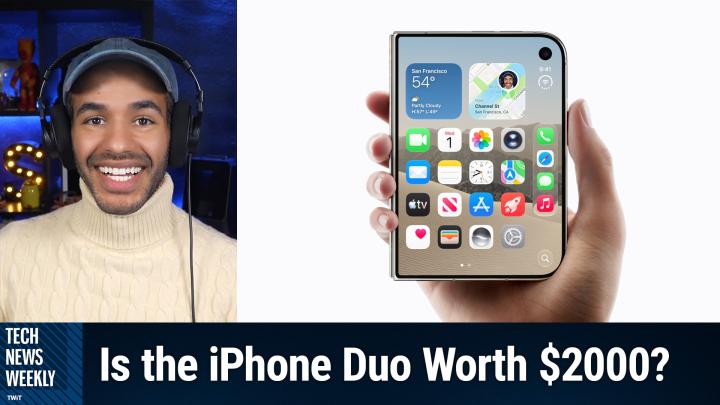
All right, let's take a quick break before we come back with our first interview of the show. For almost 2 decades now, the iPhone has changed in small and careful ways. Apple, though, has made its biggest bet on the shape of its phone since the very first one. It's a device that unfolds into something new and frankly asks longtime iPhone users Like many of our listeners, to rethink the habits that they've had for years. So we have to ask, is it the future of the iPhone or is it just a very expensive first draft? Here to tell us after a week of folding, flipping, and living with it is The Verge's senior smartphone reviewer, Allison Johnson. Welcome to the show, Allison.
Allison Johnson [00:12:00]:
Hey, thanks for having me.
Mikah Sargent [00:12:02]:
Absolutely. So let's, uh, let's get right into it. Apple's first foldable, it's finally joined the market, is I think, uh, in comparison to other foldables, it's shaped less like that tall slab and instead is more like a passport. So for folks who haven't held one yet, which is most people, uh, what is the iPhone Duo like closed versus open? And then how did that shape change the way that you actually used it day to day?
Allison Johnson [00:12:32]:
Yeah. So Apple did go with this kind of passport shape. Um, and you, you know, as you mentioned, a lot of the previous book-style foldables have been in that more like tall and narrow kind of format. So I've got the phone here. Yeah. It's a sort of— it's tough to use one-handed, honestly, on the COVID screen. It's a small screen. It's a 5.4-inch display.
Allison Johnson [00:13:00]:
And a good chunk of the side of the front is taken up by a control panel. So it's fine for— quick, like texts, scrolling through email, just whatever you want to do quickly on your phone. I enjoy a small screen, honestly. I'm like an iPhone mini girly.
Mikah Sargent [00:13:21]:
Oh, okay. Yeah.
Allison Johnson [00:13:22]:
Yeah. But it is kind of a heavy, chunky phone. So you do tend to want to open it up. And that's where I think this phone really shines is having that wide aspect screen. Not just that, but the matte finish on the display that is very nice. So everything sort of like nudges you toward that experience. And I think that's the one that people will really be drawn to and really enjoy.
Mikah Sargent [00:13:55]:
Yeah. And one of the, I mean, you touched on it there and it's something that I've been considering because I am left-handed. One of the loudest reactions online after the announcement was about the one-handed use. Especially from left-handed people. I didn't say anything out loud, but I was thinking it. They were worried about controls living on the right side, right? Along with plenty of people, this is where I did get loud, wondering how they'd feel about trading Face ID, the beautiful, wonderful Face ID, for Touch ID. So now that you've had the opportunity to live with it, I'd like to know what was holding and unlocking the Duo really like? Did you find anything that made it easier? And also, What, um, what's, what's your day-to-day smartphone and your kind of typical unlocking use case?
Allison Johnson [00:14:42]:
Yeah, the— so the funny thing that happened is just being so used to Face ID being there, um, I would pick up the phone and, you know, your notifications are sort of, um, bunched up, and I would just stare at it waiting for Face ID to kick in.
Mikah Sargent [00:15:00]:
Yeah.
Allison Johnson [00:15:00]:
And then the notifications don't expand. Obviously that didn't happen and I had to be like, oh yeah, Touch ID. It's, I got used to it. It was okay. It didn't ruin my life. It feels a little slow. There is a deliberate kind of lag. So you aren't just like launched right into your home screen, it sounds like.
Allison Johnson [00:15:23]:
And you can tweak that in the settings. I didn't end up doing that. What I did do just in the past couple of days is, um, enable the, the Apple Watch integration where you can unlock it with your watch. And that has felt a lot faster for me and much more like, okay, I am just jumping into whatever I'm doing because I am frequently like holding a cup of coffee and doing something and having to like reposition my hand and then wait. Um, wasn't my favorite experience. So the, the other thing that will happen to you is that You kind of, by its nature, you turn the phone into different positions. You can, you know, you can do all the things where it's like kind of folded in half, or you open it up and you rotate it to portrait orientation, and all of a sudden the buttons are in totally different places. So one of the hot tips we got was to enroll like a lot of fingers.
Allison Johnson [00:16:21]:
Ah. So you always have like a finger that's like close by where the Touch ID is, so you're not reaching around with your thumb.
Mikah Sargent [00:16:31]:
That makes sense. That makes sense. So a lot of people seem to assume that the Duo simply opens up into an iPad, but it's not really how Apple built it. So what happens when you open an app on that inner screen, and how much does your experience depend on which app you're using? I know that I've In leading up to this, I went around on Reddit and social media to see kind of what are the questions that everyone seems to have, and what are the maybe the misunderstandings that people have before getting a chance to talk to you? And yeah, that's something I kept seeing in response to people who were saying I'm interested in this phone. People saying isn't it just opens up and it's an iPad inside? Why not just have an iPad mini? But the software. As you said, seems to encourage people to go to that bigger inside screen and use that experience.
Allison Johnson [00:17:30]:
Yeah, it's— you would think that it would be an iPad when you open it up, and it's definitely not. You are using iPhone apps, and the apps need to go through a couple levels of updates to be like fully optimized for the Duo and for the inner screen especially. So the The way to think about it is there's sort of 3 categories. There's apps that are updated only to iOS 26. And when you're running one on the COVID screen, you open up to the inner screen, it's just sitting in the middle of the screen with these big black bars on either side. Not great. But as soon as an app is updated to iOS 27 support, it'll have support for that. dynamic resizing.
Allison Johnson [00:18:21]:
So it'll take up the whole inner screen, which feels better, but can be kind of messy because it's just like stretched. So you're, it's not a like well-thought-through experience. You're just suddenly using big app. But then that third category is apps that have updated to support iOS 27.1, which specifically adds the support for the Duo. And the controls along the rail on the outer screen and then controls on the inner screen in more thoughtful layout approaches. We saw this happen to multiple apps, like, like every single day we would open up the phone while we were working on this review and an app had been updated and it was just a totally different experience. Wow. So it was a wild journey.
Mikah Sargent [00:19:12]:
Yeah, that's kind of fun.
Allison Johnson [00:19:14]:
Yeah.
Mikah Sargent [00:19:14]:
I, I do keep seeing now apps that are in the updates that are saying, okay, you know, adding support for— I'm looking forward. I, um, despite being up at 4:55 AM or 4:45 AM, uh, and, and ordering as soon as possible, I'm about a month out. So, um, in the meantime, this is, this is how I'm getting to learn about it. And this is interesting too. You wrote a whole separate piece about the finish on the inner display and The reason why I say this is particularly interesting is because I have, uh, I remember back whenever the Studio Display came out and there was, or whichever display it was that had the option for that, um, the, the, this kind of display that cuts back on glare and people at the time who got it going, oh wow, I ended up returning it. It, it cut down on brightness too much, et cetera, et cetera, et cetera. And so. People were leading up to this going, oh, I wonder if it's going to be the same thing.
Mikah Sargent [00:20:16]:
So what won you over with this display? How did it hold up in the situations where you were going into that big screen? Uh, yeah, what made it good?
Allison Johnson [00:20:25]:
Yeah, I think the, the nature of the device is one that you're going to take outside and you're going to use it in so many different kinds of lighting, like great lighting, terrible lighting. So it just sort of makes sense to have, have this be the default on a, you know, if it was on, on my monitor that I was looking at all the time in inside, I don't think I would enjoy it. But it really, and it's very subtle, you know, it's definitely, you open the phone, you notice it right away. You're like, wow, this is, this is different. It doesn't feel like Aggressively matte, if that makes sense. Yeah, that does. Yeah. So, um, you know, there's specific like paper-like feel tablets and, and e-readers.
Allison Johnson [00:21:15]:
Um, so it's not quite that. It's sort of in this like subtle middle ground where it really does help with the glare. Um, I was watching episodes of Widow's Bay on my tray table, you know, with the phone propped up. Um, on my flight and, you know, someone throws open the, the window in your aisle and you've got glare and stuff you're dealing with. And it was great for that. I, I really enjoyed it in a lot of different lighting scenarios. And it, it never bothered me too much in the situations where you're like, well, because it's diffusing the light a little bit that's coming from the display, you lose a little bit of like the rich blacks and the contrast, which I think is true. But to me on this kind of device, I'm like, I'm just grateful I can watch a show on a big screen.
Allison Johnson [00:22:09]:
It all feels like upside, you know?
Mikah Sargent [00:22:11]:
Yeah, absolutely.
Allison Johnson [00:22:12]:
Yeah.
Mikah Sargent [00:22:12]:
Speaking of that, all feeling like upside, this next question, at a starting price of $2,000, I think that it's fair to say that buyers will tend to expect the best of everything. This is the flagship upon flagship. ships, right? So when it came to the concerns that I've seen from people, including myself, I have the 17 Pro Max right now and love the cameras on it. How did the cameras and the battery hold up for you, especially while you were traveling with it?
Allison Johnson [00:22:49]:
Well, I've got good news and bad news. The good news is the battery. I really had a good time with the battery. It has It has lasted through some pretty intense days. It was not even halfway charged up when I took it on the plane last night, 5-hour flight. I was doing all kinds of things on the inner screen and it was down to 30%. And that's all on Wi-Fi. That's pretty friendly to the battery.
Allison Johnson [00:23:19]:
But it just wasn't a thing that gave me anxiety. It's so variable. I know that our editor-in-chief, Nilay Patel, he was also working on this review. He had a very different experience. And I think he was on, you know, more train rides where the cell signal's coming in and out.
Mikah Sargent [00:23:38]:
Ah, yeah.
Allison Johnson [00:23:39]:
Doing all kinds of power moves on the inner screen. And you won't get as good battery life that way. So that is highly variable, but I had a good time with it. I am sorry to say that the, the cameras are okay. You have an okay main camera, you have the ultra-wide camera, but I really miss the telephoto and that there's just nothing, there's no getting around that. It's just not here. Digital zoom is okay. It's not a replacement for the, for the 4x telephoto, you know, on the 17 Pro or the 18 Pro.
Allison Johnson [00:24:18]:
And every time I went back to the 18 Pro when I was reviewing it, I was like, oh, the telephoto is just so nice to have. You just get those, get those shots that look a little different. It feels nice. General shooting, you know, you're taking pictures of your kid or you're out and about, it will be fine. I'm, I don't have huge concerns about, you know, slightly smaller camera sensor that is in the, in the main camera on the Duo. But really the telephoto is the thing I think people will miss.
Mikah Sargent [00:24:52]:
The other big question I saw, and I think is going to take time to figure out, durability. You know, whether the crease is going to get worse, whether the inner screen scratches easily, if it feels like it would scratch easily. And then what happens if you go to the beach and a grain of sand gets caught in the fold? With just this short period of time of constant folding, what did it tell you? And what do we know in terms of what Apple is sort of prepared for or is preparing people for? And then I guess most importantly to me, did you feel a sense within yourself of needing to be more precious with it about where you put it and tucked it away? And was that kind of constantly in your mind?
Allison Johnson [00:25:45]:
Yeah, so having used quite a few foldables over the years, which, you know, maybe biases me to be a little bit more desensitized, but this feels like it starts from a place of, it feels pretty good, you know? It doesn't feel like I need to be super precious with it. It has that IP68 rating, which is— Fully water resistant, fully dustproof, or not dustproof, but dust resistant to you know the greatest extent it can be. So would I take it to the beach still? I I don't know. I think I would be like super extra careful with that. It has just like a reassuring solid feel to it, and maybe some of that is is just the weight in the you know the the finish and the materials that Apple used. I didn't notice. any big problems with like the crease getting dramatically worse or scratches or anything like that. It very much just feels like a phone I could just throw in the bottom of my tote bag, which is super dusty and gross.
Allison Johnson [00:26:58]:
So I think people's like kind of pain tolerance for how they wanna treat it like a regular phone will vary. I would say, Like, get AppleCare. Don't mess around. Don't roll the dice. The repair costs are expensive. And just having that, like, say something does happen, say my kid spills something on the inner screen and the hinge is compromised, or I don't know. I personally would want that peace of mind.
Mikah Sargent [00:27:32]:
Absolutely. Well, Allison, I want to thank you so much for taking the time to join us today, especially given the work you've been doing with these reviews. If people would like to keep up to date with the work that you're doing, where are the places they should go to do so?
Allison Johnson [00:27:48]:
Yeah, come, come see me on The Verge. I'm also on Threads @aliceandjoe1 and Instagram too. So, well, I'll see you around.
Mikah Sargent [00:27:58]:
See you around. Thank you so much. We appreciate it.
Allison Johnson [00:28:01]:
Thank you.
Mikah Sargent [00:28:02]:
Alrighty, folks, we're gonna take another quick break and then we'll be back with our next interview after that. All right, we are back from the break, and now it's time for our next interview. Xbox, of course, turns 25 this year, but this anniversary looks less like a victory lap and more like a rescue mission. Microsoft has handed one of gaming's most recognizable brands to a leader who'd never worked in the industry, and, well, she's wasted no time shaking things up. The big question is whether Xbox can be turned around in the first place and what it'll look like when the dust settles. Joining us today to talk about it is Fortune's Sebastian Herrera. Welcome to the show.
Sebastian Herrera [00:28:47]:
Thanks so much for having me.
Mikah Sargent [00:28:48]:
Yeah, absolutely. So as I mentioned, uh, during the intro there, Xbox hitting its 25th anniversary, and frankly, the company or the, the organization has huge franchises under its roof. So How in the world did it end up in this fix-it mode instead of getting to celebrate its 25th anniversary? And, uh, what did current and former employees tell you went wrong?
Sebastian Herrera [00:29:14]:
Yeah, it's really incredible that Xbox finds itself in this place because this is one of the most iconic gaming franchises, as you just noted. Uh, it's been around for 25 years, and even if you've never picked up an Xbox controller, you probably, you know, know its, its big titles like Halo or Call of Duty or consoles like the Xbox 360. And so, you know, a lot of different things went wrong. And as, as I talked to current and former employees for my story, they told me a number of things that, that sort of, you know, happened in the past few years, but they all led to sort of a big message that Xbox lost its focus. It got away from why people went to it in the first place, which was, you know, a great console with exclusive games that you couldn't get anywhere. And so basically what happened is they tried to spread themselves in many different directions, and because of that, they lost their focus. So one example of that is they started the Game Pass subscription service, which made sense and still makes sense to a large degree, but they didn't really figure out what to put on it exclusively versus putting to put elsewhere. And they didn't really give gamers a, a great sense of why you should buy an Xbox console or an Xbox product because you didn't really need to to play a lot of their games.
Sebastian Herrera [00:30:36]:
And so on one hand, you have companies like Nintendo that really own the handheld market and have, you know, exclusives like, you know, the Mario games and all that to lock in gamers. And then PlayStation really took care of the sort of high-end console, um, you know, world, and also has exclusives that people, uh, you know, went, went and bought his consoles for. Like Spider-Man is a good example of that. Xbox hasn't really had as much, and they've really fallen in the middle, uh, that doesn't really give, uh, a lot of gamers a reason to go and buy an Xbox. Uh, so, you know, that's been a problem for them. And then behind the scenes, what employees told me is that there was a lot of dysfunction where You had teams within the same organization competing against each other. So, for example, teams that were trying to get in-store sales versus the subscription sales, and there wasn't a lot of cohesion in the mission or the vision. And so, it led to a lot of sort of strategic mistakes.
Mikah Sargent [00:31:39]:
Wow. Yeah, that's something that you hear about Microsoft in general quite a bit, it seems. Now, of course, Asha Sharma came to Xbox, no background in games. Can you tell us a little bit more about her? Obviously, everyone should go read your profile. It's fantastic and goes into great depth. What did she do before this job? And then what did you see of how she actually now runs things day to day?
Sebastian Herrera [00:32:07]:
Yeah, she's got a fascinating background because, as you noted, she had zero video game experience prior to taking the CEO role at one of the biggest gaming companies. And that's what made her a really intriguing character. But she previously worked on sort of the AI platform side of Microsoft. And then before that, she was basically building products at Meta and at Instacart. And what makes her really interesting is that she's totally different than the previous Xbox CEO, the previous Microsoft Gaming CEO, Phil Spencer, who's really a legend in the industry. He's the one that started Game Pass. He's the one that really built up the gaming business there. And he's a huge gamer.
Sebastian Herrera [00:32:51]:
There's stories of him being in meetings at Microsoft playing games or joining in on employee gaming. So he was really famous for sort of being a voice of the gamer. So what Asha brought to the table was really someone who had to come in and make tough decisions and sort of wasn't very tied to the gaming community in that way and could sort of see things in a very clear-eyed way. So, you know, and being around her for this profile, she's definitely an operator. You know, she's sort of pretty blunt, pretty cutthroat, pretty decisive, and she knows what what she wants and how to achieve it. She is a bit introverted. She's not someone who's super loud or tries to dominate the room, but she's definitely someone who sees numbers. She likes metrics reviews, for example.
Sebastian Herrera [00:33:43]:
And so she was really brought in by Satya Nadella to really right-size the business, and that's what she's doing. And she's definitely not pulling any punches as she's doing that.
Mikah Sargent [00:33:55]:
Now, So one of the biggest changes on the way that I've seen, or at least one of the biggest changes that it seems to be for people to talk about, is that there's an overhaul to Game Pass. So what's kind of the new version that's in the works? And more importantly, what is the problem that it's trying to solve when it comes to Xbox?
Sebastian Herrera [00:34:21]:
I think the bottom line for Ashish Sharma and a subscription service like Game Pass is how can you get more revenue out of it? Where can you find different revenue streams? And so Game Pass, it's ripe for reinvention because like I mentioned before, there's some confusion about what games to put on it right away versus save for later. And they made this strategic mistake by pulling the Call of Duty game on there the very first, uh, day that it was released, and then they later realized that that was cannibalizing the in-store sales. Um, so, you know, uh, Aisha, she's really thinking about a complete different overhaul for, for this, uh, subscription service. And so what I report in the— in my story is that, uh, Game Pass is going to be more of like an à la carte, uh, sort of subscription service. So where you can, you know, you can sign up for console-only games Or certain cloud features that are tiered or multiplayer features, and you're sort of paying for these different features one by one. And so you can imagine it sort of like how Apple has different services for its— or sorry, different pricing for its services that we pay into and different tiers for it. That's what Asha is planning for Game Pass, according to my reporting. And again, she's just trying to find more revenue streams for it.
Sebastian Herrera [00:35:48]:
Something that she did recently that's already out there is she put a tier structure for the cloud gaming part of Game Pass. So now, instead of before, you sort of just got it all in one. Now you have to pay a certain amount for, for example, for 10 hours of cloud gaming versus $20 versus more. And that's really a way to sort of, uh, you know, uh, get people to pay more for the service and, and depending on what they need, uh, which makes, you know, sense because cloud usage does cost money. Uh, so she's trying to find different ways of, uh, you know, different revenues.
Mikah Sargent [00:36:27]:
Absolutely. Now, speaking of that, and also one of the reasons that, that people get interested in Xbox is, well, that name, uh, Xbox. It's a hardware device. So can you tell us more about what you learned about, uh, the future of, of consoles and hardware within Xbox? And, uh, if, if you have any information about cost and, uh, software and specs and anything like that?
Sebastian Herrera [00:36:59]:
Yeah, so something that my sources told me in the course of my reporting is that Xbox is planning the next, uh, handheld device by 2027. And then the next console by the holidays of 2028. All this is being built under the name Project Helix, which Ashish Sharma has publicly said will be a family of devices. And my understanding is the first one being the handheld. For the console, which is supposed to come now in the holidays of 2028, the price range, according to my reporting, will be between $1,200 and $1,800. Now that's without Microsoft subsidizing it, and they usually do do that. So, you know, uh, it'll— we'll have to see sort of how it looks like in the end. Maybe it's, you know, I don't— I would be surprised if they release an $1,800 console.
Sebastian Herrera [00:37:50]:
You know, maybe it'll be closer to the $1,200 range, and who knows, maybe they'll bundle it with other things. I think they are smart enough to know that not a lot of people are going to want to buy an $1,800 console, but that is the price range that was internally projected at Xbox. And yeah, and there's been, you know, part of the reporting for my story is there's definitely been some battles within Xbox of what Project Helix looks like. And so one thing that I report on in my story is the Windows and Xbox teams, which have had turf battles for, you know, for years, they've been really going back and forth between what the operating system will look like for the handheld device. And I think Windows was trying to push their version of it. Xbox wanted a more updated version and to control the operating system. In the end, what I understood is that Xbox is really going to control the direction of the operating system for Project Helix, although they're still collaborating a lot because it's basically impossible to build, uh, an operating system for Xbox without, uh, having Windows involved in some way. They're the base code for everything.
Sebastian Herrera [00:39:04]:
Uh, so, you know, there's still a lot to figure out. Uh, I think, you know, Aisha's trying to move fast, but, uh, it's, you know, she's, she's operating within a lot of moving parts for sure.
Mikah Sargent [00:39:14]:
Absolutely. Now, the final question I have for you, it's kind of the question that's hanging over all of this, whether the company above Xbox, Microsoft, wants to keep Xbox at all. Um, what signs have you in your reporting— did you talk about the people are pointing to? What did Microsoft's leadership tell you? And then maybe what should our viewers who are fans of the platform and of the, the company keep an eye on next?
Sebastian Herrera [00:39:42]:
Yeah, to me, the, the question of, you know, is Microsoft going to sell Xbox, that was a central tension in my story. And, and I always thought that was sort of the big question. You know, what Microsoft leadership told me is that they're not planning on selling Xbox. However, I, in my reporting and something that I heard about from my sources, is there, there was at least one meeting and presentation where they explored what a non-Microsoft future might look like for Xbox. And that could be a number of things. You know, you could spin off Xbox, you could break it off into a subsidiary, you could do different options to sort of, uh, you know, take a little bit of pressure away from it being a Microsoft business that, that isn't an outright sale. So it's left to be seen what that will look like. Um, even after my story published, uh, The Information, which is a tech news website, reported that, uh, private equity firms had been looking at, uh, you know, Xbox, even though there wasn't any discussions.
Sebastian Herrera [00:40:44]:
So long term, it's very uncertain. I asked Asha at least 3 or 4 times, what's going to happen with it. And she told me it's not for sale, but she also didn't totally close off that it might not exist under Microsoft in 2 years. So I think for Xbox fans, I mean, the name's going to live on. Xbox isn't going to go away tomorrow. What structure that looks like, I don't know at this point. It could be a spinoff, it could be a subsidiary, it could be something else. Maybe there's a world where Xbox console doesn't even exist and it just becomes a platform.
Sebastian Herrera [00:41:25]:
It's left to be seen, but I think she's doing a lot of work to turn it around. I think she clearly has some plans and the Xbox name will live on, but we'll have to see what that looks like.
Mikah Sargent [00:41:38]:
Absolutely. Well, Sebastian, I want to thank you so much for taking the time to join us today. Thank you for your Wonderful reporting as well. If people would like to keep up to date with the work that you're doing, where are the places they should go to do so?
Sebastian Herrera [00:41:51]:
Definitely, I mean, fortune.com, all my articles are on there. And I'm also on X under Sebastian Herrera, and I post a lot of my stories there as well.
Mikah Sargent [00:42:02]:
All right, thank you. We appreciate it.
Sebastian Herrera [00:42:04]:
Thanks so much.
Mikah Sargent [00:42:06]:
Alrighty folks, we've got one more interview for you that will be up next. Up next. Remember Cambridge Analytica? Nearly a decade after that scandal broke, it just came back to haunt Meta in a very big way. While almost every other state settled, one went all the way to trial, and this week a judge handed down one of the largest penalties in American legal history. Joining us today to break it all down is Bloomberg Law's Isaiah Poritz. Welcome.
Isaiah Poritz [00:42:37]:
Hi there. Thanks for having me.
Mikah Sargent [00:42:38]:
Yeah, absolutely. It's a pleasure to have you on the show, and I'm glad we get to talk about this. I certainly remember Cambridge Analytica and everything that happened directly after that, but it was kind of a— it caught me off guard to see it coming back. For anyone who hasn't been following the case, what happened in that Santa Fe courtroom this week, and how does a scandal from 2018 end up in front of a New Mexico jury in 2026?
Isaiah Poritz [00:43:05]:
Yeah. So basically yesterday, a Santa Fe judge had to determine the total penalties to award the state of New Mexico. It had won its trial against Meta. It just had to determine those penalty amounts. It awarded $25 billion, an enormous eye-popping amount, maybe the largest ever. The reason why this is coming up now, I think this is a good representation of how long long cases can take in the legal system. This case was first filed in 2021, so a few years after the scandal broke. And it just, I think it goes to show that our legal system is very slow to respond to sort of immediate issues around data privacy, around fast-moving technology.
Isaiah Poritz [00:43:51]:
It takes a lot for a small state like this to sort of build up its case and present an argument. And then they're going up against a very well-resourced opponent. Meta has been willing to sort of throw the whole kitchen sink to prevent this from getting all the way to trial. And it was finally this year when we saw this come to trial.
Mikah Sargent [00:44:12]:
Now, this case wasn't just about Cambridge Analytica, as much as that rings true in my head. What specific statements from Meta and its executives did the state put in front of jurors? And then what evidence seemed to land hardest during that 2-week trial?
Isaiah Poritz [00:44:31]:
Yeah, and I think that's a good point to make, that this case is not just about Cambridge Analytica, and it's not just— it's not even about data privacy per se. New Mexico was bringing an argument under the state's Unfair Business Practices Act where they're saying essentially Meta has made false statements to the public. Its top executives have made false statements about the way that it handles user data. And then the other set of statements that the state alleged were false were related to how it handles hate speech, how it handles the enforcement of misinformation policies. So essentially the jury had to look through 29 different public statements from Mark Zuckerberg, from Sheryl Sandberg, from the sort of quarterly earnings report statements from Meta. And essentially review whether or not those statements were misleading to the public, whether or not they were misstatements. When Mark Zuckerberg or Nick Clegg says, you know, we don't profit from hate speech or we have a zero tolerance policy for hate speech, the question is, is that really true? And I think really the evidence that came to fruition here was the internal emails and the internal communication between Zuckerberg and other top executives where There is pretty clear evidence that they were aware that they did profit in certain cases from content that they would classify as hate speech, but did not fully disclose that, or that they had other issues related to data privacy that they didn't fully disclose.
Mikah Sargent [00:46:03]:
Understood. Now, this is kind of a big number as well. The jury finding more than 43 million violations of New Mexico Mexico's Unfair Practices Act. How in the world does a count even get that large? Uh, and then what actually— to try to understand that, what counts as a single violation under that law?
Isaiah Poritz [00:46:26]:
Yeah, and I, I think this, this is sort of representative of our modern era where because things go viral on the internet, the possibility— if, if a violation is considered one person's viewing of a misstatement, then if there's millions of people who view that statement, you just begin to add up huge amounts. So basically, at the end of the trial, what New Mexico told the jury is, we think that you should award violations based on either the number of people in all of New Mexico, about 2.1 million people in 2020, or the number of Facebook users who live in New Mexico, which they estimated about So for each of those statements, the jury had to go through and determine, did this statement go to all of the Facebook users in New Mexico, or did it go to all, every person in New Mexico? Was it a broad public statement that was published in the Washington Post, for example? And so once you add that up over these 29 statements, it amounts to this enormous amount, just the number of eyeballs that Facebook has. Right. calls on all of these statements. And so it's really easy when we have an internet, when we have these huge social networks, to sort of add this all up where each violation is when one person viewed a misleading statement.
Mikah Sargent [00:47:48]:
And the math on the maximum penalty would come out to roughly $219 billion, which we just throw around these numbers, but the state Asked for $35 to $40 billion, and then the judge said $25 billion, that'll do. How did Judge Matthew arrive at that number? What did he say in his ruling to justify it? And in your observation of this case and others, can you give scope or an understanding to how $25 billion sort of ranks up when it comes to these? Because there's long been this argument that tech companies are getting little slaps on their wrist for the different violations that they do. But more recently, we have seen some rather large chunks of change being taken from these companies. Is this a large chunk of change? Is this still in the slaps on wrist, or where does it stand?
Isaiah Poritz [00:48:55]:
Yeah. So, this $219 billion is based on the judge award the total possible penalty that he could. So, under the law, the statute says that if you find a willful violation, that you can award up to $5,000 per violation. He said this was willful. I'm going to award that total amount. And that's where you get the— you multiply that by 43 million violations, you get that $219 billion. That's a gargantuan amount. That's an unbelievable amount.
Isaiah Poritz [00:49:32]:
And I think it was clear early on that he wouldn't award that much, that New Mexico was admitting, look, that would violate a whole bunch of constitutional principles about unfair unfair fines and excessive fines that would sort of be ruinous to the company. And they were like, look, we understand that that's preposterous, but we still believe you shouldn't award a penalty that is going to hit them where it hurts, and they care about money, and they thought that $35, $40 billion would be sufficient. He awarded $25 billion. His opinion doesn't have a specific explanation for why 25 is the right number. But he did essentially, he awarded the total amount and then brought it down to 25. So, I think there's some thinking there that up on appeal when this is going to be challenged, that he'll still have that total award at $5,000 per violation. And the question is just now, how much, where do you bring it it down to. So it could still be— it's still a huge amount.
Isaiah Poritz [00:50:42]:
In terms of $25 billion, that is maybe the largest single verdict that's ever been awarded in the country. It's still a little bit unclear. There have been past awards where juries have awarded symbolic awards of hundreds of billion dollars against an individual, and that was purposefully— they would never be to pay that. So this is a real, real amount of money that I think Facebook is gonna care a lot about. And I think they're gonna fight very hard on appeal to try to get this tossed out or at very least reduced down. But this is, I think, one of the first times where we're seeing a fine that they really do substantively care about. You know, the previous cases involving Cambridge Analytica, the biggest settlement was with the FTC and that amounted to $5 billion. So this is a huge amount.
Isaiah Poritz [00:51:42]:
But even then, I think there are some questions about whether that's enough. You know, I think that at the end of the day, they care a lot more. You know, things are moving fast and they are having huge investment in AI. And it's pretty clear that a lot of analysts are saying this isn't a huge deal for them, that they're still forward-looking and looking at their investments in the future.
Mikah Sargent [00:52:07]:
Now, this I thought was interesting. New Mexico standing sort of apart from the group. It's repeatedly chosen to go it alone against Meta instead of joining these multi-state coalitions. And in doing so, I believe this is its second big win. What has that approach looked like? How does this outcome compare with what other states walked away with in the end? Were those settlements or losses entirely? And any insight into why or how, I guess, New Mexico has chosen to go it alone?
Isaiah Poritz [00:52:43]:
Yeah, I think that's been sort of this key question here. here that a lot of attorneys are— a lot of state attorneys general are facing now of whether or not you should join a big coalition and band together to bring a case, or if you should go alone, fight on your own turf in your home court, state court. That's a really key question. I think obviously in these cases they've shown, look, going it alone is the way to go. We've won these huge verdicts against Meta. This one earlier this year involving child harm and social media addiction. They chose not to be part of this big coalition that ended up settling. And so they're reaping a huge amount of money from that, about $1 billion.
Isaiah Poritz [00:53:26]:
And then here they are potentially— there was Raul Torres, the attorney general from New Mexico. He'd said in a press conference, we've paid for our schools for the next 100 years because we have this huge, huge sum in front of us. But that comes with its own risks. I mean, by going to trial, there's not the same level of finality as a settlement. They could potentially lose the trial, and then even after this huge award, there's gonna be a whole appeals process. So, it may be a long time before they actually see any of that money. So, it's really kind of a risk-reward calculation that a lot of these attorneys general need to make of, are they willing to put the resources in to bring in outside law firms to help them prosecute this case? Are they willing to go up on appeal and fight there? Or do they kind of want to free ride off of a bigger state like California and reap some of that money from a settlement? But I think in this case, it does seem like even if you're a small state, it's worth it to To bring this case all the way to trial, you know, on your terms, uh, uh, in your home turf.
Mikah Sargent [00:54:35]:
To round things out, of course, we have the response from Meta. Meta's chief legal officer saying that it's confident it'll win on appeal, called the case attacks on speech. Um, what arguments is Meta making? And then what are legal experts saying about how this penalty might hold up as it works its way through Yeah,
Isaiah Poritz [00:54:58]:
and I think this is kind of— everyone's waiting to see how exactly they're gonna structure an appeal here. I certainly think they will make some good arguments about free speech-related issues here. Certainly when it comes to content moderation and hate speech, there's some questions about when the jury is evaluating what exactly is hate speech, that these are things that are sort of ultimately protected by free speech. And that it's important that companies can have the discretion to sort of make these arguments and statements about how it does content moderation. It's a very, very complicated process to do content moderation at such a broad scale. So I think it'll certainly make those arguments. I think another set of arguments, especially related to the size of this penalty, is, and we've seen a little preview of it already as he was arguing, about the penalty before the judge is this question of, is this an excessive fine? There are constitutional principles that say you can't fine somebody in a way that will financially ruin them or that is completely grossly disproportionate to what the harm or what the crime was. So, I think they'll certainly be able to make potentially strong arguments that, hey, look, these statements didn't harm anyone.
Isaiah Poritz [00:56:13]:
They didn't show They harmed anyone, yet were getting fined this enormous amount. And I think there's certainly a possibility they could at least try to reduce the fine by saying this is not a proportionate violation. It's not tenable under our Constitution.
Mikah Sargent [00:56:34]:
All right. Well, Isaiah, I want to thank you so much for taking the time to join us, helping us to understand what's going on in the case. If people would like to follow along with the great work that you're doing, where are the places they should go to do so?
Isaiah Poritz [00:56:47]:
I'm on X still, @IsaiahPoritz, and my work is on Bloomberg Law. So yeah.
Mikah Sargent [00:56:57]:
Wonderful. Well, thank you very much for your time today. We appreciate it.
Isaiah Poritz [00:57:01]:
Great. Thank you so much. Have a good one.
Mikah Sargent [00:57:03]:
You too. Alrighty, folks, that brings us to the end of this episode of Tech News Weekly. Of course, the show publishes every Thursday at twit.tv/TNW. That is where you can go to subscribe to the show. In audio and video formats. If you'd like to follow me online, I'm @mikahsargent on many a social media network, or you can head to chihuahua.coffee, C-H-I-H-U-A-H-U-A.coffee, where I've got links to the places I'm most active online. Be sure to check out my other shows, including Hands-On AI, which publishes today, iOS Today, which publishes today. I'm forgetting something, I'm sure, but you can check out all the good stuff there, and I will see you again next week for another episode of Tech News Weekly. Bye-bye