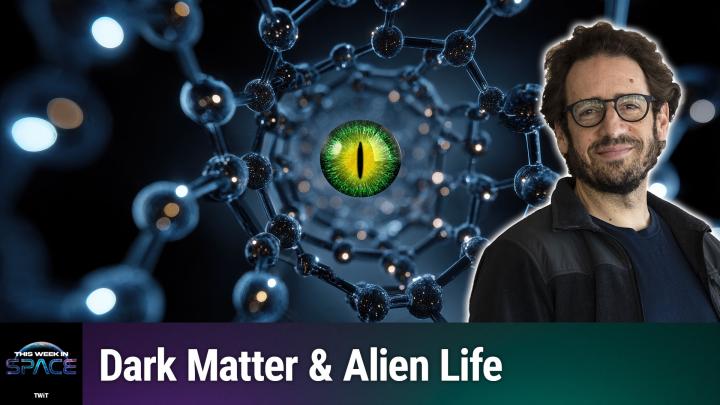
This Week in Space 216 Transcript
Please be advised that this transcript is AI-generated and may not be word-for-word. Time codes refer to the approximate times in the ad-free version of the show.
Tariq Malik [00:00:00]:
Coming up on this week in space, NASA's Perseverance rover has found more clues about the potential for life on Mars. A NASA space telescope is falling out of space, but there's a plan to save it. And could there be life out there in the dark matter cosmos? We find out with experimental particle physicist Daniel Whiteson of UC Irvine. Check it out.
Rod Pyle [00:00:29]:
This is This Week in Space. Episode number 216, recorded on June 26, 2026: Dark Matter Intelligence. Hello, and welcome to another episode This Week in Space, the Dark Matter Intelligence Edition. I'm Rod Pyle, editor in chief of Ad Astra magazine, and I'm here, as always, with my pal, Tariq Malik. Well, except for last week. Welcome back.
Tariq Malik [00:00:52]:
I missed her. I'm back from outer space.
Rod Pyle [00:00:55]:
Right, and now you have to keep up with Sue Carlin's performance from last week.
Tariq Malik [00:01:00]:
I will do my best. I'm no sue, but I'll try.
Rod Pyle [00:01:02]:
Gonna keep on you. Today we'll be speaking with UC Irvine professor of Physics, Dr. Daniel Whiteson about ETS, SETI, first contact, communicating with alien intelligences, and much more. And when I say much more, I mean much more, because this guy's a mind blower. But first, speaking of blowing minds, here's a space joke from Jamie Marsh.
Tariq Malik [00:01:26]:
Jamie.
Rod Pyle [00:01:26]:
Quite some time ago. Hey, Tariq.
Tariq Malik [00:01:29]:
Yes, Rod?
Rod Pyle [00:01:30]:
A friend said she wanted to become a star. I told her to be serious.
Tariq Malik [00:01:35]:
I like that one.
Rod Pyle [00:01:36]:
Okay, let's try another one. Hey, Tarik.
Tariq Malik [00:01:39]:
Yes, Rod?
Rod Pyle [00:01:40]:
What did Earth say to Mars?
Tariq Malik [00:01:42]:
I don't know. What did Earth say to Mars?
Rod Pyle [00:01:43]:
You need to get a life. Or some life.
Tariq Malik [00:01:49]:
Hey, that was good. That was good.
Rod Pyle [00:01:50]:
That was bad. Yeah. However, I've heard that some people want to crush us into Beetlejuice and preserve us. And preserve us. And formal house when it's joke time time on this show. But you can help by sending us your best worst or most indifferent space joke at Twits tv. We'll be happy to blame it on you on the air. John, why are you holding your fingers up like that?
Tariq Malik [00:02:13]:
He said Beetlejuice.
Dr. Daniel Whiteson [00:02:15]:
Oh.
Rod Pyle [00:02:16]:
Oh, got it. I only said it once.
Tariq Malik [00:02:20]:
I said it three times.
Rod Pyle [00:02:22]:
Yeah, okay, let's. Let's leave this morass and go on to headline news.
Tariq Malik [00:02:27]:
Headline. Oh, headline news.
Dr. Daniel Whiteson [00:02:30]:
Headline news.
Tariq Malik [00:02:31]:
Wait, I was way early. I'm out of practice. I'm out of practice, man. I got to work on that more. I got to work on that more.
Rod Pyle [00:02:38]:
So, going back to one of my favorite stories, let's talk about Boeing's Starliner.
Tariq Malik [00:02:44]:
It's so funny. Starliner, where art thou? We were talking about it today at work, too.
Rod Pyle [00:02:50]:
NASA and Boeing claim to be, quote, making progress, unquote, on the troubled Starliner spacecraft, while insiders say it could be at least another year. Yeah, and that would be for an uncrewed test flight. After lots of investigation, NASA rated Starliner's troubles in flight as a type A mishap, which is as bad as it gets. So that's a big deal. And work continues, but still primarily on the misfiring thrusters and heat issues with them, which, quote, remain as constraints. Now, at the same time, while expressing confidence is Starliner, NASA quietly contracted for six more flights to SpaceX, which would take us through the end of the space station era long. What the heck is going on?
Tariq Malik [00:03:33]:
Yeah, this is, this is, this is an interesting one. This actually came out of Space News. There was a, an aerospace safety advisory panel, meaning they have these every quarter or so that they kind of weigh in on what NASA's been doing where the safety concerns, things like the ISS leak. Right. That air leak on the space station. They come up in these, in these conferences. This was on, on the 22nd, so just at the start of this week. And, and in it, you know, Boeing and NASA say that they're still making progress to fix the Starliner vehicle.
Tariq Malik [00:04:09]:
How long has it been, Rod? That first. I feel like the first test flight
Rod Pyle [00:04:13]:
was before COVID Well, let's talk about development. It's been at least a decade.
Tariq Malik [00:04:17]:
Yeah.
Rod Pyle [00:04:18]:
And I don't think any other spacecraft has taken this long to get Right. And Boeing's been there since the 1950s. They've done this. Not this exact part, but they've done an awful lot of space before. They've built a few airplanes in their time. You and SpaceX did it in what, six years?
Tariq Malik [00:04:37]:
Yeah, we should, we should recap. We should recap. So, so when Boeing first launched Starliner, they launched an uncrewed test flight and it failed to reach orbit like it did not. Well, it failed to reach its intended orbit. It reached an orbit where it wasn't going to be able to reach the space station. So it wasn't really the greatest of test flights. Then they had to fly it again and that one did do okay. And, and it was able to reach the space station, but it took a couple years for them to get.
Rod Pyle [00:04:59]:
That's also uncrewed.
Tariq Malik [00:05:00]:
That was also uncrewed. Then they were getting ready to launch the crewed test flight and this actually had. They had to stand down because, oh, no, we forgot to test the parachutes with the actual, like, loads that we were going to need for a crewed flight. So they have to redesign parts of the parachutes. And then they discovered they had, like, hundreds of meters of flammable tape inside the crew compartment, which they somehow did not detect on the last two test flights. And so they had to rip it all out and then redo it all. And that added more delays. Then finally, they did launch the astronauts Sunny Williams and Butch Wilmore on a crewed test flight back in 2024.
Tariq Malik [00:05:38]:
It is 2026 now, Rod. So this is how long it's been. And they had thruster issues that raised serious control questions about the spacecraft, because if they couldn't get those thrusters to work properly, they would not have to not only dock with the space station, but to even come back home again. They could have been stuck there, like, without the ability to control themselves. Boeing says they think that they know that it's a heating issue with these thrusters and that they're coming up with a way to make it work. But the astronauts, eventually, yeah, the astronauts did not come home on the Starliner. NASA was worried to the point that they did not want them to return home and instead launched a crew Dragon with, with fewer people on it in order to make up seats for them to come back, something they'd never done before. And those astronauts, Sonny Williams and Butcher spent more time on the ISS than.
Tariq Malik [00:06:31]:
I think they were up there for maybe 10 weeks. They spent like 10 months, nine months. I was gonna say 10 days. Maybe, maybe, maybe 10 days. Supposed to be 10 days, but 10 days. And they, and they ended up spending nine months on, on the space station, even longer than like a typical, a post, a previously typical situation. So that's like the setup. They return the Starliner empty later, later that summer.
Tariq Malik [00:06:54]:
And I think in, in 2025, that summer, it came back by itself and, and now we're in, we're in this waiting phase. They were supposed to do another uncrewed test flight in April, and it's here we are in June, you know, and so they're still looking at like, what, what the issues are for this, I'd heard August now for, for this next uncrewed test. And, and it's clear that they still don't have like a final, final, final fix on these technical issues. That there's just, it's like a lot of moving parts about how it's going to work over time. And it's disappointing, right? The, they, they, they've been trying to, they have like, I think there 72 observations that NASA found and that Boeing team's found from that CFT mission, the crew flight test mission. And, and they're, they're, they're kind of fixing. I think there's 22 anomalies that they've been able to address out of 28. But the biggest ones, like the thrusters, they still can't figure it out.
Tariq Malik [00:07:55]:
And the question is, as you mentioned, do they still have time and Runway to figure it out before the space station falls out of the sky? And, and who's on the hook for those?
Rod Pyle [00:08:05]:
The other question is why they bother? They got to be over upside down. At least 2 billion at this point. Maybe closer to 3.
Dr. Daniel Whiteson [00:08:13]:
Yeah.
Rod Pyle [00:08:14]:
And you know, you'd think given Boeing's history, recent history, that they just walk away from it, but they seem to want to continue. Maybe they see a future there. Okay, let's move on. We've got a story from Space.com yes, I like to call Martian mudstones. Recent detections from NASA's Perseverance rover indicate the most robust evidence of ancient life on the Red Planet yet. Possibly. In two mudstone samples in Jezero Crater, they found complex carbon structures that may be indicative of ancient microbial life. And not just one or two, but hundreds of detections just within these two ancient sedimentary rocks.
Rod Pyle [00:08:52]:
Yeah, these are in the same neighborhood as last year's find of potential microbial fossils, but even stronger. And while this is not conclusive evidence, a case can be made. Of course, for abiotic formation, there's always a case for that. But at least according to what I read, it's much more likely that it's critters. But yeah, you know, we need a sample return mission.
Tariq Malik [00:09:16]:
We need it. This is, it's another feather in the cap for the case for a sample return. No, not feather in the cap. It's another flag. It's another reason. Right, it's another. There you go. So, so this was in the same rock, right? The same kind of rocky outcrop where Perseverance found like Chevy of falls.
Tariq Malik [00:09:36]:
That's what, that's what the rock is where they found these, these weird leopard that when they were able to look at them, they found these potential bio signatures, things that could have been made by, in a very, very strong signature. Now they have even more with this follow up which says that that first one wasn't a fluke. What I found more interesting about this, this new study is the relatively quiet fanfare that it came out this week. Right. Because it was in a scientific journal. It was released through like embargo. But yeah, it came out in science advances on June 24, so a couple days ago as we're recording this podcast. But you would have expected that if they found even more weighty evidence in the search for potential life on Mars that you would have had at least a teleconference from NASA, you know, about this.
Tariq Malik [00:10:27]:
And I was really surprised and struck that we didn't get one. I thought they were just trying to sit on it so that it didn't get leaked ahead of time out of the embargo. But at least you know, we're getting our money's worth out of the 2 billion or whatever. Plus Perseverance was in this search for where, where to look and whether or not they collect some more samples and, and save them or, or whatnot. You know, we'll have to see how it all goes. But yeah, let's go there. Let's go to Cheval Falls for this sample return mission and get those rocks back on, on Earth. Rod, I think that that's going to be it.
Tariq Malik [00:10:58]:
By the way, Perseverance just completed a marathon on Mars. So get, get that rover a metal.
Rod Pyle [00:11:03]:
Right, you hear that China? You have a sample return target. Now unfortunately it's, it's not deep enough in the planet to achieve their landing, but that's the way it goes. All right, let's talk about Swift. Swift one lastly descending.
Tariq Malik [00:11:18]:
That's right, that's right. So I, last week I actually had the pleasure of going to see NASA's Swift Boost mission down at the WALLOPS flight facility before it left for the Kwajalein Atoll in the South Pacific. The Swift Space Observatory, which if you don't recall is a space telescope that was launched in 2004 to study gamma ray bursts and find them very quickly because these are very short lived events. And it can find them. Like much, it's autonomous. It looks for bright flashes, zooms in on them. And then scientists get some valuable data. They've been able to help confirm a few things like all the gold and platinum in your jewelry that you are wearing right now, it came from these types of explosions in space and, and they found some even like the brightest of all time.
Tariq Malik [00:12:04]:
The boat is what they call it, this space telescope has been able to do it, but it's like nearly 22 years old and it doesn't have an engine and it's doing fine. It's like, you know, if your car was, was doing, doing perfect, but then a storm came and is just slowly washing it out to sea. That's what's happening. There have been a lot of an uptick in solar activity. The Earth's atmosphere is puffed up. That's what happens when we get a lot of solar activity. That increases drag. It's pulling it out of space.
Tariq Malik [00:12:32]:
This mission is going to save it by docking with it, something that's never been designed to do, pushing it into a higher orbit and giving it a new lease on life. And it's a small company that's. And they built it. Rod, how long would it take you to build a mission from scratch? What do you think?
Rod Pyle [00:12:46]:
Well, let's ask Boeing.
Tariq Malik [00:12:48]:
Nine months from the time that NASA gave them the contract In September of 2025 to now, the spacecraft is in the rocket. Three robotic arms, three hall thrusters, something like 16 different RCS thrusters, 22 different sensors on board. They've got it all to work to a confidence level that, that they're ready to go up and try to dock with a falling space telescope that was never designed. Not like Hubble was never designed to be grappled. You know, so many things can go wrong and they're going to go try it, but the alternative is that it just falls out of space by the end of the year.
Rod Pyle [00:13:19]:
Now, is it currently stable or is it tumbling?
Tariq Malik [00:13:22]:
It's not tumbling, no. They've been able to put it in a low power mode since February. That is not doing science so that it can use its little gyros or whatever the things that let it point to keep its stability so that it's not uncontrolled in space and it never has been. It's doing fine. It's just being dragged down over time. But by October, like right, it was originally in a 600 kilometer orbit and right now it's in the 300 kilometer places. And by October it could be around 100. And that is too low to be safe for the cat.
Tariq Malik [00:13:54]:
This spacecraft built by Catalyst, it's called Link to go and catch it reliably because it'll get too dynamic at that point in time. So, you know, they've got a shot, but they have to get there soon. And they're supposed to launch on June 27, but I'm hearing that date might change to earlier next week. I'll have an update for you all on this mission by next week.
Rod Pyle [00:14:14]:
And speaking of updates, I believe we have a new app out there.
Tariq Malik [00:14:18]:
That's right. This is for all of you space heads out there, I guess we call you all space fans, right? But if you have an Android or an iOS device, so Apple or Samsung or whatever, you can actually download the all new Space.com app, which is really exciting because, you know, we're like 25 plus years old and we've never had an app before. But it's a very sleek and compartmentalized version of Space.com. it has all of our coverage, allows you to save your articles. You can actually pick what subjects you want to prioritize so that that's what you more often. And you can sign up for our ad free version if you feel like supporting us and the great work that we do, then it's a small fee, either monthly or annual. But you can do that there and you can just find it wherever in your devices, your stores, on the Google Play Store, on the Apple Store, you can find it all there.
Rod Pyle [00:15:12]:
Okay. And speaking of self promotion, we have merch. If you're looking at video, we have shirts.
Tariq Malik [00:15:18]:
I forgot to wear my shirt today. I know, I forgot. I bought it and everything there.
Rod Pyle [00:15:24]:
Yeah, there it is. So you can go on the Twitch store and support our show by buying merch. We don't get anything out of it, but they do. And that's what's important because that keeps us on the air.
Tariq Malik [00:15:35]:
I can't believe I forgot. I should have coordinated with.
Rod Pyle [00:15:37]:
Finally, out of the mailbag, we got a very nice long message from a gentleman named Malte in Sweden.
Tariq Malik [00:15:44]:
Malte.
Rod Pyle [00:15:44]:
Last week. And Malte, I just want to say from us to you, we thank you for listening to the show. Stay with us.
Tariq Malik [00:15:52]:
And
Rod Pyle [00:15:55]:
we're working on your request, so hang in there.
Tariq Malik [00:15:58]:
Yeah. Thank you. Oh, oh, sorry about that. I dropped my mouse.
Rod Pyle [00:16:03]:
Oh, okay.
Tariq Malik [00:16:04]:
Well, we can edit that in post, right, John?
Rod Pyle [00:16:07]:
Oh, why would we bother? Oh, go ahead, fall out of your chair one more time just for me. All right, we'll be back in just a few minutes with a few seconds, actually, with Dr. Daniel Whiteson. So stick with us. And we are back with Dr. Daniel Whiteson, who is a professor of physics and astronomy at UC Irvine and, how would I put it? A widely sought and widely heard guest across the interwebs. When I looked you up, I thought, you know, sometimes I have to really dig to find something somebody's done. But with you, it's TED Talks, it's this podcast, it's that TV show.
Rod Pyle [00:16:41]:
You're all over the place. Welcome to the show.
Dr. Daniel Whiteson [00:16:43]:
Thank you very much for having me. And yes, I Love talking about physics and aliens and space. And I'll do it at the drop of a hat.
Rod Pyle [00:16:52]:
Hey, let's hire this guy full time. So thanks and welcome to the show. And Tariq has a question that he just loves to ask.
Tariq Malik [00:17:00]:
I do, I do, Daniel. You know, for everyone that come on the show, I'm always curious about the path to space that they took. And, you know, just kind of looking through the research. You seem to have definitely passed differential equations like us, a bane of Rod and I. But I'm very curious how you. You got interested in the specific, either in space in general or in the specific kind of tracks that have caught your professional focus. Was it something that, you know, you had been just kind of pining for since you were, like, a kid, or was it something that you found out, you know, later? There was a big aha moment, and you're like, I'm really into this. I think I.
Tariq Malik [00:17:42]:
I want to just keep doing it forever.
Dr. Daniel Whiteson [00:17:44]:
Yeah, great question. I have sort of an unusual journey to space science and thinking about aliens and particles in space. I started out in love space because I was a camper. I was a boy scout. I love dark skies and looking up at the night sky and imagining what might be out there and, you know, thrilled at what felt like the best view in the universe. You know, people are amazed when you can, like, see across a valley or see across a city, but when you look up at the night sky, you're literally looking across the universe. It's, you know, you're at the top of an incredible mountain. So that was my, you know, introductory enthusiasm about space.
Dr. Daniel Whiteson [00:18:25]:
And then I tried to dig a little deeper, deeper, and I got a telescope, and I joined astronomy clubs. And that's when it fizzled out a little bit, surprisingly, because I'm not a big fan of staying up at night and getting cold. And, you know, you can look through a telescope, but you don't really see that much. You know, stars are point sources. If you're a really good telescope, maybe you can see that Beetlejuice is a little bit more than a point source. But there's only so many times you can, like, scan across the Moon. It didn't get. Really get my science juices flowing.
Dr. Daniel Whiteson [00:18:54]:
I ended up being more excited by particle physics, which is why my professional little gig is mostly smashing protons together with a large hadron collider to try to discover new sources of matter and energy and all sorts of stuff. But then that took me back to astrophysics, because something that is fascinating about space Is that it's a continuous source of particles. And so for a particle physicist, space is fascinating. It's filled with super high energy particles that nobody understands. Cosmic rays are just particles from space. And there are things out there capable of boosting those particles to sane energies that we can't even reproduce within a factor of a thousand or a million here on earth. And we don't know what's making it. And so that got me back to space thinking about, like, what out there in the universe is making these particles? How can we study the universe beyond just photons, but by studying the protons, the neutrinos, the heavy iron nuclei, all the information that's coming from space?
Tariq Malik [00:19:56]:
Okay, I was gonna say. I was gonna say that.
Rod Pyle [00:19:59]:
Yeah.
Tariq Malik [00:20:00]:
I, I also am not a fan of staying up extra, extra super late or being out in the cold. But I was also a boy scout. I was also a boy scout. I got the, the stargazing merit badge.
Rod Pyle [00:20:09]:
Yeah.
Tariq Malik [00:20:10]:
So very, very, very cool.
Rod Pyle [00:20:12]:
So, Rod, aren't you important?
Dr. Daniel Whiteson [00:20:15]:
Yeah.
Rod Pyle [00:20:15]:
Although I, I do have to say astronomy. So I worked at Griffith Observatory for about a decade, so I too spent a lot of time, late nights with a, in that case, moderately large telescope, a 12 inch refractor. Back when astronomy was actually a skin contact sport, you know, you had to look through an eyepiece. At this point, every time I go to an observatory or talk to an astronomer, it's like, okay, well here's what I see on my monitor, and it's, you know, been stacked a thousand deep and denoised and all that. And it's incredible stuff.
Dr. Daniel Whiteson [00:20:45]:
Yeah.
Rod Pyle [00:20:46]:
And I mean, I love it. You know, my son just got one of those sea star electronic telescope, so you could set it up in the middle of Manhattan and get these incredible deep sky objects that look like they were shot out in the middle of Alaska or whatever. But it seems like you do lose something by not being at the eyepiece. And I do like staying up late and being cold and lonely. So I guess that's just me.
Dr. Daniel Whiteson [00:21:09]:
I don't mean that in any sort of judgmental way. One of my favorite things about science is that it's very personal. Like, I like writing code and doing statistics and thinking about particles. Somebody else right now is like up to their ankles in goo looking for, you know, weird spiders in rainforests and more power to them. I'm glad that they're out there doing their thing and I'm doing my thing. And the best thing about science is that everybody gets to do what's their jam. And we're all different, and our curiosities are personal. And that's why we learn so much about so many things in the universe, because we don't all share the same joys and loves.
Dr. Daniel Whiteson [00:21:46]:
So when I have young students, I'm always trying to help them figure out, like, what is it? That's your jam. What are your questions about the universe, and how can we make sure we're answering them? Because that's the biggest part of the journey in becoming a scientist, is figuring out, like, what is the thing I want to know.
Rod Pyle [00:22:05]:
Well, so last week we had David Brin on famous science fiction author, and we talked about Disclosure Day, the movie, and Disclosure Day, the phenomenon, and aliens and conspiracies and all that. He's. He's more along the lines of me, which is, oh, give me a break. So we're kind of continuing that vein today.
Dr. Daniel Whiteson [00:22:26]:
All right.
Rod Pyle [00:22:27]:
But I didn't want to cut off your. Your work at the lhc, which sounds fascinating. I mean, what's it like to be a part of a big team like that, yet working on your own theoretical problems? That must be incredibly exciting.
Dr. Daniel Whiteson [00:22:42]:
It is exciting, and it's also frustrating. It's exciting because you meet people from around the world. So I have friends in basically every city anywhere I go in the world. I know people, and I can go and have dinner with them and eat the local cuisine. I once, one summer, spent the whole summer going up and down Italy, visiting people in every city and eating their grandmother's cooking. And it was amazing. Oh, my gosh. Only because I met all those people at CERN and became friends with them.
Dr. Daniel Whiteson [00:23:10]:
So it's wonderful to be at, like, an international center where, like, all of humanity is coming together to answer questions about the universe. It can also, it be exhilarating because you're doing things you could never do as an individual. I could never build that whole facility and operate it. We're doing things, you know, on the scale of like building the Golden Gate Bridge, a project that requires massive collaboration, but lets you do things that no individual could ever do. So that's exciting. It can also be frustrating because, you know, you're writing a paper and you need all 5,000 of your co authors to approve it. So you get into lots of arguments about, does a comma belong here? Take the comma out. Okay, we took it out.
Dr. Daniel Whiteson [00:23:53]:
Put the comma back in. Okay, we put it back in. All sorts of stuff. And, you know, those cultural differences show up. Also, somebody from Japan is not going to say no to your idea. But there might. Maybe they don't actually support it. And so lots of arguments and politics and cultural differences.
Dr. Daniel Whiteson [00:24:12]:
So it's thrilling and it's frustrating. It also gives me the opportunity to do things that I think are really exciting. My goal in operating the collider and in looking through the data is to look for things that nobody's ever looked for before. I want that opportunity for discovery. I'm not interested in, like, let's measure this thing slightly more precisely than somebody else has measured it. I want to be somebody who turns over a stone that nobody's ever turned over before, because that's where maybe the universe is hiding the next big discovery. So, for example, recently we created a search for particles that don't move in the way that we expect. Most particles we create in the collider move through a magnetic field, and they follow a specific helical trajectory.
Dr. Daniel Whiteson [00:25:00]:
And so all of our computer algorithms look for particles following a helix. And so we asked, what if there are particles that don't follow a helix? Some crazy surprise the universe has in store for us. So we developed a new algorithm that could find particles that move in any sort of weird but smooth path so that we're ready for those surprises. And I don't know if those particles exist or that we'll find them, but I want to make sure we could, you know, I want to be there, be ready when the universe sends us that message. So it's a lot of swinging for home runs and mostly missing.
Tariq Malik [00:25:34]:
That's awesome. You know, for folks who maybe aren't aware, the LHC or the Large Hadron Collider, it's a 27 kilometer, like, ring buried, what, like 100, 100 meters underground, you know, in. On the. They say Franco Swiss border near Geneva in Switzerland. Right. That's. That's where it is. And you fling all these particles out and break other particles into smaller particles to find out what makes the universe tick and hopefully.
Tariq Malik [00:26:00]:
Right, Daniel. Not make a black hole. Like, are any of your experiments designed as at building a black hole?
Dr. Daniel Whiteson [00:26:06]:
You're totally. You're absolutely wrong. I absolutely do hope we make a black hole. Really would be fascinating. We would learn so much about the nature of the universe and space and time and gravity, and it would evaporate in microseconds. And so it'd be totally safe. If there was any danger to creating black holes, our planet would have been eaten already because there are much higher energy collisions happening every single day in our atmosphere, naturally. So if they created black holes that were capable of Eating the Earth, we already would have been gobbled up.
Tariq Malik [00:26:40]:
Well, that's, I think I take some comfort there. But as, as a scientist who gets to, to work with that facility, is there, is, is it just that you, you craft an experiment that you'd like to run, Obviously there's a competition cycle, and then you wait for the results, or do you get to go there and like, push a button and. And then watch it go? Right.
Dr. Daniel Whiteson [00:27:01]:
Well, it actually works a little bit differently from that. We develop a general purpose detector which takes pictures of the collisions that happen. And everybody uses that same detector. So we gather very broad spectrum kinds of information about all the collisions, and then everybody just analyzes the data after the fact to ask their question. So I'm looking for some new weird particle that moves in a weird way. Somebody else is measuring precisely the properties of an existing particle we already know about. We all use the same data set. We just analyze it differently.
Dr. Daniel Whiteson [00:27:33]:
But we do get to go and operate the detector because you need people on shift to make sure things are working. And at the center of the control room, there's a big red button that I know that I'm the kind of person, you see a big red button, you want to press that button. How far down do you have to press before it clicks? What sounds does it make? And so I was tortured by that button because I desperately wanted to press it. But, you know, it's protected through like one of these glass boxes you have to open up. But I was actually on shift, and I think it was 2008 when they had, they had the accident just after the LFC turned on and they had to shut it down and we had to press the button. And that was terrible news for science and for lots of people's careers, but I got to press the button. So.
Rod Pyle [00:28:17]:
Wow, that's pretty cool. Well, we're going to press a button into a break, and so stand by. We'll be right, right back. So this isn't my question, Daniel, but. But did it make the kind of squawking siren noise that we all hope it would make
Tariq Malik [00:28:33]:
from, like, Star Wars?
Dr. Daniel Whiteson [00:28:36]:
There's one of those spinning lights like you would see on the top of a police car that goes off when you press that button. Very satisfying.
Rod Pyle [00:28:44]:
Okay, well, so as long as we're talking about particle physics, which Tariq and I have absolutely no expertise in whatsoever, and, and we're talking about possible life beyond Earth, intelligent life beyond Earth, beyond what normally we'd see with a radio telescope, is there any idea about, Gee, Maybe there's some kind of message hidden in this, this, this background of particles we're seeing, or something along those lines. Is that, that just too far out there?
Dr. Daniel Whiteson [00:29:17]:
It's not too far out there at all. You know, we often look for intelligent life in the universe using radio waves because that's how we like to communicate. But we also want to think broadly and think about what aliens might be like, how differently they might want to communicate. And we want to be listening on all channels. And so it's more than just listening to photons that come from other planets or galaxies. There are other particles we can observe that neutrinos, for example, are everywhere. And they might encode something fascinating. Or protons.
Dr. Daniel Whiteson [00:29:51]:
There's lots of protons flying through the universe. And one of my favorite speculations is that the source of the highest energy protons, you know, you could measure the energy of these protons, and as they get higher and higher energy, they get rarer and rarer. So the very, very high energy ones hit the Earth, Earth like once per square kilometer per century. So they're quite rare, but they're fascinating because we don't know anything in the universe capable of making them naturally. Right. There's no natural process out there. If you ask an astrophysicist, what's the highest energy particle you expect to ever see, and they start from a supernova and they slingshot it around a black hole or whatever. You get them, them total license.
Dr. Daniel Whiteson [00:30:38]:
They come up with a number. And yet we, when we go look at particles in the universe, we find particles a thousand times more energetic than anything we know can produce. Which means there's either some new natural source of these things we don't know about, which would be fascinating from a science point of view, or there's an artificial source of these things. Maybe these super high energy particles are like, you know, pollution from an alien particle accelerator the size of a solar system somewhere, and we're just like in the backwash from it. No evidence of that, of course, but it's fun speculation. And I think it just points to this larger point that you're making that we should be paying attention in every possible way for signals. Because whenever we limit how we're looking at the universe, we're imposing our cultural priors. We're assuming that aliens are going to speak or think or communicate in the way that we do.
Dr. Daniel Whiteson [00:31:37]:
We're making that classic Star Trek mistake of saying aliens are humans with like a croissant on their forehead, right? Or pointy ears or whatever. And instead of starting from humanity and thinking away. We need to think very, very broadly about what possible ways aliens could be and how they might communicate with us. And as a particle physicist, I hope they choose particles.
Rod Pyle [00:31:58]:
So, Tariq, I like this guy because he makes our question questions sound intelligent.
Tariq Malik [00:32:03]:
I was gonna say, you know about that highest energy particle thing. This comes to mind because I was just writing about the Swift Space Observatory and how it's looking for gamma ray bursts, like these most explosive events in the universe. But this, this sounds like it's something more powerful than even that, right? Yes. Could it be like another big banger from the Big Banger or there's a new Big Bang, I don't know.
Dr. Daniel Whiteson [00:32:30]:
Yeah, warfare. The most energetic one in, in history. You can look it up. It's called the oh my God particle because when they saw it, somebody wrote on the logbook like, oh my God. You know, it's sort of like the wow signal. And the most amazing thing about these particles is that the universe is opaque to them. Right. Photons can fly across the universe.
Dr. Daniel Whiteson [00:32:54]:
You can see a photon from the big bang, from the cosmic microwave background, or from a really dist star, and it hasn't lost energy. I mean, actually the expansion of the universe does redshift it, but it's not like flying through space. It loses energy. However, if you are a super high energy proton, as you fly through space, you interact with the cosmic microwave background and you lose energy. So space is mostly opaque to these super duper high energy protons. So if you shoot one at the Earth from really far away, it's not going to get here. It's going to slow down and peter out. Which means these super high energy protons are not coming from very far away.
Dr. Daniel Whiteson [00:33:33]:
There's some local source of these things or they would never get here. Right. That's really exciting. But you know, this is locosmically local. So it's not like they're coming from Earth or Mars. We're talking they're coming from the local group of galaxies, which is still, you know, like tens of millions of light years across. Vast from like a Southern California point of view, but tiny from a universe point of view. Relative to like the size of the observable universe.
Dr. Daniel Whiteson [00:34:01]:
It's a tiny volume from which these particles must be generated if we're capable of seeing them here on Earth. Because to these particles, the universe is foggy instead of clear.
Rod Pyle [00:34:14]:
Well, so since you touched on scale, and I don't necessarily want to leave this line, of course, conversation, because I think it's fascinating, but one thing that always occurs to us, we're talking about, you know, possible alien visitation and this kind of thing, which I'm not a big fan of that belief, but, you know, who can say no? What the hell do I know? Yeah, but these distances are vast, fast, and crossing them is quite an endeavor. It does always amaze me that, that some extraterrestrial might make it across that distance and absolutely accidentally forget to hit the brakes and slam into Earth in 1947. But that's just me. But as a physicist, you know, this is your bread and butter. I mean, how do you, how do you accommodate this in the thinking about potential visitation? Or do we not? Or is it as simple as crossing dimensions and somebody steps out of your closet, says, yo, I'm from Alpha Centauri?
Dr. Daniel Whiteson [00:35:10]:
Yeah, great question. So many fun ways to go. You're right that the universe is vast, but it's also old. And the speed of light, while it's a limitation, it's also not that small. And so, for example, if you asked, how long would it take an alien civilization to explore the whole galaxy? Well, the whole galaxy. Wow. It's really big. There's so many planets, it's 100,000 light years across.
Dr. Daniel Whiteson [00:35:37]:
It would take a long, long time. That's true. But the universe is quite old, and there's been the building blocks of life and maybe intelligence for billions of years. If, for example, you built self replicating probes, von Neumann machines which could go out, mine asteroids to make, to get the raw materials to make more copies of themselves, and you lean on the exponential factor there, you send out five, which become 25, which become 125. A few generations in, you have billions. And so it actually only takes like a few hundred thousand years, maybe a million years or so to explore the whole galaxy. Galaxy to touch every single, like, life, living, life giving planet with a probe. So, yes, the universe is large, but it's old enough that it's possible to have explored the whole galaxy already.
Dr. Daniel Whiteson [00:36:32]:
So I don't think that the scale of the universe prevents aliens from having sent a probe to explore Earth.
Tariq Malik [00:36:39]:
Wow.
Dr. Daniel Whiteson [00:36:40]:
And even, even beyond, you know, current physics. Well, there are some possibilities in current physics. You know, warp drives and wormholes, they're theoretical, but they're not prohibited. But we should also remember that our knowledge of current physics is, is imperfect. You know, we have two great theories of physics. General relativity, which tells us about space and mass and time, and quantum mechanics, which tells us about the fundamental particles. And they're in great Conflict. They're completely incompatible with each other, which means that there's the fundamental nature of the universe itself.
Dr. Daniel Whiteson [00:37:13]:
The basic rules of how things operate. They're totally unknown to us. And any limitation that comes from general relativity or quantum mechanics might not be exact. It might not be perfect. It might not be absolute. There could be huge loopholes in those when we get to a fundamental theory. And so a civilization that's millions or billions of years old could be unimaginably far advanced relative to ours in their understanding of the nature of space and time, which could give them the ability to manipulate it in ways we can't even imagine to rule out. And so I think that if aliens showed up in our atmosphere, you know, it would be an exciting day or a dangerous day, but it also could be a day that we learn real deep truths about the nature of space and time.
Tariq Malik [00:38:04]:
Time. What if they show up in our atmosphere and they're like, no, no, no. I mean, that's a. Right. And then they. Then they dip. But they're so advanced, they can. They can manipulate that we can't even see them anymore.
Tariq Malik [00:38:15]:
And then that's it. Yeah, we're like, well, that's. That's a big revelation for us as well, that we're the ones that no one wants to touch.
Rod Pyle [00:38:23]:
So this conversation. We got to jump to a break real quick. But this conversation, for some reason, is making me think of Horton. Here's a who, which we all read as kids or had read to us, I think, with Dr. Seuss. Maybe that high energy particle is the probe itself. Wouldn't that be interesting? Probably impossible, but interesting.
Dr. Daniel Whiteson [00:38:42]:
There's a great book called the Woman who Was a Planet about microscopic aliens who come and invade Earth, and we don't even know this.
Rod Pyle [00:38:51]:
Well, let's probe our way into a break, and we'll be right back. So standby.
Tariq Malik [00:38:55]:
Well, I guess just to kind of close out this, this idea about, about particles and like the scale of, of of the universe there. You know, I'm very curious, Daniel, if, if there's one project, because you've got SETI that's going on right now to reach out to folks, but you've got the, the particle physics that you're doing, too, that could be part of all of this. Is there like a, an effort that would tie all of those science, like to try to, I guess, hit every way that we could reach somebody out there, you know, not, not just through, like, radio, like SETI is doing, or, or even optical, like what we do with where we Scan the skies and all that to make sure that, like, if, if someone in, like, what am I, music teacher, you say in Milpitas, right. Gets, gets this particle flare or, or a signal that there's like, a way to, to make sure that we figure it out at all. I mean, I, I, it's a very vague question. I'm just trying to wonder, like, is there a way to have, like, one, one radio that, that can hit all those bases so that says that this is, this is our beacon. We're gonna, we're gonna get it here from one way or another.
Dr. Daniel Whiteson [00:40:03]:
Well, I agree with you that we should be doing as much listening as possible because we don't want to miss that message. Right. And the sad thing is that most of the information that comes to Earth is ignored. You know, most of the photons from the universe land on sidewalk or a tree or whatever, and whatever information they contain about the origin of the universe or aliens or whatever is just ignored. You know, the, the fraction of information that's coming at us is overwhelming, and we're mostly throwing it away. And the, the other thing to remember is we could do a lot more. You know, space telescopes cost, cost a lot of money, but they're cheap compared to, like, how much we spend on roombas every year. Right? Like, what would you prefer? Everybody has a roomba or we have 10 new space telescopes that tell us about incredible things from the early universe.
Dr. Daniel Whiteson [00:40:55]:
I don't know why.
Rod Pyle [00:40:56]:
And unlike Ruben, space telescopes work, but
Dr. Daniel Whiteson [00:41:00]:
we keep choosing roombas over learning about the universe. So we're like kids in a candy store. We got the money in our pockets, the candy is there, but we just walk out and go buy something else instead. And to me, that's really frustrating. I wish that we had 10 times as many telescopes on Earth and in space and observatories. I think it's a, it's a huge investment in ourselves, in our future and our knowledge of the universe. I don't know why it's not bipartisan. I don't know why it's not more broadly popular.
Dr. Daniel Whiteson [00:41:29]:
I'm not a political person. I don't get it. To me, science is, you know, a joy, and it belongs to everybody, and everybody should be in favor of it. Curiosity driven research has created our way of life, our entire society, our wealth, our power, everything. So I'm all in favor of, you know, spending less money on roombas and cell phones and more money on observatories that will tell us about the nature of the universe, that will capture some of this incredible information that the universe is screaming at us. Think about how much we've learned about the nature of the universe, this vast cosmos, and we've barely ever left, right, just by sitting here on this rock and paying attention occasionally to the photons that come here. We've learned about the ancient history of the universe, the far reaches of the universe. We've seen incredible things.
Dr. Daniel Whiteson [00:42:22]:
Black holes and neutron stars and all sorts of science fiction like stuff. Why don't we do more of it? You know, it's like you go to see a great movie, you're like, let's make more of those. We're not. Then to me, that's, that's a fundamental disconnect I'll never really understand.
Tariq Malik [00:42:38]:
Well, Please, where's my Arecibo 2? That's what I want, right?
Rod Pyle [00:42:42]:
Let's not make too many more disclosure days, because that wasn't a favorite. We did get a comment, which I enjoy on discord from Butch Henderson who said, but cats can't ride on a telescope, which is, you know, we got to have our priorities straight.
Dr. Daniel Whiteson [00:42:56]:
Not yet.
Rod Pyle [00:42:56]:
I mean, not yet.
Dr. Daniel Whiteson [00:42:57]:
You tell the engineers to put that in the specs. They will make it happen.
Rod Pyle [00:43:00]:
Oh, yeah, very good. That's very.
Tariq Malik [00:43:02]:
Well, they named, they named features of Saturn's rings after kittens. Right. You know, Felicet, first cat in space. I mean, okay, I gotta enjoy that stuff.
Rod Pyle [00:43:11]:
So I, I just have to go here and get your opinion on this. I don't want to go too far down the they walk among us path. Although I, I will be asking you something later that relates to that. But. Oh boy, you know, I'm old enough to remember Project Blue Book. And I'm old enough to remember, remember when that was finally released and we
Dr. Daniel Whiteson [00:43:28]:
were all amped up about it.
Rod Pyle [00:43:29]:
I mean, I was eight or something. But we're very excited about it. Basically the air force said, nah, nothing to see here at swamp gas and weather balloons. We kind of went, that's not what we wanted. So, you know, cut across the decades to today. And if you spend time on the government disclosure site, which I have.
Dr. Daniel Whiteson [00:43:49]:
Which have I.
Rod Pyle [00:43:51]:
Okay, so, you know, it looks like X Files and it starts, starts with this big blurb about, oh, we're totally transparent about everything except the reflecting pool or whatever, blah, blah, blah, blah, blah. And it looks very fancy pants. And then you start digging into the pictures and it's like the same smudgy crap we've been seeing since the 1960s with a few exceptions, but for the most part, kind of Been there, done that sort of thing, at least for me. So I guess my question is, you know, for 20 years now we've had multi megapixel cameras in 3 billion hands and pockets across this planet. And yet the evidence, you know, you'd expect it to go exponential because now anybody anywhere can shoot video, can shoot stills, can record audio. Why hasn't that happened?
Dr. Daniel Whiteson [00:44:38]:
Yeah, I think there's a great argument I've heard Mick west make, which is that these phenomena remain in the low information zone. They're there because we don't have good pictures. They only exist, exist in the places where we can't get good pictures. You know, if we had crisp images, we would see that these are balloons or seagulls or whatever. The other point I want to make is, you know, from the movie Disclosure Day, there's a really interesting argument that it, I think maybe accidentally makes, which is that the government cannot keep a secret for very long. If a lot of people are involved, right. You know, inevitably somebody in this valley, fast bureaucracy is going to want to spill and they're going to spill. And that's the whole movie, right? Somebody wants to spill and they spill and they want to keep them spilling it.
Dr. Daniel Whiteson [00:45:24]:
And it's hard for me to imagine that being kept secret for very long. And I grew up among secrecy. I'm a child of Los Alamos. Both of my parents worked behind the fence.
Tariq Malik [00:45:34]:
Oh, wow.
Dr. Daniel Whiteson [00:45:35]:
They had Q clearances. I don't know what they worked on. But you know, even Los Alamos, like how long did we keep the secret of a time tectonic weapons, we let that slip to our like, desperate enemies in just a few years. Like a few years. We kept a deadly secret, powerful technology that could destroy the planet. How long? And we're supposed to have kept the Roswell Seeker for 80 years. Now it's, it, it, it's hard for me to believe that a lot of people have kept that secret. And bravo, you and these conspiracies often also involve a huge community of physicists who are in principle like reverse engineering alien technology and like, you know, academia is not that big.
Dr. Daniel Whiteson [00:46:19]:
I went to school with all these people. I know where people go to work. There's not a bunch of people out there who like disappeared and working on mysterious stuff like, where do these people go to school? Where do they go to grad school? Who are they with, like these people. I don't think these people are real. And if they are, I want to work with, with you. Reach out to me, give me a job. I would love to work on reverse engineering the alien tech. Please call me.
Tariq Malik [00:46:43]:
He promises not to spill. Right.
Dr. Daniel Whiteson [00:46:46]:
Promises, promise. So let me just end by saying I want to believe like I want there to be aliens. I'm very excited to speak to aliens about the nature of quantum gravity. Every time I see a picture, I'm like, I hope this is the one. I want that day to come, but because I want it to be real and you have to be very careful about believing things you want to be true, I find myself insisting on being skeptical and essentially demanding hard physical evidence before I convince myself that that's what we're dealing with.
Tariq Malik [00:47:19]:
Yeah, that's how I feel about Michael Jackson. Right.
Rod Pyle [00:47:22]:
So, okay, well, but this does, you know, this does bring to mind Sagan's admonition about extra extraordinary claims and extraordinary evidence. And we just haven't seen it yet, you know, unless we're missing something massive or as you say, you know, this idea of keeping secrets, which kind of plays into the whole moon denier conspiracy of we never landed on the moon. Well, you know, if you talk to moonwalkers, if you talk to some of the 400,000 people that worked on that program, those guys don't keep secrets, you
Dr. Daniel Whiteson [00:47:55]:
know, not like that.
Rod Pyle [00:47:57]:
And the evidence is just not there. Tariq, shall we go to a break and then we can come back and talk about actually communicating with these people?
Tariq Malik [00:48:05]:
Yes, we can. I should probably explain. I have a very guilty pleasure about Daniel not fully believing that Michael Jackson died. And I actually am very embarrassed. I'm very embarrassed that I can't get past it because I keep trying to remind myself every day. That's why. To explain the comment, can you bring
Rod Pyle [00:48:23]:
in the switch pitting host? Oh, my gosh. Okay, let's go to a break after this embarrassment. We'll be right back.
Tariq Malik [00:48:31]:
I know, I know.
Rod Pyle [00:48:32]:
So one of the things that got me to reach out to you that I thought was just so cool was you're talking about how much dark matter there is in the universe and how it's this kind of big mystery to us. And then you extended that, which I thought was incredibly exciting to this idea of, hey, hey, what if there's people living over there in that neighborhood, in that dimension, on that side of the street. And for all I know that I could have a six tentacled critter sitting on my lap right now that just lives in this parallel dark matter house. Can you kind of expand on that?
Dr. Daniel Whiteson [00:49:08]:
Sure. So dark matter is amazing because not only is it out there and it's matter and it's gravitating. And, you know, for anybody who thinks, oh, dark matter is just a placeholder, we have like 11 independent lines of evidence that dark matter is matter and it's out there. It's not just a fudge factor for galaxy rotations. But the thing that's most amazing about dark matter is how much of it there is. To explain the large scale structure and the ripples and the cosmic microwave background and of course, galaxy rotations, you need a huge amount of dark matter, like five times as much much as normal matter. So the universe is mostly dark matter. And we typically think about it in this fairly simple way, like, well, is it all one kind of particle? And maybe that's true.
Dr. Daniel Whiteson [00:49:53]:
And it's a fine approach scientifically to start from a simple theory, but it might also be very complex. Like our kind of matter, there's lots of different kinds of particles and it makes all sorts of complex stuff and fascinating emergent phenomena like this podcast, right? Or humans or Roombas or all this kind of stuff comes out of a normal matter. And so dark matter might also be mostly one kind of simple thing. The way like our kind of matter is mostly hydrogen, right? Most of the universe is hydrogen. Dark matter might be one kind of simple thing, but it might also have some complexity to it. And it's possible for that kind of more complex dark matter to have interactions, which means it could have, for example, dark chemistry, which means you could have dark biology. And of course, dark life, right? Dark intelligence, dark people, dark aliens. And you know, one of the biggest constraints on that is that we don't see dark matter interacting.
Dr. Daniel Whiteson [00:50:52]:
We see it flowing around the universe in these big fluffy clouds. It doesn't seem to stick together, but that's where the huge amount of it comes in. We're very limited in our measurements of dark matter because the only way we can interact with it is through gravity. So we're sensitive to huge, huge planet or star sized blobs of it. And it's from those measurements that we can tell that at least most of it doesn't interact. But that doesn't rule out some portions of it being more complex and having interactions. And so there could very well be dark life. And we talked about aliens.
Dr. Daniel Whiteson [00:51:26]:
But, you know, dark matter is all around us. There's a dark matter wind passing through us right now. What sort of. Absolutely. Dark matter is everywhere. And it's not just out there, it's here with us. And so if there are dark matter beings, they might not be aliens. They could be neighbors, right? And they might be totally unaware of us, just like we're unaware of them.
Tariq Malik [00:51:49]:
Wait, I've never heard of, I've never heard of dark wind. I've never. So it's like, it's like the neutrinos, it's like passing through us.
Dr. Daniel Whiteson [00:51:58]:
Exactly.
Tariq Malik [00:51:59]:
All the time.
Dr. Daniel Whiteson [00:52:00]:
And wow, the Earth is going around the Sun. And so if there's dark matter, we will be changing our velocity relative to the dark matter on an annual basis. So one thing they look for is a dark matter annual modulation. Do you see it coming in one direction and then later in another direction, which correlates with our motion around the sun because we have a relative velocity to the dark matter in the universe.
Rod Pyle [00:52:24]:
So that explains Michael Jackson. Tar.
Tariq Malik [00:52:27]:
Yeah, there you go. Well, you know, I guess the, the, this is wild percentage wise for dark matter. One of my astronomy final questions to actually get a degree and graduate from college was explain the dark matter problem. And I had to do it in math. And I don't think I did it very well, but I got to be in the class. But that's to say what an accomplishment, right? The, the percentage wise from the amount of matter that we think think that there is in the universe versus what we can see, it's like in the single digits, right? Is that a safe thing? I've heard like 4% universe is what we can see. But is that accurate? Maybe I'm getting it wrong.
Dr. Daniel Whiteson [00:53:08]:
No, you're getting it right. But you have to think about the denominator carefully. Normal matter is 5% not of the matter in the universe, but at the energy in the universe. And so if you're talking about energy density, like how much energy energy is in a cubic meter or cubic light year of space, 5% of that energy is what we call baryonic matter kind of matter. That makes it mean you and atoms and quarks and all that kind of stuff. And something like 27 is dark matter and the rest is dark energy. And so if you're including energy in the equation, then normal matter is about 4 or 5% and dark matter is like 27ish percent.
Tariq Malik [00:53:47]:
Wow. Wow.
Dr. Daniel Whiteson [00:53:48]:
There's a lot of it, right?
Tariq Malik [00:53:49]:
So we haven't even talked about dark energy yet. And what if there's like dark energy beings? There's energy beings in Star Trek, right? And then we would, we wouldn't even know.
Dr. Daniel Whiteson [00:53:58]:
Dark energy is a much weirder footing, right? Dark matter, we know it's matter, we know it's there. We're very confident that it's a thing. Dark energy is more a statement of our lack of knowledge.
Tariq Malik [00:54:10]:
Yeah.
Dr. Daniel Whiteson [00:54:10]:
We know that the universe is expanding and that expansion tension is accelerating. We don't know why. We know how much energy it would take to do that acceleration. And that's the measurement of dark energy. But we don't have a coherent theory that explains why that acceleration is happening. There's all sorts of puzzles, the Hubble tension or the universe stuff that we don't understand. So the relationship between dark matter and dark energy is basically just the word dark, you know.
Tariq Malik [00:54:34]:
Well, I, I, I, My mind is blown by this conversation.
Rod Pyle [00:54:38]:
Okay, well you sit and be blown in a corner. I'm going to change the topic a little bit.
Dr. Daniel Whiteson [00:54:41]:
Cool.
Tariq Malik [00:54:42]:
Can I ask one more question though? Just about the, to get back to the dark matter thing because it just, it dawns on me and people, they look, they've been looking for Planet 9 forever and they can't find it. But they say, oh, we can tell by the gravity. So could, could there be dark matter planets with us in a habitable zone where habitable is different because it's, there's dark matter there, you know, I mean, or there's, there's, they're not even aliens. Like you're saying they're dark matter earthlings with, from a dark matter Earth. Right. So that just happens to be like right on top of us. Oh my gosh.
Dr. Daniel Whiteson [00:55:18]:
Yes. And there could be dark stars.
Tariq Malik [00:55:20]:
Oh my gosh.
Dr. Daniel Whiteson [00:55:21]:
And they could be emitting dark photons.
Rod Pyle [00:55:23]:
Wow.
Dr. Daniel Whiteson [00:55:24]:
Hitting dark planets now again, we don't have any evidence of that. But also we can't rule it out. We are very insensitive to structure in dark matter on a small scale. We're small is like smaller than a solar system because it's only interacts with us gravitationally and gravity is super duper weak. So that's why it's such a challenge to, to understand dark matter. And that's why we're so desperately looking for dark matter to have any other kind of interaction. Like all the dark matter experiments. Vast tanks of quiet liquid underground looking for a dark matter particle.
Dr. Daniel Whiteson [00:55:56]:
They're hoping it has a non gravity interaction because that would make it much easier to study and to probe. So far we haven't seen anything.
Tariq Malik [00:56:04]:
Can you imagine if there is like a dark matter civilization and it's like most of the universe?
Dr. Daniel Whiteson [00:56:11]:
Yeah.
Tariq Malik [00:56:11]:
And they're like, and they can see us let's say. And they're like, they won't answer at all. Like it's like we, we call them all the time, you know, we, we've visited them, we walk around. They just pass right through us like we're nothing. Who do they think they are? Right?
Rod Pyle [00:56:24]:
They're libertarians. That's what.
Dr. Daniel Whiteson [00:56:26]:
Why.
Rod Pyle [00:56:26]:
Okay, so I'm gonna do a sl. I mean, we could talk about this all day.
Tariq Malik [00:56:31]:
Oh, man.
Rod Pyle [00:56:32]:
God, it's just so fascinating. And, and just so you know, Daniel Tarik gets mind blown every week. For me, it's a little less so. But I have to say mind blown, but I do want to move on a little bit.
Dr. Daniel Whiteson [00:56:42]:
Yeah.
Rod Pyle [00:56:42]:
So when we look back at the history of astronomy and, and thinkers along this vein, you know, we see people, I mean, as far back as the Greeks, thinking about, about possible life elsewhere. But certainly Camille Flammarion, if you're familiar with him, talking about, you know, he kind of picked up this plurality of worlds term from the Greeks, but changed it to, okay, so we got beings living in other planets in our solar system. And then he evolved that to actually they're us. And as we die, each time we die and reincarnate or change energy, we go out to the next planet. And I mean, he was just, just all over the place, wrote, wrote. Interesting, although barely readable science fiction very early on. And this is like 1840, I think 1850. But then moving up through Lowell and others, Percival Lowell that is, you know, we begin to see ideas of very specific ideas about life on other planets.
Rod Pyle [00:57:37]:
Mars in Lowell's case, and the idea that, you know, maybe we could communicate by creating huge geometric forms, you know, on, on land masses, so that you could see them from another, from a nearby planet and so forth, which is kind of all predicated on this conceit that of course everybody else is going to have base 10 math and everybody else is going to have verbs and adjectives and nouns and probably speak with their mouths with gas going past vocal cords and this kind of thing. We've seen that in movies because I'm old. Old as early as the 1950s of, you know, what aliens are going to look like. Like you say, they're. They're like Wharf. Wharf always struck me as having dog poop on his forehead. But croissant works, whatever the case may be, we have this very human centric view of this.
Dr. Daniel Whiteson [00:58:26]:
Yeah.
Rod Pyle [00:58:27]:
And you've, you've spoken very eloquently on how hard it's probably really going to be if we do ever make contact to actually communicate, which was kind of addressed decades ago by the, the Pioneer 10 and 11 plaques and the Voyager record, which conveniently came with a phonograph needle because it was, after all, the 1970s and it's a huge topic, but how the heck do you communicate with a completely alien culture?
Dr. Daniel Whiteson [00:58:57]:
Yeah, it's a great question. And it goes to the heart of, you know, the whole goal of the scientific, scientific enterprise in physics, which is, you know, to understand the truth of the universe. And I think for a long time physics, or most physicists have this implicit assumption that what we're doing is revealing reality. We are learning the mechanisms of the universe, that there's no humanity encoded in our physics, that it's, it's fundamental and it's true. And that when we meet alien aliens, we can use that as a universal language, right? That we can say, let's talk about math, let's start with arithmetic. I actually asked Noam Chomsky, I said, aliens have arrived. How do we talk to them? And he said, we start with arithmetic. And you know, it's cool and it makes sense.
Dr. Daniel Whiteson [00:59:45]:
But as a skeptic, I have to ask myself like, well, how do we know that our description of the universe is unique like physics? For since Newton has made this bold claim that our description of the universe doesn't just hold here, it holds in the heavens and it holds across the universe. And we have data for that. That's amazing. We can predict how galaxies spin and we can look at those galaxies and we can understand them and we can see how things happen in distant galaxies and use our physics to describe it. That's true. That works. But then there's another leap of saying, well, the denizens of those galaxies must also discover the same description that we discover, which is an assumption that our description is universal. And it's certainly possible that they find other ways to, to explain the universe.
Dr. Daniel Whiteson [01:00:34]:
And how mind blowing would it be if they showed up and they had a different theory of physics, one that worked as well as ours, but was fundamentally incompatible with ours. It told a different story about the universe. And so to your question, how do you, you communicate with aliens? Is I think you have to step back and, and make as few assumptions as possible and try to strip everything away that might be human about the way we communicate so that you can be as open minded as possible to the ways that they could, you know, examine and explore and explain the universe. And I think that makes it impossible to do what SETI is trying to do do, which is to communicate via messages across the universe. And I totally support seti and I think we should listen and we should look for messages, but I also think if we got a message, we would have no hope of decoding it without knowing their culture and their techniques and their strategies and the way they think. And the only chance is if the aliens show up and we can like, point at stuff, be like rocks, apple donut, and build some primitives from there.
Tariq Malik [01:01:46]:
Which is the whole point of that. That story in the movie Arrival, right, is they show up and they spend eons, months upon months upon months trying to just develop a vocabulary.
Dr. Daniel Whiteson [01:01:59]:
It will be hard.
Tariq Malik [01:02:00]:
Yeah.
Rod Pyle [01:02:00]:
So, Tariq, before you give your last question, I just wanted to make a point. Daniel, I don't know if you saw it, but a few years back, there was, I think it was an engineer or a professor of engineering who handed his students basically, in effect, a clone of the Voyager record and said, okay, interpret this. Now we have 10 fingers and 10 toes and we think like human beings. And we may have some vague familiarity with long playing record albums in the 1970s, 60s and 70s. And yet it took these kids, as I recall, a better part of a year to extract even the most basic data from this. And that, I don't think included the video signal, which is encoded in there.
Dr. Daniel Whiteson [01:02:44]:
Yeah.
Rod Pyle [01:02:45]:
So obviously that's very hard.
Dr. Daniel Whiteson [01:02:48]:
And that's the challenge on Easy, right? That's humans to humans.
Rod Pyle [01:02:52]:
Yeah, yeah, yeah. So what do you do? Or do you just not do anything and hope it kind of falls together?
Dr. Daniel Whiteson [01:03:01]:
I think you get out there and you explore the universe. We gotta land on those planets if we're going to talk to them. If we get some artifact from an alien civilization, we'd be lucky to recognize that it is an artifact. Like, think about the wow signal. The wow Signal looks a lot like an alien message. Might look like it's a huge spike in exactly the place you would look. But we can't tell if it contains any information. Maybe it does.
Dr. Daniel Whiteson [01:03:25]:
Maybe it's rich in data about that alien civilization, but we don't, you know, even know how to, like, open the file, you know. And so I think that's the challenge. And I think that's why we got to meet these folks in person or invite them to visit. A lot of people are worried. The dark forest theory, you know, advertising our existence, inviting aliens. That's true, but I think it's worth the risk. You know, if there was alien. If there were aliens, like, flying by, made the option to, like, press the red button and let the aliens know we're here.
Dr. Daniel Whiteson [01:03:53]:
Or not.
Tariq Malik [01:03:53]:
Not.
Dr. Daniel Whiteson [01:03:54]:
I am mashing that button. Because even if they do nuke us from Space. As long as they tell us a little bit about the universe, I think it's a fair deal. Wow.
Tariq Malik [01:04:04]:
I was going to say, by the way, wow, Signal is the title of the new Muse album. So they, they've gotten into that. That, that was my question was, it was like a two part question. One was should we still be risking it? Especially if, if, if we're worried about regular matter, you know, aliens coming, coming, coming to get us, that these dark matter aliens who we can't even see, you know, or, or like one, one other question that I was wondering about in this communication, this way, this, this disconnect that you were describing about understanding of, of how the universe works is, you know, we've, we haven't seen the entire universe. We can only see what we can see. And if, if, if, if there's a possibility of places where, let's say life can evolve or, or come together, where the, where the universe just fundamentally works different. Right. And you know, if it's, if it's a dark energy, dark matter place that we can't see or detect, things can be really weird there.
Tariq Malik [01:05:08]:
And then there would be no commonality. No. Like me going to, you know, my father's family's farm in Pakistan. I don't, I don't speak Urdu, I don't know. But we can point to an apple and say apple, you know, or in Mexico, manzana, you know, so, you know, we can do that, but we wouldn't be able to do that even if we showed up because we can't even interact with it at all. Yeah, I don't know if there's a question there.
Rod Pyle [01:05:32]:
I guess I ask you if you
Dr. Daniel Whiteson [01:05:34]:
had a question, I can answer it anyway. Even if you don't have a question, which is, I think you're right. And I think the lesson is to be open minded about the limitations in our knowledge and places where we may have made assumptions where, you know, aliens might have gone a different way or had different experiences and been led to a different understanding of the universe. And you know, even if you just like look back in history and the history of human science, there's so many places where we went a specific direction because of happenstance stance. You know, a guy leaves uranium in a drawer next to a photographic plate over the weekend because it happened to be cloudy in Paris and boom, discover his radiation. And that could have happened 100 years earlier or later. And like think about if it happened 100 years earlier and quantum mechanics had kicked off a century earlier, Einstein would have learned Quantum mechanics. And he would have had a quantum mechanical understanding when he developed his theory of gravity.
Dr. Daniel Whiteson [01:06:32]:
Maybe, maybe he wouldn't have developed a classical general relativity. Maybe he would have solved quantum gravity from the beginning. Maybe aliens took a totally different path. So I like to imagine, like, you know, a thousand parallel universes where even just humans and Earth science develops. And you can ask, like, is our current example common? Is it unusual? Like, how much does it that even. Even that vary? If the Mayans hadn't been wiped out, what signs would they be doing now? And so I think that even. Even the variation among potential human examples gives you a sense that the alien experience in science could be very, very different. And the lesson is to keep an open mind and.
Dr. Daniel Whiteson [01:07:14]:
And to try to interrogate those assumptions. The places where our humanity and our particular experience might have. Might have led us down one path, but there are other paths. And that's the whole premise of my book, Do Aliens Speak Physics? Where we try to. To find those places in our science that might be influenced by our humanity.
Tariq Malik [01:07:33]:
Wow.
Rod Pyle [01:07:34]:
Available in a bookstore near you or on Amazon. Very good. I'm glad you.
Tariq Malik [01:07:40]:
So three things that we learn, right? The universe is weird. We might not be able to see the aliens always push the red button. That's what I've learned from this.
Rod Pyle [01:07:50]:
And if the Mayans were still in charge, we might still have Human Sacrifice Night has some candidates, but at least you have chocolate. So we've gotten through about half our questions. Daniel, we're gonna have to have you back. And I think my vote would be tar. You know, we could get Daniel and David Brin on together, and we could. We could kind of relax while they talked. But then if we really want to make it interesting, we could bring on Avi Loeb.
Tariq Malik [01:08:15]:
I am so kind of toss some
Rod Pyle [01:08:16]:
red meat into the conversation.
Tariq Malik [01:08:18]:
Oh, boy, I am so bummed. I. I missed the David Brin talk yet last week, but hopefully next time, so.
Rod Pyle [01:08:22]:
All right, well, I want to thank everybody for joining us, which, unfortunately, we have to stop because we're at almost an hour already. I know, it's been really great, Daniel, and I want to thank you and everybody for joining us for episode number 216 that we like to call Dark Matter Intelligence. Daniel, where can we best follow everything you do and what you think about? Online? Online?
Tariq Malik [01:08:46]:
Yeah.
Dr. Daniel Whiteson [01:08:46]:
You can Google me. You can Google me. But my podcast is Daniel and Kelly's Extraordinary Universe, which you can find on all platforms. Kelly Wienersmith is a friend of mine, and we talk about everything that's exciting and amazing about the universe in very accessible terms. And my book is called Do Aliens Speak Physics? With my friend a cartoonist, Andy Warner, who drew all sorts of amazing potential, very creative aliens for the book and
Rod Pyle [01:09:14]:
and Tarik, I have to note that I got like I think a sentence and a half in the Wienersmith book. That was my the reward for my long interview with them. Tarik, where can we stalk you these days?
Tariq Malik [01:09:27]:
Well, you can find me at well space.com as always, also on all of the socials @tariqjmalik. And if you like video games, you can find me on YouTube @spacetronplays. Plus there's a new Star Trek game out. Looking forward to trying the demo. It's going to be really exciting and enjoying the first week of summer, by the way, as we record this summer is now officially underway. It's going to be a cool, cool summer.
Rod Pyle [01:09:54]:
You wish. It's going to be a blistering summer out here and you can always find me sweating it out at pylebooks.com or astermagazine.com remember you can always drop us a line at twis@twit.tv. We welcome your comments, suggestions, ideas, space jokes, anything else you want to send our way because we do answer all our email New Episodes this podcast publish every Friday on your favorite podcatcher, so make sure to subscribe, tell your friends and give us reviews. We'll take five thumbs up or five alien digits, whatever you got. As long as it's five of them, we're happy campers. And you can head to our website at twit.tv/twis. Finally, you can follow the Twit Tech podcast network it on Twitter and on Facebook and TWIT TV on Instagram. Thank you very much Daniel.
Rod Pyle [01:10:40]:
We really appreciate coming on and thanks everybody for listening. We'll see you next week.