This Week in Space 221 Transcript
Please be advised that this transcript is AI-generated and may not be word-for-word. Time codes refer to the approximate times in the ad-free version of the show.
Tariq Malik [00:00:00]:
Coming up on This Week in Space, Rod is out, so it's the all-Tariq show with special guest Rick Jenet. We'll talk about a starship that floats, a new NASA space telescope that's going to launch, and a mission to rescue a different one that's in peril, plus so much more. Tune in, check it out.
Tariq Malik [00:00:17]:
This is This Week in Space, episode number 221, recorded on July 31st, 2026: Starship Can Float? Well, hello everybody and welcome to another edition of This Week in Space, the Starship Can Float edition. Uh, I'm your host, Tariq Malik, uh, editor-in-chief of space.com, and my co-host today is friend of the show and the best Rod Pyle impersonator I could find, Rick Jenet of the National Space Society. Rick, thank you so much for stepping into Rod's Unfillable shoes this week to join us.
Rick Jenet [00:00:57]:
Totally unfillable large shoes that I could never try to fill, but I'm very happy to be here, and thanks. Thank you for giving me the opportunity.
Tariq Malik [00:01:05]:
Well, I really do appreciate it because we've got a lot of fun space news to talk about. It's gonna be another headline show, everybody. Headlines, there's a lot of them, and you probably already know what the first one is gonna be from the name. It's gonna be all about Starship. But first, Before Rick and I get into it, we do have a joke from Tucker Drake. And Rick, are you ready for this one?
Rick Jenet [00:01:28]:
I'm ready for it. Yeah. We're gonna get the laugh track after it.
Tariq Malik [00:01:31]:
I hope so. I hope so. And if it's a bad joke, then we can, we can, we can blame Tucker, I suppose. But, but so here's the joke. Here's the joke. So I just spent $200 to buy a special edition of the Star Trek II DVD only to discover one big problem. What do you think it was?
Rick Jenet [00:01:49]:
Uh, it wasn't there.
Tariq Malik [00:01:51]:
The seller was a con man.
Rick Jenet [00:01:53]:
Oh, it's actually a pretty awesome joke. That is a totally awesome joke. I love it.
Tariq Malik [00:01:59]:
Crying? Come on, John. Come on. That was a good one. Thank you very much, Tucker. Awesome. And, and, and by the way, just, just so everyone is, you know, is, is, you know, aware, Rod and I and Rick are always looking for the next great space joke, and you can send those in to us at TWIS@twit.tv. That is TWIS@twit.tv. Please keep them coming.
Tariq Malik [00:02:25]:
We all depend on it. It's the highlight of my week, as opposed to— well, I guess to talking about space, which we're gonna get into right now. And, and I think that'll get us to headlines. Should we do the jiggy? Yeah.
Rick Jenet [00:02:39]:
Headline news.
Tariq Malik [00:02:41]:
Oh, I was way early. I was way early. I'm sorry, I threw you off. That's okay, that's okay, that's okay. Um, it's always a good goal to shoot for, right? So we'll have to, we'll have to try next time. I'll be, I'll be better, everybody. I'll be better. But the big thing is Starship.
Tariq Malik [00:02:56]:
Rick, did you see the, the Starship launch last Friday? It happened after our, our episode.
Rick Jenet [00:03:01]:
I did. No, it was, it was phenomenal. So usually what happens during these things is all my, my space friends that start texting me, this is like, it's about to launch, it's launching in 5, it's launching in 4, you know, that whole, that whole thing. Yeah.
Tariq Malik [00:03:14]:
Well, so Starship flight, did you watch the video live too, or did you see it?
Rick Jenet [00:03:18]:
Watched it live, yep, and then caught it afterwards as well.
Tariq Malik [00:03:22]:
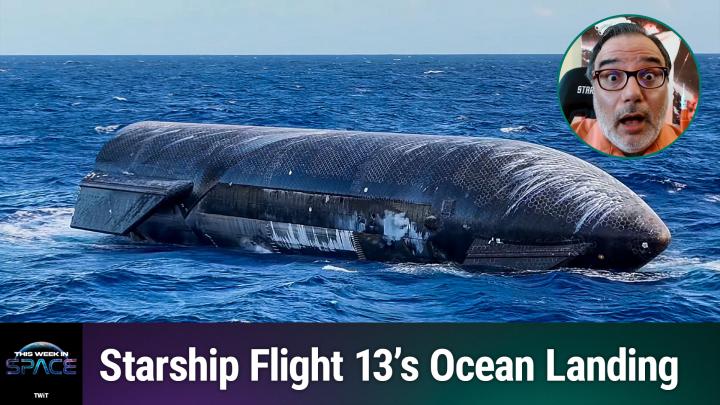
Yeah, so for folks who may have missed it because they had better things to do on a Friday night, SpaceX launched Starship Flight 13 after our last episode on, what was that, July 24th? So landing day for Apollo 11. And it seems to have gone Very, very well. This was their 13th test flight. It was the 2nd of the year and the 2nd ever of the version 3 Starship. And they didn't land the booster again. Like, it crashed into the Gulf of Mexico. I think it only had something like, like, like 5 of the 13 engines or 3 of the 13 engines that they needed to fire to do that, that landing burn and splashdown. But The Starship, the ship part successfully got into space.
Tariq Malik [00:04:09]:
It deployed the brand new Starlink V3 satellites. And there's lots of things. In fact, I think we have some video of the landing too. I don't know, John, can you show that? It's the one that was there on line— was it 30, 32, 30, 20, 22? We'll have to see. We'll have to see. But if we don't, That's the ship itself. They had these, these cameras on the buoys, a camera on a drone out in the Indian Ocean after this hour-long suborbital test flight. And the ship came down and, uh, like hovered over the ocean and then gently splashed into the Indian Ocean to float.
Tariq Malik [00:04:51]:
Did you know, Rick, that the Starships can float themselves?
Rick Jenet [00:04:54]:
Well, it's actually— it's an interesting thing because the thing is still floating, right? Yeah, it's still there.
Tariq Malik [00:05:01]:
It's only been a week and it's still out there.
Rick Jenet [00:05:03]:
And this is one of the things where you start to put your engineering and physics hat on and you're like, what is it about this thing that it's able to float? And it shows, I think it shows some rather important things. One is the heat tiles somewhat worked, the heat shields. I know there's issues and discussions about that, but at least there wasn't like one or two that burned through or anything like that.
Tariq Malik [00:05:22]:
Yeah.
Rick Jenet [00:05:22]:
So for the most part, so it's still holding up. The welds are so well, the manufacturing of the actual skin is skin tight. It's perfect as well the different bulkheads. So everything is holding up. So in some sense, it's an amazing test, just the fact that it's able to float after launch.
Tariq Malik [00:05:42]:
Well, what I found interesting is that in the past when I've, I've covered these launches and I've shared them out with like my, my followers and the audience and whatnot, they always watch Starship come back down, it hovers over the ocean, and everyone hails it as this great success. And then of course it tips over, which is planned. There's no landing pad. out there in the ocean and then it explodes in a massive fireball and everyone's like, if it was successful, why did it explode? And like, that was the big thing here is that it didn't explode. And like you just said, it's still floating out there, you know?
Rick Jenet [00:06:16]:
Totally amazing. Yeah, no, great work.
Tariq Malik [00:06:19]:
So I guess there's a couple of other things I wanted to flag about this one because there is a recovery crew out there right now trying to figure out, I guess, how to fish this thing out. of the ocean. But you mentioned the heat shield, and this seems like it's invaluable for SpaceX because for the first time they can actually get samples of the heat shield, you know, not from debris that they have to pick out of the ocean, but from the ship itself. And that, I think, will be interesting. There was a study or a report from Ars Technica where they actually spoke to the inventor of NASA's PICA heat tiles, or the tiles that they use on the Orion capsule.
Rick Jenet [00:06:53]:
Mm-hmm.
Tariq Malik [00:06:55]:
And they're saying that, uh, it was— that inventor was saying that, you know, this is— these tiles might be an Achilles heel for the Starship fast turnaround. I think space— uh, Elon, uh, Musk, SpaceX's founder, has said that he kind of wants to see like a 1-hour turnaround, 2-hour turnaround in the future. That's distant future right now. They don't even have enough launch pads for that kind of thing. Uh, but, uh, but that because of the inherent, I guess, the What do you call it? The fragility of the tiles themselves, that, that you're, you're not going to be able to do that because even the space shuttle needed rapid inspections or in-depth inspections and turnaround. We've got a close-up if you're watching the stream of those heat shields. They look pristine, by the way, the cleanest heat shield I've seen on the return. Uh, this, these ones here, there's none of that discoloration, uh, or anything that you would see, that orange stuff that we'd seen in the past.
Tariq Malik [00:07:47]:
Um, but, you know—
Rick Jenet [00:07:48]:
Well, the, the, the issue always was the inspection time.
Tariq Malik [00:07:51]:
Yeah.
Rick Jenet [00:07:51]:
And, you know, the, the, the, the thing that you just couldn't fail. Okay. And, you know, when you're bringing, uh, when you're bringing humans, you don't wanna fail on something like this. Um, and if you're gonna try to say that you have reliable, you, you wanna like turn this thing around fast. Um, I mean, that's one way of looking at it. But if you look at the, I was just before this, I was just looking at the economics of this thing. You know, the incremental cost of a shuttle was $4 billion in today's, in today's dollars.
Tariq Malik [00:08:16]:
Mm-hmm.
Rick Jenet [00:08:18]:
incremental cost of a Starship is $100 million. So, you know, you put 30 of them, you got 30 of them going, you're inspecting bunches and you're launching bunches. I mean, it's just a totally different, uh, different ball game. Um, and obviously as more of these things fly, you're going to get the heat shields, you're going to get that, that improved technology.
Tariq Malik [00:08:37]:
Yeah, and I, I think I agree. I think that the rapid reuse, even though that's like SpaceX's Holy Grail— actually Elon Musk called it the Holy Grail, the reusable aspect of all this. The fast, fast turnaround may not be a huge issue when SpaceX has already shown they can build the engines at scale, they can build the ships at scale. You know, they're building— what do they call it— the Gigafactory in Florida to turn these machines out. I mean, so that seems like if you're building a fleet of Toyotas, then if you've got 30 of them, I mean, how many— I guess you use half of them for a moonshot, right? 18.
Rick Jenet [00:09:11]:
Yeah. So you use those half, you're refurbishing the others while they're sitting down. I mean, so you make it up. If it takes 3 months, okay, then I just increase my fleet accordingly. So, um, yeah.
Tariq Malik [00:09:23]:
Well, but it was a very exciting flight, lasted about an hour. They've— they proved out a lot of things there. There's already images also from the Starlink V3s too. They're very, very cool. I think I check— encourage everyone to look at them. We'll see. I guess we'll have an update maybe next episode on if they've fished it out of the ocean yet or not, or if it's still out there floating. But There's been a— there was a few other, uh, short SpaceX news.
Tariq Malik [00:09:43]:
They, they, they got, uh, they launched an NRO satellite this week. Actually, there's a Starlink launch tonight too, so be sure to tune in to watch that on, uh, on their— what is it— their X channel. Uh, they also got a $1.6 billion, uh, contract from the Space Force for like 18 different NRO launches. So that'll be on a Falcon 9 out of Vandenberg. So they're, they're still, they're still—
Rick Jenet [00:10:04]:
They're moving.
Tariq Malik [00:10:05]:
Yeah, cooking on that whole thing. Um, and I, and I think, I think that's, that's our Starship. Anything else to say about Starship? Do you think they're gonna get to the moon now, uh, Rick, with all this?
Rick Jenet [00:10:14]:
We'll see. We'll see. I hope so. You know, one step at a time, one, one explosion at a time. But they're gonna—
Tariq Malik [00:10:19]:
hopefully not.
Rick Jenet [00:10:20]:
I think they're gonna make it.
Tariq Malik [00:10:21]:
Oh, oh, you actually reminded me, after this, just to close off the whole discussion, Elon Musk made a statement after this, just on, on X, that said that if they can, you know, kind of close out their inspections of the, the telemetry from the ship on how it performed, because it did seem to do its entry perfectly. They may actually try to catch the ship on the next flight. So Flight 14, which we know they're preparing for because they've already tested the booster. So, so, Rick, next time we talk, they could have already caught it.
Rick Jenet [00:10:53]:
They could have already caught it. That would be, that would be phenomenal. That would be phenomenal.
Tariq Malik [00:10:59]:
Well, Flight 13, not unlucky. So, but, but with any luck, we'll have some better other, other headlines for you all to come right after this break. And we're back, and now we've got a lot of other space news to tell. I mean, I tell you, I'm still riding the SpaceX high, uh, for that. We, we're a week later, we still posted another story from this, this flight, some of the videos of the, the landing, Rick. Um, but there's other stuff that, that happened this week in space too. Um, have you been following the Roman Space Telescope drama or story or saga, uh, today?
Rick Jenet [00:11:34]:
Um, well, um, in some sense, back when it was WFIRST, um, and various different aspects So which particular one are you referring to now?
Tariq Malik [00:11:44]:
I was just talking about the whole, the whole kind of like the, the, the, the life of this story, because this week NASA came out and said that they are officially 1 month away from the Roman Space Telescope launch. Liftoff is set for August 31st, I believe. August 30th, August 31st, August 30th. I don't even know my own headlines. August 30th. So we are officially 1 full month away. And, and this is the next great space telescope. And, and this is gonna be really exciting.
Tariq Malik [00:12:15]:
Right now, there wasn't anything like really new in the press conference that NASA had this week. But what they did say is that they're chomping at the bit because this will, and I quote, be like a— it's— they called it like magic with physics. This spacecraft is gonna map so much of the sky that its first month is gonna collect enough data that would take the Hubble Space Telescope 100 years, which I don't, I don't think I can even fathom that much data, Rick. I don't know about you.
Rick Jenet [00:12:44]:
Well, it's an interesting thing, right? It's a, um, so the thing, the thing that, that drives that comment is basically that it's a wide field of view. So James Webb and Hubble, they're both narrow field of view and they go very deep. Um, so, uh, The, uh, this one is going to go— Roman is going to go basically very huge field of view but not quite as deep. Um, and interestingly enough, its, um, its primary science driver is going to be very similar to the Hubble. Um, and I, you know, it's kind of funny, I don't know how many people actually remember what the Hubble, uh, what the primary science driver of the Hubble Space Telescope was.
Tariq Malik [00:13:23]:
Remind us, remind us.
Rick Jenet [00:13:24]:
So, uh, it wasn't to get pretty pictures, so which is amazing and shows the, you know, how beautiful our universe is, but actually it was to measure the Hubble constant. It was to measure, believe it or not, and it was to measure, you know, how fast galaxies are receding from us as a function of distance away, and which gave us this very important physical constraint on the structure of our universe. And so the Roman Telescope is actually going to get to this sort of the next level, which has to do with measuring the acceleration of the universe, which has been an important piece. And it's related to the whole dark energy, dark matter questions that have been coming around. that have come up in the last couple of decades. So yeah, very exciting to see this finally get off the ground.
Tariq Malik [00:14:11]:
You mentioned the WFIRST days for Roman, and I feel like I have to remind our listeners what that is. Can you share that story for people?
Rick Jenet [00:14:21]:
So the part that I know, of course, is the original concept of what was later called the Roman Telescope was WFIRST, which was to have this wide field of view. It's basically a wide field of view infrared Infrared Space Telescope. That's what WFIRST stands for, uh, at least I think it's— that's what it is anyway. Um, and the, the idea, they sketched a smaller, uh, like, you know, I think 1-meter-class telescope. Um, but then a very interesting thing happened, uh, on the way to the Coliseum, right? I love this.
Tariq Malik [00:14:54]:
I love this story.
Rick Jenet [00:14:57]:
And, uh, NRO, just, you know, the National Reconnaissance Office, just suddenly said, hey, You know, we happen to have these, uh, these large, uh, you know, they were actually, they were larger than Hubble class. I think they were 2-meter, 2.4-meter class, uh, telescopes, uh, uh, lenses, uh, optics, actually mirrors that, um, just happened to be hanging out. Uh, we're not going to use them anymore, so, um, you want to use them?
Tariq Malik [00:15:22]:
It's a— they were spy telescope, like the guts of spy telescopes, right? Spy satellites. They had 2 of them. And they're like, hey, we found them in the attic. You guys want them? Or we're gonna—
Rick Jenet [00:15:34]:
That's right. And I actually remember, um, I, you know, I remember the discussions in the astrophysics community about this. It's just like, oh, that's great, but they're just the optics for it. And, you know, they were, they were specially designed for— they had a particular focal length, a special curvature, all this kind of stuff. It wasn't quite right. So, you know, they didn't— you know, they were actually just going to be like, thanks but no thanks. Um, but it wasn't until, you know, and I don't know the full details of the story, but eventually they realized, oh wait, we could refurbish these and stuff. Um, and it turns out it was at the end, the cost, it didn't save any money.
Rick Jenet [00:16:08]:
It just created a better instrument.
Tariq Malik [00:16:10]:
Yeah.
Rick Jenet [00:16:11]:
So, um, that was the, that was the sort of the punchline on that. So, yeah.
Tariq Malik [00:16:14]:
And we, we found out this week they still have the other optics in, in, you know, on the ground if they want to do something with it in the near future. So, uh, Roman, so it launches on the 30th. It'll take about a month or so. of checkout. It's going to Lagrange Point 2. That's where the James Webb Space Telescope is. I guess all the cool space telescopes hang out there because the Hubble is stuck in low Earth orbit, right? So, so it could be serviced. Um, maybe a 5-year lifetime.
Tariq Malik [00:16:41]:
However, it could last a lot longer than that. You know, you're talking about Hubble. Hubble is like 30-some-odd years now on.
Rick Jenet [00:16:47]:
Yep.
Tariq Malik [00:16:47]:
And WFIRST, like, the, the origins of this telescope, as I recommend, as I recall, was one of like the core recommendations of the National Academies for Science for what NASA really should be doing. So this is gonna check off that, that, that missing link, it seems like, in this, this bit of astronomy. And then you've got 3 big observatories all at the same time. That'd be really exciting.
Rick Jenet [00:17:09]:
That is, that is pretty exciting. And, um, 3, yeah, 3 big space telescopes. Um, the fact that this data can now be released to basically everyone on the planet So, uh, we get eyes, you know, we get eyes ranging from, uh, amateur enthusiasts all the way up to professional astronomers that are able to use this data, uh, and tease out the, uh, the, the secrets of the universe with it. You know, it's a, it's a great time.
Tariq Malik [00:17:33]:
Yeah. Also, it survived cancellation too. I think in the first Trump administration, it was earmarked for cancellation because they hadn't, like, even though they already had all the optics for free, they hadn't, uh, done anything too much on it. And, um, and NASA Administrator Jim Bridenstine named it after Nancy Grace Roman, the first chief scientist at NASA. And then it made it unkillable as a space mission. So there you go. It's all fueled up. It's ready to launch.
Tariq Malik [00:18:02]:
It's going to fly on a SpaceX Falcon Heavy. Another SpaceX tie there, Rick. I guess that we can't get away from them anyway.
Rick Jenet [00:18:09]:
Nope.
Tariq Malik [00:18:10]:
So I think we've got a few more minutes for this segment left, but there is a bit of an emergency in space that I'm very sad to tell everybody about. And this is the Lynk mission. It's another space telescope mission, right? It's the Catalyst Lynk mission to service and reboost the falling Swift Space Observatory. It's got a bit of a problem. Have you heard about this mission, Rick, too much, or have you been following it?
Rick Jenet [00:18:36]:
Just a little bit. I've followed it only this week or so.
Tariq Malik [00:18:39]:
Yeah, yeah. So this is like— it's an unprecedented mission. In 9 months, Catalyst got a contract from NASA to fly an untested spacecraft to the Swift Space Observatory to give it a boost. It's, it's, it's being affected by drag from the Earth's atmosphere. And by like October, the Swift— the Swift— I can't speak. I can't speak. I'm so, I'm so flustered by this situation. The Swift Observatory, which has been up there for about 14 years, will be so low that it's just going to fall out of space, but it's okay.
Tariq Malik [00:19:12]:
Otherwise, it's got years of life on it. They just— it doesn't have an engine because it's a space telescope, but it just has those, those reaction wheels that spin it around real quick. So they launched this mission in record time as an experiment to see if they could do it, to fly a robotic arm carrying spacecraft full of sensors, full of thrusters, to just grab on wherever it can and reboost it. And unfortunately, that Lynx spacecraft has an issue. It has its own reaction wheel problems right now, and it's spinning in space. And so it's not clear, Rick, if they're going to be able to save the spacecraft that's supposed to save the spacecraft right now. And, and I really hope that they can get it, uh, because this, this sounds like a type of service and a type of expedience when it comes to space missions that we would all like to see. in the near future, especially if you've got a bunch of these new missions that are all coming up and on their end of the line.
Rick Jenet [00:20:07]:
Oh, definitely. And, I mean, this is a, this is a technology. It's a dual-use technology. I'm not surprised they could run it out in 9 months because this particular company is also a defense company. And this is something that, you know, rendezvous proximity operations, RPO, obviously, you know, DOD is very interested in. I see a lot of different companies working in this space, a lot of funding going into it. So I think they repurposed— then again, my own personal opinion— I think they just repurposed designs and plans, and this became a great test mission that they could do in civilian space. And actually, you know, they could actually brag about it if successful.
Rick Jenet [00:20:50]:
But either way, I mean, this is— it's testing new technology, so it's a great— you know, it's— you got to do it.
Tariq Malik [00:20:55]:
I think you can brag about it anyway, just the fact that you get I mean, you, you've put a spacecraft together. It's not like the software like went wonky or the arms started thrashing around or anything, you know, just to put a spacecraft and get it into space within a— that's like science fiction movie timelines right there. Right?
Rick Jenet [00:21:13]:
Right. But this is what, this is what Space Force is really pushing on this. They want to move. They want to get, they want to, you know, from, from solicitation to up in space, they want to get that like less than a year, which is an amazing, you know, amazing time period, amazing timescale. And we're getting there. We're getting pretty close to it.
Tariq Malik [00:21:30]:
So slowly, slowly but steadily. So this, this, this Lynx spacecraft follows on a few others. I think that there is another company— oh, and their, their, their name escapes me right now, but they have flown to a couple of Intelsat satellites.
Rick Jenet [00:21:46]:
Was it—
Tariq Malik [00:21:46]:
I think Northrop Grumman built it is what it is, the MEV, right? The Mission Extension Vehicles. They've launched 2 of them already. And Northrop Grumman also launched this, this rocket too, launched on the last Pegasus. Uh, XL.
Rick Jenet [00:21:58]:
So, and relate— and related is, um, companies like Astroscale out of Japan that are building, uh, you know, it's, it's, you know, same concept except it's with derelict spacecraft rather than active spacecraft. But you want to go up there, grab them, move them out of orbit, or put them in a, in a, in a parking orbit or something, or a, uh, something along those lines.
Tariq Malik [00:22:17]:
So, yeah.
Rick Jenet [00:22:18]:
Um, yeah.
Tariq Malik [00:22:20]:
Speaking about parking orbits, we have to park it for like a little bit, but we will be right back. So do stay tuned. We'll come back right after our break. Well, speaking of beleaguered missions, Rick, I have one that might have a silver lining on this one. It's all about Boeing's Starliner, which I feel gets a lot of— what do you call it? A lot of guff because of the challenges that they've had. So have you been following? What happened this week at all?
Rick Jenet [00:22:52]:
A little bit. A little bit. Yeah. But I think the latest that came out is they're really not actually sure it's going to fly this year.
Tariq Malik [00:23:00]:
Yeah.
Rick Jenet [00:23:01]:
Yeah.
Tariq Malik [00:23:02]:
Well, see, this is the big question. This is what happened. I missed this. This actually happened on Tuesday, and Ars Technica has the story on the Boeing— what do they call that? They call it their quarterly report because they're a public company. They have to give public reports and, and whatnot. And, uh, and as I understand it, they, they don't think they, they can— well, they know they're not going to be able to launch crew this year, but they're really hopeful that they can launch the uncrewed test flight. So just to kind of catch people up— oh, it's been years. It's been— I feel it's a, it's a very long saga.
Tariq Malik [00:23:36]:
Boeing launched the first, the first Starliner. It was an uncrewed mission. It didn't reach the space station, so it was a bit of a failure. They launched the first They had to repeat that. That wasn't a success. They had to do a whole bunch of redesigns because they launched the uncrewed versions without the crewed version stuff on it, like parachute ratings. And there was like all sorts of flammable wiring tape and stuff like that. Lots of headaches.
Tariq Malik [00:24:00]:
And then they launched Suni Williams and Butch Wilmore on the first crewed test flight. I guess that's a couple of years back now. And what was supposed to be up to a 10-day mission ended up taking, what, like a— 2 years.
Rick Jenet [00:24:09]:
few months because of—
Tariq Malik [00:24:11]:
Like, like, like 8 months, 9 months. Yeah. And it took, it took, it took forever because of thruster issues that, that just truly were never solved, that they'd come up before. And so since then— and they came back on a SpaceX Dragon, there's your SpaceX link for this story too— since then Boeing has been trying to iron out all of those kinks, and they still in this Uh, in this quarterly briefing said that they still haven't ironed out all of that stuff, but they're hopeful that they know like the, the, the control regime to avoid the, the thruster overheating in order to, to get to this cargo launch by, by the end of the year. But it's still unclear, and the years are numbered, right, Rick? I mean, the space station is going to come down in— what is it? It's 2026 now, like in 4 years.
Rick Jenet [00:24:58]:
Yeah, like in 4 years.
Tariq Malik [00:24:59]:
They're supposed to like launch at least 4 or 6 of these for NASA? I don't know.
Rick Jenet [00:25:03]:
Yeah, it's, I mean, it's an amazing story about— I'm trying to put this as kindly as possible, but it really shows what SpaceX is doing.
Tariq Malik [00:25:14]:
Yeah.
Rick Jenet [00:25:14]:
To see these, what they, that someone like Boeing, I don't think they're taking the Starliner seriously. I just, I just don't understand what, what it is, what it is in their culture that is, uh, you know, causing these, uh, these issues throughout the entire program.
Tariq Malik [00:25:30]:
That's a really interesting point. I feel that they didn't take it seriously when they were doing the legwork to build it because there was a lot of, we know how to do this, we'll do it easily. You know, we've done— we've been a major space contractor for a bajillion years, you know, since the dawn of the space age.
Rick Jenet [00:25:49]:
Yeah.
Tariq Malik [00:25:49]:
And, and that hubris really caught up with them on these test flights because of just the, the culture of the how they don't do end-to-end testing. It's just in little segments. And there was those gaps. between the segments, the handover between launch and flight software, for example, that led to the first failures and, and whatnot. And, and it seems like it's not a business that they want to stay in. And without having a destination, I don't know if they keep this going. They need to have a customer and at least one, right?
Rick Jenet [00:26:16]:
Yeah. Oh, go ahead.
Tariq Malik [00:26:17]:
Go ahead. Go ahead.
Rick Jenet [00:26:18]:
Well, I mean, if they don't have a service, they're not going to have a customer.
Tariq Malik [00:26:21]:
Yeah, that's—
Rick Jenet [00:26:23]:
but one thing I was, I was trying to look at, so I was good friends with a Boeing engineer, or at least she was, you know, she was a Boeing engineer when she retired. She actually worked on Starliner for a while. And one thing she had pointed out is there is going to be— there is a huge demographic issue in aerospace in that the aerospace engineers are aging out.
Tariq Malik [00:26:50]:
Oh.
Rick Jenet [00:26:51]:
And for years there hasn't been much there hasn't been many people going into the field. And so I had asked her, it's just like, so what do you think is going to happen? And it's like, oh, planes are going to start falling out of the sky. Well, you know—
Tariq Malik [00:27:05]:
We've seen that, right?
Rick Jenet [00:27:06]:
We've definitely started to see that. There's issues, you know, Boeing being a legacy company, you know, it's definitely, I think, suffering just like you said, it's suffering from some of these demographic issues. And you look at at least what SpaceX's reputation is it's a very young company. It's attracting young talent into the field. So I don't know, a hypothesis I have, which I cannot prove, the data is not there, is that for some reason, somehow SpaceX has all the young people.
Tariq Malik [00:27:36]:
Yeah.
Rick Jenet [00:27:36]:
And they're able to really leverage, you know, leverage that. And, you know, there's the creative thinking that comes along with doing that.
Tariq Malik [00:27:47]:
Maybe it's like a rebranding. Right? Boeing X, or, or, or like, what, what do they have? Do they have— Boeing doesn't have Skunk Works. Lockheed has Skunk Works, but Boeing has one too, right? It's what— it's how they built the X-37B. It was in that, that special program, right?
Rick Jenet [00:28:03]:
Yeah.
Tariq Malik [00:28:03]:
So, you know, you, you, you, you make that little division, the DARPA of, of, of Boeing, you know, with, with— I don't know, what do they, what do they give at, at software companies? Like scooters that are inside the building and Free lunches and all of that kind of stuff. Right.
Rick Jenet [00:28:18]:
Maybe now that, but now that, I mean, yeah, you're right. It was, it was the software people that, you know, or at least that was what was, uh, you know, the big, the big tech companies in the software development over the last 30 years have been a big brain drain. And they basically spent the last 30 years dumping their brains into silicon.
Tariq Malik [00:28:34]:
Yeah.
Rick Jenet [00:28:35]:
And so right now that's, that's gonna be the big turnaround, right? AI is basically taking all of those jobs now cuz you don't need the entry-level programmers or any of that anymore. You know, in my humble opinion here. So maybe, I'm hoping people are going to start to turn towards actual real hardware. Yeah, with the aid of AI is going to make that accelerate. Um, and so we start to get, uh, you know, we start to get young people interested and excited about space. And hopefully the show and your work, Eric, um—
Tariq Malik [00:29:04]:
And yours, Rick, and yours.
Rick Jenet [00:29:06]:
Hopefully we can do this and we, you know, we show that, you know, this, the, the real world of space exploration, uh, is, is very exciting.
Tariq Malik [00:29:13]:
So yeah, well, I guess time will tell. Time will tell. Keep, keep an eye on Boeing. I, I think if they get, if they get this uncrewed test flight off by the end of the year, that'll be a big step forward for them. I, I did hear from Eric Berger, his reporting over at Ars Technica, that they actually have earmarked every single last Atlas V rocket because there's only a few of them left for, uh, for these, these Starliner flights. They have to use them because that's what Starliner right now is built to go on. And it— I guess the key is we talked about destinations. Right now the ISS is the only destination for Starliner, but there was another one.
Tariq Malik [00:29:48]:
Bigelow Aerospace hoped to have their, their space stations be serviced by these. That would— they were supposed to be an anchor tenant. Of course, Robert Bigelow shut that company down during COVID uh, back in 2020. But, uh, uh, should another customer arise, someone like Vast— Vast has already kind of earmarked themselves for SpaceX. But, but there's, there's the possibility that someone out there might need another ride or that, that they just call this, call this the ship out of retirement, uh, after the ISS for something else, some other purpose. So that'd be interesting to see how that, how that goes. So.
Rick Jenet [00:30:19]:
It would be. And this is hinting on, you know, what is, what is the future of humans in space? This is really what we're getting at. Where is the commercial human space ecosystem? How is that going to develop? How is that going to be built up? What's going to drive that?
Tariq Malik [00:30:36]:
Yeah.
Rick Jenet [00:30:37]:
To drive that piece. Is it just gonna be robots up there? In which case, big yawn. I don't know how many people are gonna be interested in that, as opposed to let's start getting more and more people up there. Yeah.
Tariq Malik [00:30:48]:
But I will point out that it does seem that that future will be more and more commercial because we do have one last story for this segment, which is that India's first commercial rocket has at last lifted off and it was a successful mission. It was the Skyroot Aerospace's Vikram-1 rocket, which launched— actually, it launched just before our last episode, our last edition. And it made India now the 3rd country only on the planet able to have a commercial launch, like a private company, after the United States and China. Which I thought that there were more, to be honest, to be able to reach orbit. But it's been a while. A buildup. They had a bunch of delays with this rocket, but it does speak that there are other— I guess you call it space powers, right? Out there beyond national space agencies and also beyond the US or China, these juggernauts right now that are floating. So of course, China, the government supports a lot of the commercial efforts, perhaps to a higher extent than in either the United States or India right now.
Tariq Malik [00:31:56]:
So But keep it— keep an eye on— keep an eye on them, Rick, because—
Rick Jenet [00:31:59]:
No, definitely. Yeah, I mean, India is— they have been making slow, steady, um, progress in a lot of areas, um, and it was great to see. It was also great to see the— that they, um, it was very transparent as a— this is a public-private partnership. The government is going to help. They are helping. They, they immediately, uh, put the right policies in place to enable to enable this group to be successful. They were leaning, of course, on the policies that the US and others, you know, the US and Japan and so forth and even China, they were leaning, you know, they had that as an example. So it kind of wasn't as risky for a politician to go up and say, yeah, we're going to move this into the private sector.
Rick Jenet [00:32:46]:
And so they just leaned into it. And it was, it was great to see that, that they were able to, you know, come together and do this and launch their private sector space launch.
Tariq Malik [00:32:56]:
Yeah, and I'll just say that Vikram-1, it's a 4-stage rocket, it's about 70 feet tall, and it's for small satellites, right? Uh, they're starting small, 770 pounds, you know, so less than 1,000 pounds. But that's how SpaceX started with their Falcon 1 rockets, how Rocket Lab started, uh, and now they've got a medium lift that's coming up too. So, so we'll see, we'll see. And India's already got plans for its own space station, uh, for its own crew capsule, uh, on the national plan. So we'll see, we'll see how that goes. Very exciting to see. Totally. And speaking about seeing, we have to see to a break real quick, and we'll be right back after this.
Tariq Malik [00:33:29]:
So, and we're— when we're back, and I have some Artemis II news for you, Rick. So, okay, you know, the crew is still making the rounds, they're doing the celebrations, they went to the Moon, they came back, and now we're hearing, at least from the pilot Victor Glover, that NASA's plans to land the first astronauts on the Moon in the 21st century at the South Pole may not be the best case. Did you hear this at all or no?
Rick Jenet [00:33:55]:
That's interesting that you bring that up because I've been working with NSS and various groups at the United Nations trying to get the point across that the South Pole is probably not the best place to go.
Tariq Malik [00:34:07]:
Oh, so you tell me. You're the expert. You're the expert. Well, I will ask you after we talk about Glover's comments. Um, you can, you can, you can dish on, on why you and the experts at the NSS and the UN feel like that's the, uh, uh, that's the way to go. But so, so Victor Glover, Artemis II pilot, uh, you know, first to fly a moonship because he was the one that did all the manual testing on, on that mission, was at the NASA Exploration Science Forum meeting, which was, uh, a conference, uh, over the last week at the, the Ames Research Center. And, and he said that he thinks that it's a little unrealistic to target the South Pole at the first get-go for that first return to the Moon. And it's actually for reasons that listeners of the show might find more very familiar because of the challenge to get there.
Tariq Malik [00:34:58]:
It's a very remote area. You have to go into specialized orbits in order to reach it. And if you have an emergency or, or an issue where you have to escape quickly, it's very difficult to escape.
Rick Jenet [00:35:09]:
Right.
Tariq Malik [00:35:10]:
and then rendezvous with a spacecraft in orbit around the Moon in order to get back to the Earth as well. And that's kind of a lot of the reasons why the Apollo missions were around the equator, because it was easier, an easier location to target over time. And so, you know, in this talk that he gave, he said that he thinks that, you know, that's not off the table, but that we should probably go, you know, for the equator first to show that we have the capability again, to do things not just safely but reliably, and then go from there. And why would that be familiar for our listeners? Because Pascal Lee, friend of the show, has been saying this, I think, in at least 3 episodes of our discussions there. And it sounds like, Rick, you and the National Space Society feel very similar. Am I on the same—
Rick Jenet [00:35:57]:
That's not an uncorrelated piece of information because Pascal Lee is part of NSF, and of course, he's part of our Board of Science and Technical Advisors. And yeah, so we debate this point or discuss this point an awful lot. And this actually, the safety argument is a very interesting one. It's the first time I've actually heard it spelled out this particular way. So I'm sure Pascal will be very interested to see this as an added piece. But, and I know you had Pascal, Pascal's been on here before, and of course he talks about how much, you know, what is water really there? And even if it is there, it's not that much.
Tariq Malik [00:36:38]:
Yeah.
Rick Jenet [00:36:40]:
And is that really the best place for the science that you want to be able to do? And so forth, so on. The thing that always struck me in the lunar approach, which, you know, you always— if you look at how anybody considers when you go into a place you don't know, and this is, you know, from a military standpoint or an exploration standpoint, you always establish a beachhead on somewhere that's easy to get to, easy to defend, easy to supply, and so forth, right?
Tariq Malik [00:37:09]:
Yeah.
Rick Jenet [00:37:09]:
So why would you go to the hardest place? And try to put a beachhead in the hardest place. No, you find some outskirt place that you can control easy and you can work with and so forth. And then you grow from there. Now, perhaps that's a naive view, but it just seems that that should be the way to go. Now, the question of what should we do next? I think there's still some interesting discussions as to do we go right to a base? Or should we do sortie missions to figure out what's the best place to put the base? And I think that's the current active discussion I think that's going on now. It's like, do we have enough information to really say where the best place to put the base is?
Tariq Malik [00:37:54]:
Yeah, what I find interesting is that all of this discussion is going on while NASA is effectively going through a rebrand of the Artemis program to say it's a Moon-based program for a permanency. that what's a moon base? It's not just one site. It's a lot of other things that it could include. Things like a remote observatory over here. Or let's say that the moon base isn't just where the habitat is. It's like 30 miles all around it. And that's what we're going to go— that's our playground for the next 10, 15, 20 years. That sort of thing.
Tariq Malik [00:38:30]:
And really, opening up what that could be, I think, sounds very, very interesting. And it sounds like, like the— you might be about on the same page. You know, a moon base can be many things. It could be one place, it could be several different outposts that comprise your whole moon base, you know. And then you get to link them up with like a, I don't know, like a moon subway or something like that, whatever, whatever that is, right? It's a whole new thing. And, um, so, so it is interesting. But this is kind of, I think, from coming from the astronauts' mouths, the safety thing is very interesting because it highlights the inherent assumptions that— oh, and for people who don't recall, NASA's big plan for the South Pole was to get there from what they call a near rectilinear heliocentric orbit, I think. Is that what it was called? Helio orbit? NRHO? I know there's an H in there somewhere.
Rick Jenet [00:39:18]:
Near rectilinear halo orbit. Halo!
Tariq Malik [00:39:20]:
Halo, not helio.
Rick Jenet [00:39:21]:
That's the Sun.
Tariq Malik [00:39:23]:
Thank you, Rick. Halo orbit. And it was a very long orbit around the Moon. Which, which meant that like if you did have an— if you did have an issue where they had to launch into space quickly, they could— they'd have to wait until the right window to launch to, to reach the ship. And it could be a few weeks or something like that depending on what it was. And, uh, and so, uh, that, that is kind of Glover's argument here, you know, saying that, you know, instead of doing that first, let's go back, we'll prove everything out. Especially the fact that Starship— we're just talking about that— they have to demonstrate they can land on the moon.
Rick Jenet [00:39:54]:
Yeah.
Tariq Malik [00:39:55]:
There's going to be an uncrewed version of that first, then they're going to do the crewed one. They got to be able to take off in an emergency, all that stuff. And, and so you don't want to risk it on the first try.
Rick Jenet [00:40:03]:
So. And another thing I just want to point out with sort of higher, higher latitude or closer to the equator locations for a base, there is, there's plenty of science. It may not be lunar, lunar science, but there's plenty of science that can be done that does require human intervention to be present. As in certain particular types of observatories that could be put on the lunar surface. Of course, there's radio, there's also gravitational wave observatories and various other things where, you know, it would be best to actually have an ecosystem present there and the ability for people to like, okay, let's rock up to it and let's see what's going on with this system. So it could in principle— so these types of astronomical observatories could be a catalyst For helping to build that ecosystem. And doesn't mean that you have to be at the South Pole to do it.
Tariq Malik [00:40:59]:
Yeah, you could be someplace else. And also you could have non-professional astronauts doing that work, you know, citizen, citizen science, scientists, astronauts, all that kind of stuff. Me, if they need a volunteer blogger, I don't know. I don't know. Well, speaking of moons, there was some other really exciting moon news this week, Rick, because apparently for the first time Astronomers think they've finally seen an exomoon, like a moon around an alien planet. Isn't that exciting?
Rick Jenet [00:41:26]:
Yes. Yeah, that's pretty awesome.
Tariq Malik [00:41:28]:
Yeah, it's really cool. It's really cool. So this is a planet— this is— this actually is a story by my colleague Rob Lee over at space.com. It's, um, it's a, it's a, it's a planet called CD 352722. That really rolls off the tongue right there. And, and some astronomers were using the Very Large Telescope which I believe is the one that is in Arizona. There's a lot of ones that have the name Very Large Telescope, but it's 73 light-years away, about half the mass of the Sun. The star is— they call it like a brown dwarf.
Tariq Malik [00:42:03]:
It's a failed star. And, and they found what looks like a blip with this telescope. It's the direct view of a moon around the planet there, and it's, it's brand new. It's a brand new type of measurement, and the fact that it's taken this long to me is, is, is always surprising. But, but they, they feel so strongly that they found it, that it's a small rocky moon, that they published it in Nature this month. And it's been very exciting to see. And I'm surprised that we don't know, like, like, have locked these down and like more of these things. You know, you would think that— how many moons do we have in our own solar system? them, like dozens of them, right? So if not hundreds.
Tariq Malik [00:42:46]:
So, but I guess they're really small.
Rick Jenet [00:42:49]:
But it's our ability to actually detect, um, uh, to detect planets around suns is relatively recent.
Tariq Malik [00:42:58]:
Yeah.
Rick Jenet [00:42:58]:
Um, and it is a very sensitive measurement that has to be, that has to be done. So now, so, so, so now then you're trying to take a sensitive measurement to detect, uh, or you have, you have to use a very sensitive technique, uh, to detect you know, the planet itself, and now you're trying to detect some perturbation off of that. Yeah, which is even lower signal and lower signal-to-noise. So it's an even harder measurement, which is why, you know, it's taken this long before we're able to find that many moons.
Tariq Malik [00:43:26]:
Yeah, and the system, it sounds like it's an oddball type of an arrangement because, you know, we use words like planet and moon to define like what we see in our solar system, but, but they, they don't while they think this is a moon, they don't really know what it is. Because as the team leader Kevin Hoy said, uh, to, um, you know, to, to reporters, that it's, it's really hard to define because the, the moon thing— they call it an exosatellite. It's massive enough to be a planet, but it's not orbiting the star, so then it's not a planet, right? Um, it's orbiting something that orbits the star. So that's why they would say, okay, if it's going around something that's going around the star, it's a moon. But it's big enough to be a planet. So like, what is it really? So while they think it's an exomoon, maybe it could be a binary planet. That'd be weird. Probably another first too for itself.
Tariq Malik [00:44:17]:
So the universe is strange, Rick. The universe is strange. Speaking about strangeness, I think we have to take a break really quick before we get too strange, and we got to come back for our last, last section there. So, and we're back. For a preview of what promises to be a very exciting— as we're recording this, August 2026. It's going to start right after this episode airs. And there's a lot to come for. And the first big thing that I want everyone to know about, and that Rick, I would love your input on, is a SpaceX crash on the Moon.
Tariq Malik [00:44:53]:
Of course, everyone wants SpaceX to successfully land astronauts on the Moon. But on August 5th, So that's the— like, in less than a week, they're gonna crash into the Moon with part of a rocket Falcon 9 upper stage. And this is really exciting. It's gonna give scientists the chance to, to see what happens when these, these, I guess, what do you call it, human-made impacts on the Moon shake the lunar surface. And it's the, I guess, the leftovers from another Moon mission. that sent the Firefly's Blue Ghost mission and iSpace's Hakuto-R Mission 2, the Resilience lander, to the moon. It's gonna crash. Rick, should we be using the moon as a trash can?
Rick Jenet [00:45:35]:
So, well, it's not the first time, of course, um, and there's been other times we're doing it on purpose. I mean, the NASA LCROSS mission did that in 2009, um, and, uh, that's when we had the best, uh, the confirmed evidence of water on the lunar surface. So what's that?
Tariq Malik [00:45:55]:
Oh, I was gonna say, didn't some of the Apollo Saturn stages hit the Moon? I think so, right?
Rick Jenet [00:46:04]:
You know, that I'm not sure about.
Tariq Malik [00:46:05]:
Yeah, I have a half memory. I could be wrong about that. People, please don't take me to task on the socials or whatever. So you were talking about LCROSS. I remember LCROSS, it was like added on at the last minute, then it slammed into the Moon and They watched the plume afterward, right?
Rick Jenet [00:46:20]:
They watched the plume afterward, just— and I think they're going to be doing the same thing here. Yeah, as well, trying to get spectral information to see what, what gets kicked up.
Tariq Malik [00:46:31]:
Yeah. So there's a new study that came out in the arXiv server that's like for non-peer-reviewed studies, but it's a place where you can kind of get a bit of a preview of science to come. And what they found through some modeling is that the impact plume from this Falcon 9 upper stage could be bright enough to see against the dark sky of the, like, the Moon's limb, right? Because it'll be dark on that side. So it'll hit, it could be a big flash, and it means that if we're all looking at the Moon with the proper gear and good sensitive telescopes, we might actually be able to see the flash for ourselves, which is then what the scientists will be watching, uh, over. Well, so it'll be very interesting. Uh, there. It's going to crash head-on between the, um, Einstein and Bell craters. I don't know where that is.
Tariq Malik [00:47:18]:
It's on the western side of the Moon is what they're saying. And yep.
Rick Jenet [00:47:23]:
And we, uh, well, we're also gonna— what's gonna be fun to see is, of course, we have LRO in orbit over there, and we're going to image the impact sites both before and after, uh, which is going to be very neat. So, you know, that's, that's another test of, uh, of our impact model.
Tariq Malik [00:47:38]:
I almost forgot about LRO. I feel like people forget about that, that it's up there doing its thing, you know.
Rick Jenet [00:47:45]:
It's doing its thing.
Tariq Malik [00:47:47]:
How long has it been? Because that's like the last bit of Constellation program, because that was like one of the first vanguards that was part of that program.
Rick Jenet [00:47:57]:
I think it's been up for about 15, 16 years.
Tariq Malik [00:47:59]:
Yeah, that is crazy.
Rick Jenet [00:48:00]:
Most of the— most of our information, like modern information about what's on the lunar surface, is coming from It's coming from LRO.
Tariq Malik [00:48:09]:
LRO, Lunar Reconnaissance Orbiter, for folks that don't recall.
Rick Jenet [00:48:14]:
So, yep, still there and still kicking. And, um, I believe there was, uh, what is it, the, the, uh, South Koreans have their lunar, their Pathfinder lunar orbiter. Um, and I think if I remember right, um, there even was almost near collisions between the two that they had to do some redirects.
Tariq Malik [00:48:33]:
Oh, yikes.
Rick Jenet [00:48:34]:
It's interesting with just 2 orbiters, but there you go.
Tariq Malik [00:48:37]:
Well, LRO will be washing in. I think China's used— they still have some in orbit. I could have swore they moved one off to L2 or 1 or something like that. And, and I believe that India is preparing— we're talking about India earlier— they're preparing their next orbiter too, with Chandrayaan-4. So that'll be exciting to see as well. Well, speaking of LRO, which has survived so long with its solar powers by, by withstanding lunar eclipses or solar eclipses when it goes into the shadow, there will be a total solar eclipse again that it will have to survive on August 12th. Have you ever seen a total solar eclipse, Rick?
Rick Jenet [00:49:18]:
Uh, yeah, I have.
Tariq Malik [00:49:20]:
Yeah, which one did you see? Which one did you see?
Rick Jenet [00:49:22]:
Um, the one that was— what is it— the late 20-teens. I forget when it was.
Tariq Malik [00:49:27]:
2017?
Rick Jenet [00:49:28]:
Yeah.
Tariq Malik [00:49:29]:
The Great American Solar Eclipse?
Rick Jenet [00:49:30]:
The Great American Solar Eclipse.
Tariq Malik [00:49:32]:
You got to imagine, you got to imagine like, like an eagle going, right, for that one. So that was my first one as well. I saw that one and then I saw the 2024 one 7 years later up in upstate New York. But this next solar eclipse that LRO is going to have to survive as well as I guess the rest of us who aren't in the viewing area will be on August 12th, visible from a lot of Europe, Greenland, a lot of Spain. In fact, my boss is going out there, and space.com is going to have at least 2, if not 3 people observing this eclipse. A lot of Europe is going to get a partial solar eclipse. So I wanted to let everybody know now that if you are in the Europe part of the world, and you are hoping to see even a partial solar eclipse, you know, mark your calendars for August 12th. It's the only total solar eclipse of the year.
Tariq Malik [00:50:23]:
So if It's not too late. Maybe you want to go to Greenland or go to Spain. Spain's probably the more comfortable place to go. A lot of people going to the coast there, to the beaches, to be able to see it. And, and so, you know, start planning now because you only have a couple of weeks and order your glasses now if you don't have them already, because this is going to be the last total solar eclipse until next year, 2027. And that one's going to be in Egypt and it's going to be the longest.
Rick Jenet [00:50:51]:
Yeah.
Tariq Malik [00:50:52]:
total solar eclipse in like decades, if not centuries. It's gonna be very, very long. So it should be one to prepare for. And if you are wondering what to expect, then maybe go see this one. It'd be really exciting to see. So are you gonna go to Europe for this one, Rick, or no?
Rick Jenet [00:51:07]:
We'll see. Yeah, it's very easy to get me to Europe.
Tariq Malik [00:51:11]:
So, well, maybe this will do it. It's Spain, you know, you can go to the beach in Spain, or the mountains, you know, go for a hike. And want to avoid, I guess, the wildfires that are there now. One of our writer is Anthony Wood. He's actually going out there. And the area is really thick with smoke, which will of course affect your visibility and all of that. And of course, it's super hot in the UK where we have someone observing this, the partial solar eclipse too. But always check the weather ahead of time, everyone.
Tariq Malik [00:51:38]:
In 2017, when Rick— Rick, where did you go in 2017 to see yours?
Rick Jenet [00:51:43]:
We were— I was just in Boston.
Tariq Malik [00:51:45]:
No, you stayed in Boston.
Rick Jenet [00:51:46]:
Okay. Yeah, I, I, or it's somewhere in the Northeast. I don't know if it was visible from Boston. I forget now.
Tariq Malik [00:51:50]:
But yeah. So, 'cause that 2017 went from Oregon to South Carolina, but it was visible across the entire country.
Rick Jenet [00:51:59]:
Mm-hmm.
Tariq Malik [00:51:59]:
Was able to see most of it. And, and then 2024 went from Texas, well, Mexico, through Mexico, through Texas to Maine as well. And, and that one was seen by more people 'cause it was more populous cities. and everything. But now we have to wait till, I don't know, 2020-something, 2030-something for the next total solar eclipse, uh, to come to US soil. Um, but this could be like— I was like, what?
Rick Jenet [00:52:24]:
After Apophis, right?
Tariq Malik [00:52:25]:
That's right, after Apophis. Oh, you know, if, if we all survive Apophis, right?
Rick Jenet [00:52:32]:
The asteroid. There you go.
Tariq Malik [00:52:34]:
When is it coming by? 2037, is that right? 2036? I think 2036. So something like that, right?
Rick Jenet [00:52:40]:
2042? Well, there's an early one, 2028, 2029.
Tariq Malik [00:52:44]:
Yeah, there's 2.
Rick Jenet [00:52:45]:
First 2. And then, then the, uh, then if it, if it, as long as it, uh, doesn't, you know, get to a certain location in that first pass, we're okay. Yeah.
Tariq Malik [00:52:54]:
So, but, uh, one of the NASA spacecraft is gonna go see it. Um, uh, the Apophis one. Hmm. So, oh, I'm running out of time. I'm starting to get distracted. I could talk about Apophis all day. Right. I think it was OSIRIS-REx has been— it's got an extended mission to go to Apophis, and there's a few other missions.
Tariq Malik [00:53:10]:
So just, just really, really quickly there, I've got a couple of other things just to let people know about. With every solar eclipse, there is a total lunar eclipse, and that is actually going to come on August 27th. Rick, that's one that you and I will get to see because it's going to be visible from like the entire Western Hemisphere of the planet. And unfortunately, it's not a— I said total lunar eclipse earlier. I misspoke. It is a near total lunar eclipse. It's a 96% coverage. And people are calling it an almost blood moon because it will turn orange, just not that blood red color.
Tariq Malik [00:53:44]:
And so keep your calendar set for that. That's going to be a lot easier to see. More people can see it. And you don't need to worry about burning out your eyeballs because it's at night anyway. It's just reflected sunlight. And then during the month, August 12th, the same time as the lunar eclipse, there is the solar eclipse. There is the Perseid meteor shower. And it should be a really good one because it'll be a new moon.
Tariq Malik [00:54:02]:
So the moon won't be there to wash anything out. So keep an eye out for those. I once got hit in the eye by a slingshotted Skittle during a Perseid meteor shower up in the camp when I was a Boy Scout. So I would watch out for Skittles if you're gonna, if you're gonna watch the, the Perseids. And, um, and I think that's my big list, Rick, of, uh, of skywatching things that people need to look out for in, in August.
Rick Jenet [00:54:25]:
So that's quite a list. Yeah, thank you so much.
Tariq Malik [00:54:29]:
Yeah, well, and there's, there's a lot more to come. There's a lot more to come. So Uh, you know, I think though, Rick, I think, I think those are all of our, our stories that we were going to talk about today. Thank you so much for joining us and filling in for Rod while he was out.
Rick Jenet [00:54:41]:
So most welcome, most welcome, anytime. It was a whole lot of fun, and maybe next time we'll talk about aliens.
Tariq Malik [00:54:48]:
Yeah, aliens. I had a whole story about aliens and alien life, and we just did not have time. But next time, Rick, next time for sure. And so thank you, Rick. Thank you for your time. Thank you all for joining us today in our discussions about all these headlines. The Starship, it's still out there, by the way. In this, in this time, I'm sure that the, the Starship, uh, vehicle has floated like, like a mile or 20 miles or something like that.
Tariq Malik [00:55:11]:
It is out there moving at pace. So, uh, so thank you so much for joining us. Of course, um, Rick, if people want to find more about you and the National Space Society, where can they find you?
Rick Jenet [00:55:20]:
Sure. So, National Space Society, www.nss.org. And also you can find more about my work in South Texas at www.expandingfrontiers.org.
Tariq Malik [00:55:31]:
Yeah, yeah, do check that out. It's good work that Rick's doing down there in Texas. And of course you can find me at space.com as always. You can find me on the socials @TariqJMalik. And if you like people that play video games badly, then you can find me on YouTube @SpaceTronPlays. And don't forget, you can drop us a line here at This Week in Space at twis@twits- I didn't say that right. twis@twit.tv.
Tariq Malik [00:55:55]:
twis@twit.tv. That's twis@twit.tv. And, you know, we welcome your comments, your suggestions, your ideas, and, and we love getting them. And Rod, at least, will answer them all the time. I try, I try my best. Please be kind. And of course, we need space jokes. So please, please make sure that you include that too.
Tariq Malik [00:56:13]:
And of course, you can check out the National Space Society, just like Rick talked about earlier. Also space.com, the website is in the name. And National Space Society is nss.org. So both of them are great places to fill your space needs. The new episodes of This Week in Space publish every Friday on your favorite podcaster, so make sure to like, subscribe, tell your friends, give us 10 stars, 5 stars, as many stars as there are in the sky maybe. And you can also head over to our website at twit.tv/twis, and you can follow the Twit Tech Podcast Network at Twit on X and Facebook and Twitch.tv, and on Instagram, and we'll see you next time.