Windows Weekly 988 Transcript
Please be advised that this transcript is AI-generated and may not be word-for-word. Time codes refer to the approximate times in the ad-free version of the show.
Leo Laporte [00:00:00]:
It's time for Windows Weekly. Paul Thurat's here. Richard Campbell's here. A record seven builds to the Insider program. It's not simpler. It's not simpler. And is Xbox on the cutting block? Lots of interesting stories coming up next on Windows Weekly. Podcasts you love from people you trust.
Paul Thurrott [00:00:24]:
This is tw.
Leo Laporte [00:00:32]:
This is Windows Weekly with Paul Thurat and Richard Campbell. Episode 988, recorded Wednesday, June 17, 2026.
Paul Thurrott [00:00:41]:
Bubbleable.
Leo Laporte [00:00:42]:
It's time for Windows Weekly. Hello, you winners, and you dozers, too. Wake up. Here comes Paul Thurat from thurrott.com and Richard Campbell from dotnet rocks and renesradio.com. hello, guys. Looks like you're both at home.
Richard Campbell [00:01:00]:
Well, I am.
Paul Thurrott [00:01:01]:
I am actually not.
Leo Laporte [00:01:02]:
Oh, where are you, mister? Oh, you're. You. That's right. You went to graduations, didn't you?
Paul Thurrott [00:01:07]:
No, no, no, I did not. I'm in Nashville, Tennessee. I'm just here to visit my wife and kids.
Leo Laporte [00:01:15]:
Oh, you moved your wife to Nashville.
Richard Campbell [00:01:17]:
Hey, nice.
Paul Thurrott [00:01:18]:
Close, but not too close.
Leo Laporte [00:01:20]:
Yeah.
Richard Campbell [00:01:22]:
One of the things I remember well, I really liked about Nashville is, like, every single restaurant has a band. Like, it's just a thing.
Leo Laporte [00:01:28]:
Oh, yeah. Music is. It's music.
Paul Thurrott [00:01:29]:
I'm surprised they don't call it Music City or something weird.
Leo Laporte [00:01:34]:
They should.
Paul Thurrott [00:01:34]:
You know, there's a lot of music, a lot of good music, a lot of good food.
Leo Laporte [00:01:39]:
Oh, yeah. Hot wings.
Richard Campbell [00:01:40]:
Be careful with the. Yeah. Careful with the chicken sandwiches.
Leo Laporte [00:01:42]:
Yeah, yeah. Hot chicken.
Paul Thurrott [00:01:44]:
So we went to the place, I think it was just literally called Hot Chicken. And. And I got the same little speech I often get in Mexico with the sauces for tacos. It's very hot, which is like, this one is hot. This one is very hot. Yeah, you don't want to eat this one. And I did. I got it with no hot heat.
Paul Thurrott [00:02:03]:
Whatever. And he brought out some just so I could try it. And I was like, exactly the experience I had the first time I had abalor, which was like, I think you just shot me in the tongue. I don't know why.
Leo Laporte [00:02:13]:
Shot.
Paul Thurrott [00:02:14]:
I don't even know why I tried that.
Leo Laporte [00:02:15]:
Shot through the heart. And you're to blame. You should have told me it was super hot. They do that to Lisa, too. But she says, bring it on. Hotter, hotter, hotter.
Richard Campbell [00:02:26]:
Let's go, let's go.
Paul Thurrott [00:02:29]:
This will satisfy that need.
Leo Laporte [00:02:31]:
It's hot. Yes. So now I'm asking you, Mr. Thurat, and you, Mr. Richard Campbell.
Richard Campbell [00:02:40]:
Yes.
Leo Laporte [00:02:40]:
If there is anything happening in the world Of Microsoft today.
Paul Thurrott [00:02:45]:
No, not really. Slow week.
Leo Laporte [00:02:48]:
Just tell the advertisers, go home.
Richard Campbell [00:02:52]:
There's a lot to go directly to the whiskey bit. I got the whiskey right here.
Leo Laporte [00:02:55]:
Oh, he's got the. I got the whiskey right here.
Paul Thurrott [00:02:59]:
There's a lot of Xbox stuff going on, and a lot of it is not good. And there's going to be a lot more of that in the coming couple of weeks, but I'm not. I decided not. I almost put it at the top because I was like, we should just get this out of the way. But no, I don't know.
Richard Campbell [00:03:12]:
Yeah, I like opening the Windows Weekly with Windows stuff. That's kind of cool, you know, you're
Paul Thurrott [00:03:17]:
so weird like that.
Leo Laporte [00:03:18]:
The name is wrong, though. It really is Microsoft Weekly. But we. I just. I didn't think I should use their name in vain.
Richard Campbell [00:03:24]:
It's more alliterative.
Paul Thurrott [00:03:26]:
I use their name in vain every day, Leo.
Leo Laporte [00:03:28]:
Yeah, and vainly. Use your name in vain. Their name in vain. Well, let's see what's going on in the Windows Windows Insider program.
Paul Thurrott [00:03:40]:
Yep. You really have a hard time. Not you, Leo. I'm sorry. I mean, one. We all have. I don't know why. You are dumb.
Paul Thurrott [00:03:51]:
No, we're all having a really hard time understanding the Insider program. I enjoy that they simplified it. I would have enjoyed it more if they had actually simplified it.
Richard Campbell [00:04:02]:
They said they were going to simplify it. It doesn't mean it's true.
Paul Thurrott [00:04:05]:
Yeah. It's partially complicated by the fact that there are multiple supported versions of Windows. Right. So this is the world we live in.
Richard Campbell [00:04:12]:
That's the ARM problem.
Paul Thurrott [00:04:13]:
Yeah, well, it's just the Windows problem. It's actually. I would call it the Copilot problem, because when they introduced Copilot in late 20, they jammed it down everyone's throats one month before the annual feature update went out because they wanted to make sure businesses didn't skip it, which they all would have. And ever since then, they've pretty much. Well, not pretty much. They've literally just gone to a system where, if it's supported right now, you're going to get all the same features. So we have different, maybe foundational architectures in some ways, although. Oh, no, we do.
Paul Thurrott [00:04:49]:
I mean, you know, 24, 25 H2 are the same basic core OS, 26 H1, and we'll see with 26 H2. But H1, 26 H1 is a, you know, different. Right. There's some differences in there, but the fun. The features we get, no matter which version we're running are basically the same. I mean, sometimes they lag by a month on one or the other. But anyway, so we have. God, it's such a mess.
Paul Thurrott [00:05:14]:
I mean, on. I think it was Friday, but whatever day Microsoft released seven insider builds. It was the most ever supporting. Well, or against 4, 4, 3, like three supported versions of Windows and then the experimental future platforms, which doesn't address any.
Richard Campbell [00:05:36]:
Right.
Paul Thurrott [00:05:37]:
And so.
Richard Campbell [00:05:37]:
Okay.
Paul Thurrott [00:05:38]:
Yeah, right. So there's three experimental builds, one for future platforms, one for 26H1 and one for 25H2. Two beta builds, one for 26H1, one for 25H2, and then two release preview builds, one for 26H1 and 1 for both 24 and 25H2.
Richard Campbell [00:05:56]:
24H2 should be going away by now, but okay, October.
Paul Thurrott [00:06:00]:
Yeah, it's going to be out of support in October. So soon
Richard Campbell [00:06:06]:
they simplified in the sense they got rid of the four different paths, went down to three paths, but then did two builds of each. Except for experimental, where they did an extra.
Paul Thurrott [00:06:16]:
Yeah, it's like a tree based flowchart where each step you take it then expands into more steps, each tree based.
Richard Campbell [00:06:24]:
Except there's landmines.
Paul Thurrott [00:06:26]:
There you go. Yes, you have been eaten by a grue. So I tried to break this down in a way that would make sense and there is no way to do that. So if you're in the experimental channel, which is, I believe, what dev used to be, essentially, regardless of its 26H1 and 26H2, I think I love speaking like this.
Richard Campbell [00:06:51]:
Yes. I want to be experimental in the sense that some of these experiments will fail and not continue on.
Paul Thurrott [00:06:59]:
I think that's a possibility. It is a possibility, I should say. I'm sorry. Yeah, you're correct. But that said, I, I feel like that doesn't happen very often.
Leo Laporte [00:07:09]:
Right.
Paul Thurrott [00:07:10]:
And I don't, I don't know of
Richard Campbell [00:07:11]:
any major examples of it, nor should it really, like.
Paul Thurrott [00:07:15]:
Yeah, right.
Richard Campbell [00:07:15]:
I mean, if you're pushing bills to the insiders, you care, like it's important.
Paul Thurrott [00:07:20]:
I mean, every once in a while you might want to do. They used to do this with a B testing, but you might do a, an experiment literally where. Let's see what this looks like in this configuration. And these guys over here will test in a slightly different configuration.
Richard Campbell [00:07:31]:
Sure. But that means the feature is going to come. It's just a look and feel kind of thing.
Paul Thurrott [00:07:34]:
Yeah, but I am not aware of that yet in the new system. But no, no.
Richard Campbell [00:07:40]:
Why would they make AB testing clear?
Paul Thurrott [00:07:42]:
Yes, Please remember.
Richard Campbell [00:07:46]:
But this is, this is pavan's new windows. Like, I'm optimistic in the sense that there's somebody, there's leadership caring about what's going on. It's not just, you know, three groups of bullies batting, batting away at each other and deploying it to us.
Paul Thurrott [00:08:02]:
Look, for whatever it's worth, I feel like not everyone, but, you know, anyone we've heard of or they've spoken publicly or written publicly, whatever. People in positions of power, hopefully, but usually do care. Right. The rank and file in many cases are helpless. They have to do whatever the company's doing. They can't. You know, they want. Everyone wants the product to be great.
Richard Campbell [00:08:24]:
Yeah. But pre. Pre Vivant and we talked about this before, it felt like there's nobody supervising the insider program. There were a number of different teams that had access to different parts and they kind of did their own thing. And so it was kind of a mess.
Paul Thurrott [00:08:38]:
This was. I. I'm surprised I haven't written this yet, but this was very much like what happened with Longhorn when you think about it. Just all these different teams doing their own thing.
Richard Campbell [00:08:47]:
Yeah.
Paul Thurrott [00:08:47]:
And it will all come together someday. Somehow we don't know, you know, because it always has.
Richard Campbell [00:08:51]:
And at this moment they're not even talking, so.
Paul Thurrott [00:08:55]:
Yeah. So it is. Yeah, it is. I guess it's more organized in that sense. And also there is a leader who appears to be very hands on and is an engineer type. And he's. I like him. He's smart, well spoken.
Paul Thurrott [00:09:07]:
Yep.
Richard Campbell [00:09:08]:
That's. This is what has me excited. Right. It's his leadership who seems to care.
Paul Thurrott [00:09:12]:
Yep. And of course, this year we're going to talk about this probably in depth, but this is also a good year for Microsoft and Apple. Right. It's doing this infamous or famously, I guess, kind of working on the fundamentals, more and less on flashy features that maybe nobody wants, you know.
Richard Campbell [00:09:28]:
Yeah. Fixing stuff that has annoyed people for a long time.
Paul Thurrott [00:09:32]:
Yeah. So that's kind of interesting.
Richard Campbell [00:09:33]:
An excellent mission. Like a mission that is definitely feeding to the people rather than to leadership.
Paul Thurrott [00:09:42]:
Yeah. Right. I mean, you want to. You have to serve both masters to some degree, I guess, but sure. Anyway, so this year, by and large, we. We've gotten a couple of big features, but just a couple. And honestly, even the big ones, you know, the new Start menu that actually. Well, there's a new Start menu that has rolled out.
Paul Thurrott [00:10:00]:
There's a newer Start menu coming soon that has not rolled out generally, you know, to general public and the new taskbar that has also not rolled out to everybody are big in a way, but they're also, you know, they're familiar. Right. I mean, they're not actually major leaps or anything, but so whatever. There's a good range of things happening here. As far as this set of Windows Insider builds goes, they're testing the less disruptive Windows Update experience, meaning they want to have one reboot a month for people. So we have typically gotten. I don't like this term. They call it these days a security update.
Paul Thurrott [00:10:40]:
It's really what I would call a cumulative update that includes security fixes and other bug fixes, but also new features. I'd like to see those split up, but whatever. But there's also things like PC maker firmware updates and driver updates. If you check that box in Windows Update, you can get some updates for other Microsoft apps. I think Visual Studio can go through Windows Update, for example. NET updates, which are always time consuming for whatever reason, whatever they are, kind of roll those all into one day, not one update, but rather, you know, because it's going to be different for everybody, but have them all occur at the same time so that if you have to reboot, and you will, for most of those things, it will be one reboot. Not. Oh, we rebooted on Tuesday for the feature update or for the cumulative update or whatever.
Paul Thurrott [00:11:29]:
Oh, and then Wednesday I got a firmware update, rebooted again Thursday I got, you know, they'll try to try to align those up. Right. So that's good.
Richard Campbell [00:11:36]:
Optimistic.
Paul Thurrott [00:11:38]:
Yeah. So Windows search improvements, which actually is something I have complained about. Right. You can. I'm not gonna be able to do it on this computer. But if you. This is probably not the case anymore. But if you type, if you open the Windows, the start menu and start typing like ca, depending on what you ran last, you're gonna see camera or calculator as the top choice.
Paul Thurrott [00:12:03]:
Yeah, as a match. Right. It makes sense. Some time ago, a year ago or less. If you. At least on my computer when I did that, if I typed in cam, it would actually bring up calculator as the first choice. It's like, what? Or you could type something like a M E R for camera. Right.
Paul Thurrott [00:12:22]:
You know, without the C. And it wouldn't find it at all. It's now handling that thing. If you drop a letter, especially off the front, which was the biggest problem to me. If you have a typo, whatever it might be, type in some extra words, et cetera, it's actually going to start finding that stuff, like a real search. Those are both good. Those are solid. They're not flashy per se, but they're good.
Paul Thurrott [00:12:50]:
Then we get to the beta stuff and it's like 26:1 and 26:H2 are both getting that screen tint feature that we talked about previously from some earlier. Probably was an experimental. So it's moving down the chain. Right. And this is an accessibility feature, but it adds a color tint to the entire screen.
Richard Campbell [00:13:09]:
Right.
Paul Thurrott [00:13:10]:
I guess for eye strain. But I suppose, depending on it seems
Richard Campbell [00:13:14]:
I would turn off. But you know, different eyes, different problems. Right?
Paul Thurrott [00:13:19]:
Yep. It's funny because the. It's not funny. Well, it is funny. The example they use is a pink color in the screenshot and the. That's the color that my screen takes on almost on every computer. Basically when I turn on adaptive color.
Richard Campbell [00:13:32]:
Right.
Paul Thurrott [00:13:33]:
Which is not available in all computers. Depending on the capabilities of your screen, it doesn't seem to adapt, it just seems to change it. Pink. And I hate it. So I try it and it goes pink and I turn it off. But depending, you may have some kind of an eye issue or whatever where this makes sense for you. So that's fine. It's not a big deal.
Paul Thurrott [00:13:50]:
I don't hate it or anything. It's just whatever it is that's across. And it's also. Actually, it's in Release Preview. So we're going to see that in 25H2 pretty soon, I would imagine. Probably in July. Right. If it's there.
Paul Thurrott [00:14:02]:
So it's in beta across 26 and 25H2, 26H1, 25H2, but also in release preview for 25H2, suggesting, you know, it's going to be pretty quick. If you're in beta 25H2, you're also going to get the updated widget experience, which is this one I like personally, because it is literally how I configure widgets. One of the first things I do is open the widgets, go to Widget Settings and I turn off that hover feature where the mouse cursor goes over the widget icon there it launches out. Why would this one ui, click me, click me, don't click me, just come in my general direction and things will happen. And then I turn off the notifications, which are things where it will say something like some little news feed thing or like a stock ticker, something, something. I like having the weather display down there and I don't want to open widgets unless I click on it. And then I always click on it and then I hate myself because it's terrible. But whatever.
Paul Thurrott [00:15:04]:
So there's that. So that's nice. And I guess they're doing work on the back end to reduce the memory footprint, you know, in keeping with all that other efficiency type work. So that's nice. And oh yeah, the new zoom controls on magnifier. So magnifier obviously lets you zoom in and out. That's a primary feature. But now they have smaller step presets and you can actually set an exact percentage now.
Paul Thurrott [00:15:30]:
That's cool.
Richard Campbell [00:15:31]:
Seem to be a bunch of tools that are about dealing with vision impairments.
Paul Thurrott [00:15:36]:
Yeah, this is good timing for me because my eyes are terrible. So. Yeah, yeah, it's appreciated. Yeah, for sure.
Richard Campbell [00:15:44]:
This is your world now. Pink and zoomed.
Paul Thurrott [00:15:49]:
Right. Every screen I look at looks like a postage stamp and I can't read it. You know, we went to like a print. There's a famous print shop. You think about those classic like music posters, you know, but they're stamped out. They've been making since the 18th. Yeah, letterpress. Exactly.
Paul Thurrott [00:16:05]:
There's a famous place in Nashville that does this and we went there for a little, we had a little hands on tour thing, whatever. And they were showing. She had this, you know, it's like a metal plate and it's. This is the normal typeface she said for a newspaper. So if she's like. If you're reading on a phone or a computer, it's. It's. It's basically like 12 point, you know, Times New Roman or whatever.
Paul Thurrott [00:16:27]:
And I was like, I could assure you that's not what it is on my computer. It's like I couldn't see that. I'm like, is that one point type? But anyway, so there's that and then. So that's. Yeah. Beta 26 and 2026 H125 H2. And then as you get into Release Preview you get this stuff. I just talked about the screen tint thing, the widgets changes, the magnifier changes and then some Bluetooth connectivity improvements which are also going up to release preview 24H2, which is like.
Paul Thurrott [00:16:56]:
Okay, it's. Yeah. Okay, so a lot of stuff. And then there was no notation on these, so I assume these mean that they are working. Are being applied to any channel. So there are two features, well, three really. But voice access and voice typing improvements I believe are happening across the board. And then the new right click settings for touchpads, which I hope would solve my biggest accessibility problem, which is the thing I Keep bringing up where I single click on a touchpad.
Paul Thurrott [00:17:31]:
These touchpads are the size of Volkswagens now in many cases. But if I'm not in the leftmost one third of most of these touchpads, it doesn't register as a click. And I hate it so much. And they have these right click, you know, you can, there's a right click in the corner or right click on the side. You can, you know, two finger right click, which is what I prefer. I've talked about how you can open a menu anywhere in Windows and you can just click, you know, tap the touchpad to select the item, it closes the menu, which should mean it was selected, but it did not select it because I, you know, I'm too far over on the touchpad, I guess. If I'm too far over, why did it do anything? You, you, you registered the click but you didn't apply it to the ui. So anyway, it's not going to fix that.
Paul Thurrott [00:18:23]:
But it is a way to customize the size of the right click area. I would like that to be off, which you can do, by the way. You can turn that off. I would like the size of the left click zone to be the whole touchpad. You cannot do that. I don't know why.
Richard Campbell [00:18:40]:
No.
Paul Thurrott [00:18:41]:
So I always hate when you get
Richard Campbell [00:18:43]:
a surprise right click out of your touchpad.
Paul Thurrott [00:18:46]:
Yeah, I mean I, I like the definitive nature of like single click is click, two fingers, right click. You know, you, you very rarely want to right click something, you know. Well, certain user interfaces maybe is the way to say it. So I, making it like a deliberate, I guess I'll call it a gesture. I'm not really sure what else to call it. Like a two finger, you know, tap to me makes sense. You are very specifically trying to do that thing, you know, whereas every other time you should just be tapping it, you know, or clicking it or selecting it or however you want to say that. But I don't know.
Paul Thurrott [00:19:27]:
Yeah, so there, that's the mess that is the Windows Insider program.
Richard Campbell [00:19:31]:
Everything's going very well.
Paul Thurrott [00:19:34]:
Well, I, I mean to be fair to them, you know, and they're doing monthly updates now where they kind of recap what they've done. I mean they are, they're moving forward on the stuff. They, they set up this list, they're checking them off, they're getting them out there. The biggest ones have not come out to stable yet, but you know, Windows Update with that new calendar control and the ability to delay forever, the new start menu, the new taskbar, this widgets thing I just talked about, I gotta
Richard Campbell [00:20:00]:
believe that there's an initiative somewhere to unify the versions.
Paul Thurrott [00:20:03]:
Right.
Richard Campbell [00:20:05]:
Why does the ARM build have to be separate from the x86 build?
Leo Laporte [00:20:08]:
Like.
Paul Thurrott [00:20:09]:
Yeah, so I had made the comment, I know a couple weeks ago is probably. It must have been a release preview or one of the insider builds. I was saying, you know, it looked like they kind of lined them up, but then patch Tuesday happened this month and 26H1 is still a month behind, so. Right. It may be because 26H1 is such a one off and they are at some point going to bring them back together in some way. But I.
Richard Campbell [00:20:37]:
Well, and maybe that's. That's true. They want to unify the ARM builds into that and then it would just be four builds this particular iteration instead of seven, which is, you know, something. What does experimental platforms actually mean if not arm?
Paul Thurrott [00:20:52]:
I think. Well, so you had made the point that experimental should mean or maybe does mean the features that may or may not make it. Right.
Richard Campbell [00:20:59]:
Yeah, but there were three platforms, experimental deploys, right? Yeah, but then they.
Paul Thurrott [00:21:03]:
Well, yeah, so there's an experimental tied to each of the supported versions of Windows and then there's a future platforms one. So future platforms to me means. Even if they might not call it this, but the thing we sort of think of as Windows 12 or the next thing that, you know, the 26H1, which is only on ARM technically, is not going to get 26H2. They haven't said what it's going to get or when. And I think it's that, if that makes sense. It's not Raspberry PI or they're not.
Richard Campbell [00:21:34]:
Yeah.
Paul Thurrott [00:21:35]:
Well, that should work too.
Leo Laporte [00:21:36]:
GX Spark.
Paul Thurrott [00:21:39]:
Yeah. So. Well, I don't want to get. Yeah. I've got a thing coming up about some of the work Microsoft is doing to lower the system requirements and so forth, in keeping with our little component crisis that, you know. So we'll talk about that in a bit.
Richard Campbell [00:21:58]:
But.
Paul Thurrott [00:21:59]:
Okay, that's part of it.
Leo Laporte [00:22:01]:
Do you want to take a break now? Would you like to.
Paul Thurrott [00:22:05]:
I'll do a little jog around the house.
Leo Laporte [00:22:06]:
Keep Richard away from the whiskey while we pause.
Richard Campbell [00:22:09]:
I have not opened this bottle yet. I'm gonna tell you the whole story before I open it. It'll be a surprise for me.
Leo Laporte [00:22:16]:
Exciting. Yeah. I like the tasting part of it. That's always fun. And your tasting notes are very good. I don't. You know, I'm trying to do this with coffee and I. It says, well, is you know, is it floral? Is it.
Leo Laporte [00:22:29]:
Do you taste berries? Is it not tast?
Richard Campbell [00:22:31]:
Coffee tastes like coffee.
Leo Laporte [00:22:33]:
It tastes like coffee. Is it.
Richard Campbell [00:22:35]:
I read tasting notes for whiskey that say things like pencil shavings and old leather and I'm like, no, no, I'm looking for that.
Leo Laporte [00:22:41]:
I have had wine that tastes like old leather, but I don't know if that was intentional.
Richard Campbell [00:22:46]:
I'm going to call that a feature. Why'd you put that on the bottle?
Leo Laporte [00:22:49]:
Could have been the boda bag it was in. I don't know. Let me talk about our sponsor for this segment of Windows Weekly. Then we will continue on. All right, moving on.
Paul Thurrott [00:23:01]:
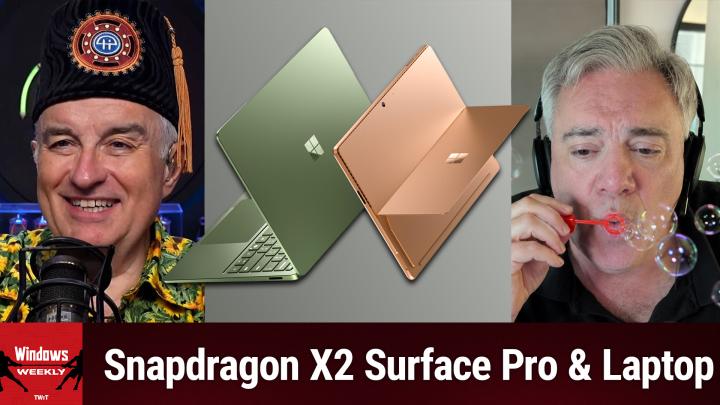
Yes. Well, there were rumors earlier this year that Microsoft wasn't going to ship new Snapdragon X2 based surface PCs until the second half of the year. They announced the intel core Ultra Series 3 models, I think a couple weeks ago, fairly recently and that kind of, you know, that maybe cemented that theory. But then they just announced them this week, so.
Leo Laporte [00:23:28]:
Well, that's the second half.
Richard Campbell [00:23:30]:
I thought they would have announced them at build, I think. But they only talked about the Ultra Build.
Paul Thurrott [00:23:33]:
Right, right. Which is the one that is not coming until. That might explain the rumor there, to be honest, to maybe someone missing. They heard ARM or something and thought that's what it meant. But so in keeping with the lineup as it stood until fairly recently, there's a 13 inch model, a 13.8 inch model and a 15 inch model or series of models. When they went to the ARM chips two years ago with the first Snapdragon X, there was just a 13.8 and a 15 inch. And then sometime last year I think it was, they introduced the 13 as a, as kind of a lower cost option. And then on the, on the Pro side they have a new 13 inch Surface Pro which was the site, you know, has been the size for a couple of generations and then a smaller 12 inch as well.
Paul Thurrott [00:24:25]:
So they have the, you know, the smaller Surface Pro and the smaller Surface laptop to kind of come in at a lower price, which these days is not a low price.
Richard Campbell [00:24:34]:
There are no low prices.
Paul Thurrott [00:24:35]:
Not a one. No. But especially with Microsoft. Right. And it's not their fault. But per se. But you know, you know, a couple things going into any kind of Surface launch, they're going to have fun new colors which you can't get because they're only going to be on certain models and they're not going to be on the one you want.
Richard Campbell [00:24:51]:
Yeah.
Paul Thurrott [00:24:51]:
This year those colors are like a jade green which you can only Get I think on the 13 point inch, 8 inch surface laptop. And then there's kind of a, I think they call it Dune, which is kind of a gold tan, kind of bronze color, which I believe is only on the 13 inch Surface Pro. But, but even less so than that, it's only on certain configurations. Like this is always the problem, you
Richard Campbell [00:25:15]:
know, and this is where I think they're missing out on an opportunity. Like the logical thing to do is make the highest end unit with the most memory and the most storage and the highest processor in hot pink.
Paul Thurrott [00:25:25]:
Yeah.
Richard Campbell [00:25:25]:
So the geek who just has to own it. Has to own it.
Paul Thurrott [00:25:29]:
Actually you're right. And honestly as someone who wanted the like 2 years ago I would have gotten that light blue color they had. It was not available in the high end configuration I got. And yeah, I would have appreciated that
Richard Campbell [00:25:40]:
honestly, because I think the only picture of the Ultra we got, it's black. Of course it's black.
Paul Thurrott [00:25:45]:
Yeah. So the problem with a black laptop, any dark colored laptop, assuming it's made of aluminum, is that it's anodized. That means you can scratch up the color and that means you're going to see the silver underneath. And I hate that so much it makes me crazy. Yeah, so I had to get a. When I bought my surface laptop7 2 years ago, I had to get it in black. That was the only color that was available in the configuration I wanted. And sure enough there's plenty of silver on the edges, you know, just from me rubbing my hands, you know, as I type or whatever.
Paul Thurrott [00:26:13]:
It just what happens, you know, it's the reality of it.
Richard Campbell [00:26:17]:
The vinyl wrap.
Paul Thurrott [00:26:19]:
Yeah, yeah, right. It's tough on the hard corners though, you know, this is not, I don't
Richard Campbell [00:26:23]:
know, it's nothing you can do about that.
Paul Thurrott [00:26:26]:
The other thing you kind of go into this knowing is that Microsoft's prices are going to be a little higher because Microsoft in the PC space is sort of a boutique company, so to speak, and does not have the volume discounts like a Lenovo or Apple and
Richard Campbell [00:26:39]:
never tried to be right. It's like they were supposed to be reference machines and they're pricey.
Paul Thurrott [00:26:44]:
Yeah. So they've always, that's always been true, you know. And the problem is with the component crisis, it gets exacerbated and exaggerated and it. And sometimes to ludicrous degrees. So for example, with the, the laptop I bought two years ago, which was a 32 gigabytes of RAM, one terabyte of storage, 15 inch configuration, I believe was $2,200. Which by the way a lot of money for that kind of a laptop at that time. I mean that's, you know, I would say from a. Well, and maybe this would.
Paul Thurrott [00:27:17]:
No, it wouldn't be. It. This would be Intel, AMD, Snapdragon, whatever that would. That's more like 15, $1600. It was expensive.
Richard Campbell [00:27:23]:
Yep.
Paul Thurrott [00:27:24]:
That configuration today is I think $1950. It's significantly more expensive. $750 more. The price difference is going to vary by configuration. The biggest jump, the most terrible jumps are. Well, there's two is when you go to 32 gigs of RAM or then 64, which is like off the charts. Or when you go from 512 to 1 terabyte or to 2 terabytes, both of which are off the charts. And this is, this is the thing I was talking about earlier.
Paul Thurrott [00:27:56]:
You know, we know Apple's doing this on the, on the Mac side and on iOS, etc. But Microsoft is doing it with Windows. This is the pain point thing. So they're addressing user concerns related to features they maybe wanted, like moving the taskbar around. Okay, that's great. But they're also designing these things or designing all the system components so they take up less resources, they give up RAM more quickly, they'll do a little CPU boost for app launch speed, but then they'll go right back down. And this is going to help those who are staying with a computer they already own, which might only have, you know, hopefully not four, but eight gigs of RAM or something. It will help PC makers that now want to sell cheaper devices.
Paul Thurrott [00:28:37]:
Because the only way to do that is not to have all that RAM and storage in there. You know, all that later.
Richard Campbell [00:28:43]:
Right. These are all hardwired.
Paul Thurrott [00:28:45]:
Yeah. So this is the right, this is the double edged sword of these integrated SOCs is that's true with Apple Silicon, it's true of Snapdragon, it's true of the Nvidia thing that's coming. It's true of some like Lunar Lake. It was true, but it's not true of the Panther Lake stuff for Intel. It is true with some of the AMD configurations as well. The RAM is integrated on the soc. So you get what you get when you buy it and you cannot upgrade that. The rest of these computers are by and large much more upgradable than they've been in years.
Paul Thurrott [00:29:15]:
Meaning you can just take off the back with normal tools. You can replace the ssd, the wireless module, the battery, you know, basically everything. I mean, but as a, as an end user you could actually upgrade certain components very easily. And I did that last year with us with a Snapdragon laptop actually, right when I did the SSD upgrade. But the RAM is integrated so this is why this work is so crucial. We'll get to that in a moment. But the, these, these things are tough because I, when I look at the prices of these computers, I, I, I, I would just never upgrade. I, there's no way.
Paul Thurrott [00:29:53]:
Plus, you know, two years is not a long, long time. I will, One of the nice things about the Snapdragon stuff is that those laptops from two years ago are fantastic. They're still great day to day use. Normal laptop productivity work. There's no Difference X to X2 doesn't matter. You could have the cheapest, lowest end, X1 gen plus whatever it's called. It actually it's called Snapdragon X. That thing's going to work great still, there's no problem there.
Paul Thurrott [00:30:20]:
But then the other little thing, you know again this is Microsoft because Microsoft, they're not Apple, you know, they're not Dell or Lenovo or hp. You know, they have trade in programs like everyone else. They do it through a third party. And one of the things I looked at was like, you know, if I got enough for my Surface laptop, I guess I would consider this upgrade. But the, the quote they're offering is like up to 900 cash back with your trade in. And I have the second highest snap or what do you call it, service laptop 7 laptop you can get. So I'm thinking okay, up to 900, maybe I'll get 700, no, $318 and some change was what I was going to get. And it's like yikes, give it to a friend.
Paul Thurrott [00:31:02]:
Yep, yep. So we'll get to that in a bit. There's a little bit more I want to say about that but Samsung maybe coincidentally or not also announced a new version of their really nice Windows laptop series. They have like Galaxy Book, whatever. So we're up to, I think this one is Galaxy Book 6. Yeah. Edge, which is a, this is crazy. It's a 16 gigabyte configuration, one terabyte of RAM storage.
Paul Thurrott [00:31:29]:
Sorry. For 2100 dollars.
Richard Campbell [00:31:31]:
Yeah. Wow.
Paul Thurrott [00:31:32]:
Like, I mean, yikes. It is a, I think it's a 50. Yeah. 15 point or no, 16, sorry 16 inch screen. But I, they're gonna have a hard time selling these. Not because there's anything wrong with the laptop. So I'm, this one, the Surface stuff, they're all, these are great computers but these Prices are too high for most people, I think.
Richard Campbell [00:31:54]:
Yeah. And you know what, it just makes a lot of sense to wait a year.
Paul Thurrott [00:31:57]:
Yeah, it stinks that you can't upgrade more of it because you could make a case for low balling on if you could, you know, RAM and storage now just to get it. And I can upgrade those one at a time. Maybe over some period of time.
Richard Campbell [00:32:10]:
You can't. No, it used to be we just buy new STDDR for it and upgrade it, but that, that time is passed.
Leo Laporte [00:32:17]:
Will a year be enough, you think? I mean, will it, will they price?
Paul Thurrott [00:32:21]:
Well, we don't. Yeah, we don't know. So when this could be a long
Leo Laporte [00:32:25]:
term problem, it's going to go through
Paul Thurrott [00:32:27]:
at least 20, 27. The thing is every once in a while you'll see, look, there are instances of sales and things. Right. I've seen decent SSDs for good prices very briefly. So you could kind of time it for one of those type of situations. Look, I review over 20 laptops a year. I can only think of one laptop in the past at least two years and possibly three where the Ram was upgradable. Even on systems where the RAM is not integrated into the SoC, it is almost always soldered onto the motherboard.
Paul Thurrott [00:33:02]:
And you just, I don't understand this. I mean I, I do understand why they did it because that's, technically that helps them create a thinner laptop. And RAM makers have come up with smaller like they're not called so dimms or whatever anymore. They're smaller modules that will help with that. They're probably similar to like a M2, whatever that is, 2240, whatever those little cards are, little half size cards but they're not common. You don't see them a lot. I don't, I've only seen it on one laptop. So we're just not there.
Paul Thurrott [00:33:36]:
And I, and I don't think we're ever going to get there on arm. I don't see that changing, I don't see it changing on the Apple side if that matters to anybody. But it's just, you know, where we're at and it's too bad because I do think we could get, A lot of us could get away with a slightly lower end configuration right now with the hope of upgrading later. It's kind of a nice thing that you can upgrade something and use it for longer and get, you know, and kind of keep that system going for a longer period of time. It's good for all kinds of reasons.
Richard Campbell [00:34:05]:
Right.
Paul Thurrott [00:34:05]:
But I don't know this is, this
Richard Campbell [00:34:09]:
is, I think it's just people are going to look at that and go, I'm going to wait. Yeah, I can keep, I can keep this machine. You know, I look at my Studio 2, which is what, two and a half years old, and just pave it, right? It'll be, it'll be happier with a pave after two and a half years. All those software changes are like fatty food. That thing needs an angioplasty. It just needs to be blown out and it'll be good to go.
Paul Thurrott [00:34:31]:
Yeah, exactly.
Leo Laporte [00:34:32]:
I feel very fortunate that I bought that Framework desktop when I did with 128 gigs of RAM, because I know
Paul Thurrott [00:34:39]:
you'd be facing a car payment if you bought that thing today.
Leo Laporte [00:34:43]:
But the thing is reason you want ram on the SoC because you want the bandwidth.
Paul Thurrott [00:34:50]:
No, I know, that's what I mean. There are real benefits to it, there's no doubt about it. But the thing, you know, when Apple moved to the M series Apple silicon chips, one of the question marks was, well they, they do have these, you know, they have these big desktops at the time, like the Power Mac. These are, they can be configured in ways that are essentially like portable or not portable, like workstation type computers. Will there be some version of them in the future where they offer dedicated graphics? You know, and their answer is no.
Leo Laporte [00:35:23]:
You don't believe in metal?
Paul Thurrott [00:35:24]:
They're like, no, this is the way we're doing this. And so that was like a, that was a minor thing. I mean, in some ways you know that. But the RAM thing is a big one because that impacts everybody, right? And so when you have something like a MacBook Neo, which is inexpensive but is only 8 gigs of RAM, the fact that you can't even get a 16 gig configuration is unfortunate to me.
Richard Campbell [00:35:46]:
That was a showstopper for certain people.
Leo Laporte [00:35:49]:
Well, it's interesting because the next gen iPhones are going to have to have 12 gigs of RAM so they can run the Apple models and RAM is going to become suddenly a big deal. The reason I feel good about the Framework is because I had the thought a year ago, maybe I should have a central server and then I don't have to spend so much on the laptops. They can be thin clients connecting to something with more horsepower. And that's in fact what I'm doing. So I'm not so worried about RAM in the laptops anymore because all the work's being done.
Paul Thurrott [00:36:19]:
This is, you know, there's, there are many ways where the big remain big and get bigger. And in the case of big tech, they maintain their market dominance or whatever. And that's one aspect of this, you know, where you have a bigger company like Apple or a bigger player like Lenovo who are right, they buy it in volume. They buy in volume, so they get those discounts. But there's also, we shouldn't discount the notion of like well run companies versus less well run companies. I mean, whatever anyone thinks of Apple, because Tim Cook with his little finger on the spreadsheet there knows exactly when memory prices change by a penny. Probably bulk ordered RAM very early on, much order than a lot of company, earlier than a lot of companies. And so they're benefiting from two things there, right.
Paul Thurrott [00:37:05]:
Which is their size and the scope of how much they sell. But also just smart leadership that really helps. And Microsoft is, I don't know anything about who's running this and how smart they are about this stuff. It doesn't matter because they just don't sell enough. They can't. There's not much they can do to solve that for themselves.
Richard Campbell [00:37:23]:
You know what this means? We need memory futures market.
Leo Laporte [00:37:27]:
I'm sure there is one.
Paul Thurrott [00:37:28]:
I'm pretty sure every gambling outfit that is what sports are today is also betting on the price of ram, you know. Yeah, I, yeah, sure. So look, all things end at some point and I don't know that prices on RAM ever come down, but hopefully they likely will.
Richard Campbell [00:37:47]:
I mean the big issue here is the back orders. Right. Like this is what Micron and all those guys are talking about is not that they're not going to jack up their production, they're going to raise it by 25% or something because they've got a huge backlog that they don't think is ever going to get filled, that people are going to disappear.
Paul Thurrott [00:38:04]:
Yep.
Richard Campbell [00:38:06]:
And once that backlog starts to subside, you know, things will be different.
Paul Thurrott [00:38:08]:
Yeah, I don't know. I wish I would love some clarity here, but two years ago Microsoft and Apple both did something that I thought was the greatest step forward and made so much sense and still does, but not when the prices are where they are, which was, you know, Microsoft has this minimum requirement in Windows 11 of 4 gigabytes of RAM, which is completely unrealistic and has been for years. And so when I write, you know, the Windows 11 field guide, whatever version I've, I mean, I don't, I'd have to figure it out. But for several years my recommendation has been like, you need 16 gigs of RAM at a minimum. That's the minimum, that's like a realistic minimum.
Richard Campbell [00:38:47]:
Yeah.
Paul Thurrott [00:38:48]:
And then Apple. Anyway, so Copilot plus PC, that's the minimum. Right. So they have this spec. It's a brand or, you know, whatever you want to call that. I guess it's a brand, but it's also a specification. And one of the specifications you have to meet to get this is 16 gigs of RAM. And I was like, beautiful.
Paul Thurrott [00:39:07]:
Apple did the same thing when they moved to 16 gigs of Ram as a minimum on MAX at that time. Now they know now they have an eight gig model again. But. And I was like, okay, this is, this is. I like to see the, the minimum make sense. You know, it's common sense. Like they, it seemed like this was a good deal. Now two years later, we have a component price crisis and we have computer makers selling or trying to sell computers with just 8 gigs of RAM that are brand new.
Paul Thurrott [00:39:37]:
Yeah. Apple's doing it with like a phone chip. We have a price point. Yep. Yeah. Just, you know, and okay. But both Apple and Microsoft, and not for the first time in their histories, are also looking at their platforms and going to release a major update to all of them that are basically just about making those things run better with fewer resources. Right, right.
Paul Thurrott [00:40:01]:
It's the simplest way to say it. So when you think about the pain point stuff that Microsoft's doing, yeah, there are features like moving the taskbar around, but really the big stuff to me is all the, you know, we're actually going over the code with the fine tooth combo. We're going to like fix inefficiencies. We're going to let this thing work better and with less ram, less storage, less processor power or whatever, you know, we have Snapdragon C chips coming on their ARM side. We have the Wild Lake. Is it Wild Wildcat, I guess, or whatever the intel chipset is. Everyone's gonna make these laptops and they're probably gonna. Some of them on the Windows side will probably even come with four gigs of ram, which makes me want to cry inside.
Paul Thurrott [00:40:38]:
But eight gigs of ram, whatever, that's
Richard Campbell [00:40:41]:
all that's gonna happen with a four gig machine is it's gonna get returned. It's still expensive.
Paul Thurrott [00:40:45]:
I can't even imagine. I.
Richard Campbell [00:40:46]:
And you're gonna be furious.
Paul Thurrott [00:40:48]:
I don't like four gigs of RAM and a vm, you know, but I mean, it's whatever. But okay. I mean, look, different people have different needs. I. There is. I I. The one thing I. The qualifier I will add to this is that when I talk about Computers, I'm talking about computers a human being will actually use every day.
Paul Thurrott [00:41:03]:
It's a primary device, right? For some people, a computer like this is like the Chromebook use case in some ways, or at least it was in the beginning. Other than like education or whatever is like a secondary device. You're doing. You're spending most of your time on a phone probably. But every once in a while you need that big screen and you full size keyboard. Get a type out something, whatever. If you're just using it occasionally, like for that kind of thing. A Chromebook, a MacBook Neo 8, 4, 8 maybe, but 8 gigabyte Windows laptop.
Richard Campbell [00:41:32]:
Yes, but you spent $3,000 or something used occasionally.
Paul Thurrott [00:41:36]:
I know, yeah, that's the problem. So with the price, I know the prices are crazy.
Richard Campbell [00:41:40]:
Buy another phone.
Paul Thurrott [00:41:42]:
But here's the thing. The silver lining to this, the little flower growing out of the shitstorm that is everything that's happening in our lives right now, is that this is the. This type of situation is what drives innovation in a way. You know, when you are forced to make do with less, life finds a way. You know the Jurassic park thing. Like we. I was just rereading, I'm gonna. I'm working on this series of articles about whatever kind of tech history thing.
Paul Thurrott [00:42:07]:
But I was reading about, you know, when the Vic 20, the Commodore Vic 20 came out in 1980 or 81, whatever year that was the norm at the time for things like the Commodore PET or the Apple II or TRS 80 or whatever is like 16 kilobytes of RAM. The IBM PC came out with a minimum of 16, but it was really, you know, more than that, depending on where we were at. And they're like, yeah, we have this cute little computer. It's 5k of RAM and it's actually not even 5k. It's really like 3.5k of RAM and it can't even do a 40 column text display. It's 22 columns at best. It doesn't even have sprites. But we can sell it for $300, which was the price of an Atari 2600.
Paul Thurrott [00:42:48]:
And developers worked with what they had and made incredible arcade quality games on this thing. And that's what you do when you have to. We have lived in a world where we essentially have infinite resources and certainly for developers at Microsoft and maybe elsewhere, act as if they do. And you, you write to this world where everyone has gigabytes of memory and gigabytes of storage and amazing processors and you don't really write tight efficient code anymore because you don't have to. No, no.
Richard Campbell [00:43:19]:
And that's been true for a long time.
Paul Thurrott [00:43:21]:
Yep.
Richard Campbell [00:43:21]:
Because we weren't.
Paul Thurrott [00:43:22]:
So this. But this exacerbates it, right? I mean the component crisis really drives this home like.
Richard Campbell [00:43:26]:
And then, and then you throw in the LLMs where you can tell the tool, go find me resource savings.
Paul Thurrott [00:43:33]:
Yes, yes, definitely. Yes. And so I, it doesn't, you know, I'm not, I'm not going to thank AI for ruining the world. But, but there is, you know, there's always that other side of the coin, however you want to say that, where, yes, there's bad, you know, to this,
Richard Campbell [00:43:51]:
but I also say the Vic 20 became the gateway drug to the 64. I know almost nobody who loved their Vic 20 didn't immediately get a 64.
Leo Laporte [00:44:00]:
There were a lot of them in closets.
Paul Thurrott [00:44:02]:
Yeah, yeah. And actually the interesting thing about that history is that the Vic 20, you know, 300 bucks was in the market for maybe two years before the Commodore 64 came out. So the expectation from a lot of people was that, well, they'll replace the Commodore 64 in two or three years. And they didn't. You know, I mean, yes, There was
Richard Campbell [00:44:21]:
a 128, eventually a 128, but it
Paul Thurrott [00:44:23]:
was a Commodore 64 with other stuff. And then that came and went to the Commodore 64 kept going. And that thing was in the market until the mid, or at least early 90s.
Richard Campbell [00:44:31]:
Well, it was the, it was the happy size, right?
Paul Thurrott [00:44:34]:
Yeah, it worked. It was a nice. Yeah, it was a good combination of capabilities. And I. So the stuff that's happening now will benefit everybody. Right. So if you have to buy a computer and you're not going to get the thing you wanted, maybe because the prices are so high, Apple, if you're on that side of the fence, or Microsoft on this side, will are doing the work to make that make more sense. Right.
Paul Thurrott [00:44:57]:
In the sense that the OS will run better, etc. But if you already have a computer, that also means you can keep that thing running for longer. Right. We're going to benefit that way. And if you do buy or have a computer with lots of RAM and lots of storage, you're still going to benefit from this stuff. I mean, it's all good. There's no downside to this.
Richard Campbell [00:45:15]:
No. I've never met anybody with 128 gigs of RAM going, damn it, too much memory.
Paul Thurrott [00:45:20]:
I wish I had more RAM. Yeah, I can only run 117 VMs. I don't know what's going on? Yeah, but I got the prices. Really, they just blow my mind. You could spend 3, $700 on a surface laptop.
Richard Campbell [00:45:34]:
Yep.
Paul Thurrott [00:45:35]:
There is no planet on which that makes any sense. None like that is. That's insane.
Richard Campbell [00:45:40]:
And the other thing, Ultra is going to be more, right? Yeah, it's going to be.
Paul Thurrott [00:45:45]:
Yeah, that's going to be the next step up for sure. One thing I found, actually, I'll say two things. Big fan of the Snapdragon stuff. I think I made that very obvious. I still laugh out loud a little bit every time I open the lid. Just comes on. Love it. Efficiency, reliability, performance, the whole thing, it's great.
Paul Thurrott [00:46:02]:
It is astonishing to me. And this happened a year ago when I bought that at the time, $600 Omnibook 5 with a base level Snapdragon X processor. This year the version of that is a IdeaPad Slim 15 inch X2 based, you know, X2 plus based laptop. Right where these are the, these have the lowest end chip you can get in this processor family. And they are wonderful. Like they're wonderful. And here's a little kick you in the gut thing if you're a big fan of Microsoft surface. That 15 inch idea pad, which is a Snapdragon X2 plus, 16 gigabytes of RAM, 512 gigabytes of storage, which the surface will cost you $1,700 you can buy right now for $850 which is one half of the price of the service.
Paul Thurrott [00:46:56]:
One half. And it is the exact same internals. Yeah, that's what you're going to do if you want that thing. And the nice thing is as a way to. And by the way, $850 is a, an excellent price to pay for a laptop. Yes, it is the lowest end Snapdragon but there's something magical about these chips where those low end things work great. It is one of my, well the, the year old X1, you know, non plus version, the, the new X2 plus IdeaPad are still among my favorite computers.
Richard Campbell [00:47:31]:
X1's two years old.
Paul Thurrott [00:47:33]:
But yeah, well the, the laptop I bought was from a year ago, but yes, but it's there like so these things have legs, they work great. You can save money by going down market. You can't do that with Surface. Like one of the problems with Surface laptop is that you can choose between an X2 plus and an X2 elite. So you're like, well I'll save some money that way. If you go down to plus, you only get that one config it's the 16 gig of RAM512, but like I said, $1700. It's if you go to the X2 Elite, you only add a hundred dollars to the cost. So like saving 100 bucks, it's like, like maybe, you know, yes, I guess I would do it, but how about saving $850? You know, get that you would get the Lenovo instead.
Richard Campbell [00:48:19]:
Yeah.
Paul Thurrott [00:48:19]:
And I guess at least it's an option. You know, at least it's an option. You know, a year ago the equivalent, like I said, was selling for $600.
Richard Campbell [00:48:29]:
Yeah.
Paul Thurrott [00:48:30]:
So even that's more expensive, but at least it's under a thousand dollars.
Richard Campbell [00:48:33]:
At least it's hard. And I noticed like, seems like the default rig for these surfaces are the X2s are 16 gigs and then you get it in jade and jade.
Paul Thurrott [00:48:45]:
Yes. Well, one of the. There are many open questions here and I. They'll be answered in time as things happen because you know, as we've been talking about, I feel like they're either going to have to change the Copilot plus PC brand or make those features available elsewhere, which, you know, we talk about this and not just up the chain for people with high end GPUs, et cetera, but because PC makers are going to have to sell eight gig configurations. Does that mean we're going to get a Surface Laptop Pro with 8 gigs of RAM, which they've not announced yet, but probably will. And if so, is that thing now not a Copilot plus PC because it doesn't officially meet that number? Or do you just use the spec up? You know, we don't know. I don't know what, I don't know
Richard Campbell [00:49:30]:
what if any of that stuff actually works right like that you don't just make an eight gig machine, you have to go through the full set of testing.
Paul Thurrott [00:49:37]:
Yeah, but if you think about like, like I don't actually know what the interaction is here. So if you think about a 16 gig copilot plus PC has this 40 tops or 80 tops MPU depending on the gen and you're running whatever local AI models to do things like super res or what do you call it, like super resolution upscaling or image creation in one of those photos or paint apps or background removal or whatever it is if you have an eight gig machine and now you've updated the API so that those things can actually run against the cpu. A GPU if you have integrated gpu, an MPU if you have that, whatever. How does that impact things like Would it still just, would it just work? Would it run a little more slowly? Would it not work at all? You know, is the RAM that important? You know, Leo mentioned the phone thing. Like we've seen this with all phones but Apple's, you know, every year now is raising the RAM and the phones because you need that. You know, it's, this is always explicitly stated. You do need it for these AI operations, at least for them to run well. You know, it was.
Paul Thurrott [00:50:43]:
Remember when the Google had come up with the first Gemini Nano on device model and I think, I guess it would have been the Pixel 9 series of phones. It was on all of them, I think. Yes. And then when the 9A came out they were like, yeah, it only has eight gigs of RAM, we can't put it on there. And everyone freaked out and complained and they, they found a way. You know, life finds a way. I guess maybe it's not as capable, maybe it runs more slowly, I don't know. But they did kind of figure it out.
Paul Thurrott [00:51:12]:
Like I, I feel like that has to be part of what's happening. Windows and Apple, like all, all the Apple platforms, it's, it's an interesting problem.
Richard Campbell [00:51:23]:
Yep, it's a fun time and it definitely has messed with my need to replace this machine. This, this Studio 2 because it's, you know, like I said, I think if I, I think I'll, I'll pave it if it really annoys me. It's getting a little weird now. So it's been two and a half years. You expect it to get weird after a while.
Paul Thurrott [00:51:42]:
Yep. Look, you know, until two seconds ago, if you had an older computer, if you, I mean I, if you. Well I was just gonna say so you know, windows 11, I just rough, roughing it a little bit here. If you have an 8th gen intel or equivalent processor newer, you can Upgrade to Windows 11 pretty much. Right. There's exceptions in both directions, but just make it simple. But if you have an older computer, 6th, 7th gen, whatever it is, the answer to date has been, you know, put Linux on there. You know, you could work around that.
Paul Thurrott [00:52:17]:
Right. I document ways to do that all over the place. I think someone who's technical enough to run Linux could handle that. But then again if you just made Windows more efficient, you know, I don't see them lowering the requirements or anything.
Richard Campbell [00:52:32]:
I don't.
Paul Thurrott [00:52:33]:
We're not going to come wake up tomorrow and Microsoft. Yep. We're doing 7th gen and 6th gen now. You know that's not going to happen. But no, anything that could kind of keep these things going longer is good. It's good for everybody, you know, like I said, I mean.
Richard Campbell [00:52:47]:
Well, and, and spending a little time on efficiency is not a bad thing either.
Paul Thurrott [00:52:51]:
Right.
Richard Campbell [00:52:51]:
There's almost no downside to that.
Paul Thurrott [00:52:54]:
Yep. Yeah. I mean everyone, you know, Apple is, Apple does this. You know, they did WWDC last week. If you were looking for splashy excitement, whatever, it might have been a little boring, you know, but in the sense that Apple fans can rationalize anything, the general consensus here is, oh, this is like what they did with Snow Leopard. They had this, you know, remember, zero new features. They were celebrated for this. You know, they took a year off from adding new features and just to fix all the problems they created and then we celebrate them for that.
Paul Thurrott [00:53:24]:
You know, Microsoft does the same thing, guys, that's what Windows 7 was. I mean we've done this multiple times. We've all done it.
Richard Campbell [00:53:34]:
Popular version of Windows.
Paul Thurrott [00:53:35]:
Yep. It was inarguably the most popular version of Windows ever. And all it was was Windows Vista with, you know, service back to performance efficiencies. Yes, it was a service pack. I mean, and the people who made Windows 7 hate hearing that. They don't want to hear that. They would argue it, but they just were wrong. But that's all, that's all it is.
Paul Thurrott [00:53:55]:
Yeah, they're just, that's their position. So, yeah, we'll see. I, I don't know. I'm, I'm really, I'm curious. This whole year is going to be fascinating. I'm just curious to see what happens next. I feel like any given day I could, we could wake up and there will be news along these lines. There'll be some clarity someday on then, you know, whatever the 26H1 upgrade is, whatever the future of Copilot Plus PC is, whatever that Nvidia thing is and there will be lower end versions, et cetera, what the prices are, you know, we're going to learn all this stuff eventually.
Richard Campbell [00:54:30]:
Yeah,
Paul Thurrott [00:54:32]:
but you know, I think I said this last week. I mean, I, you try to understand like why is Microsoft finally listening to feedback when they've been ignoring us for so long? And one of those things is, you know, well, you know, corporate customers obviously is a pretty obvious way to go. But I'm, you know, they, they could see this component crisis unfolding too and they have this big bloated thing that's not very efficient and God, we could take a few months and actually fix this. Like we should fix this now.
Richard Campbell [00:55:01]:
That would be the Positive thing. But the other side of this is like I said, all these producers are back ordered for data centers that may or may not be built. And if the bubble burst heavily and a whole lot of those data centers went away and the back orders just evaporated, these producers should still be left holding bags on a whole bunch of very high end chips. The only things that are being ordered like we could easily see pricing tank.
Paul Thurrott [00:55:23]:
Yep. Right. Like there'll be a memory glut. Yeah, that'll be the exact a GPU glut.
Richard Campbell [00:55:30]:
And all of a sudden you're going to be sitting there with your $5,000 laptop saying you bought that for what?
Paul Thurrott [00:55:35]:
Right.
Richard Campbell [00:55:35]:
Well.
Paul Thurrott [00:55:36]:
Or you'll be sitting there with your $1,000 laptop wondering why you can't upgrade the RAM. Which is a shame, I guess. But look, I wish the way Microsoft or maybe the PC world could market things like Apple does. But like one thing I think would be a good message that could come out of Microsoft which is something Apple would have said at any given time with any update of anything which is like Windows 11, whatever it is, 26H2 because this is the one with all the efficiency stuff built into it is like getting a new Windows in your PC. You know, like is the way Apple would say it or whatever. Like we, you don't have to buy a new computer. You're going to feel like you have a new computer because it's going to run so much faster and the base
Richard Campbell [00:56:18]:
configuration is going to be 32 or 64 gigs because Ram is so cheap.
Paul Thurrott [00:56:22]:
Well, that'll be the next one. Then you'll. That, that will be why you would upgrade I guess.
Richard Campbell [00:56:26]:
But what you didn't get 256 gig of RAM in your laptop. What's wrong with you?
Paul Thurrott [00:56:31]:
Oh boy, we can only dream.
Richard Campbell [00:56:36]:
Yeah, one more.
Paul Thurrott [00:56:39]:
So I just want just real quick because at some point this year we're finally going to get these Google Book things. I think I mentioned this a week or two ago, Google, when they announced Google Book and then at IO at least in the keynote, never said the thing I was looking for which was what is this thing really? But then if you watch some of the sessions like I did it for IO and build, then a week later they actually just say this outright. They're like this is the next rendition that. This is Chrome, it's Chrome os. It's just like we're changing the underlying platform. It's going to be Android based completely now, but it is literally going to replace Chrome OS and we're calling them Google Books, whatever. But this is a replacement. Right.
Paul Thurrott [00:57:22]:
And okay. And we're going to get these Android based laptops is how I would describe that I guess. And this is similar in a way to what Apple did with iPados last year. But it's more than that. Right. Because Google has had Chromebooks for many years and they've been successful for certain audiences. They've. It's done well in certain places but of course they also sell billions of Android devices every year.
Paul Thurrott [00:57:47]:
So this is going, this is bringing Android into a new place. This is bringing Android into my place, you know meaning like where Windows is and where Apple has a Mac. So it becomes a little more important. So yesterday they released Android 17 and it's going out first on supported pixels. There's one feature in here that I think is kind of interesting. One of the worst things I ever enabled on my Android phones, this would have been on a pixel. And actually I just saw this this past month or two. It's called bubbles.
Paul Thurrott [00:58:22]:
And the way bubbles have worked in Android or at least on Pixel to date has been you could use it in the messaging app. So what this means is say my daughter because this is what. How it happened for me. My daughter texts me and you get a notification that comes down. You get like a little badge I guess on the icon right on the home screen. But you also get a little bubble. It's a circle on the screen. Over.
Paul Thurrott [00:58:48]:
It's over everything that's with my daughter's face on it because she texted me and I think I enabled it to see what it was like.
Leo Laporte [00:58:55]:
You can turn off chat bubbles. You don't have to have that.
Paul Thurrott [00:58:58]:
I hate it so much.
Richard Campbell [00:59:00]:
Yeah.
Paul Thurrott [00:59:02]:
And you can hear my function kind of get rid of it. So what would happen is my daughter's face would pop up. You think this would be give me great joy. Didn't annoyed the hell out of me. And I would swipe her away and swipe her away and swipe away until I finally figured out how to go and turn it off. And so in Android 17 they're adding this capability for all apps and so you can turn any app into a bubble which is actually a way to mobile small screen. Yeah. It's both parity free the bubbles.
Leo Laporte [00:59:32]:
Free the bubbles. Yeah.
Paul Thurrott [00:59:33]:
So it's not a little circle, it's a little floating window. I mean I think it minimizes down to a circle or something but it's like you can have a little floating window above whatever you doing. So it's kind of a Like a way to do two things at once or whatever. But if you have a bigger screen device, which today is basically just a, like a folding device, there's actually a bubble like toolbar or floating little toolbar thing where all the apps that are bubbleable can appear in this little thing on screen. And I wonder if this isn't going to be a tablet slash Google Book, you know, laptop, whatever UI of sorts where it's just like a. It's kind of like a new way to. I don't know how new it is, but a different way to multitask, which I think is interesting. I'm kind of curious now to see
Leo Laporte [01:00:23]:
this, but it's nice to see people trying stuff. Right? You can always turn it off.
Paul Thurrott [01:00:27]:
Yeah, I guess it's sort of like the stage manager thing that Apple did, you know, where it's like some people are like, oh, this is exactly what I want. And most people like, oh, what is this thing? No, stop. But you know, so some people just latch right onto it. And then some people are like, oh, like, you know, so we'll see. I don't know how successful this will be, but interesting. Windows users would not, would not approve of.
Leo Laporte [01:00:52]:
It's kind of the one thing you don't really want in your operating system is interesting.
Paul Thurrott [01:00:58]:
Yeah. I've spent a lifetime removing notifications and other annoyances and you have found another way to float something above what I'm doing. Like, this is not what I want you doing. That's for me.
Richard Campbell [01:01:09]:
There's always another pop up.
Paul Thurrott [01:01:12]:
But some people are like, nice.
Leo Laporte [01:01:14]:
Well, that's the thing. I mean, you don't know until you put it out there whether a UI improvements the problem.
Paul Thurrott [01:01:20]:
There's always going to be someone who likes these things. Right. The question is, is it going to be a mass market?
Richard Campbell [01:01:24]:
The person who made it maybe their mother. But that's.
Paul Thurrott [01:01:28]:
I'm so proud of you. Oh, do you use it? No, no.
Leo Laporte [01:01:30]:
It's terrible.
Richard Campbell [01:01:31]:
I know.
Leo Laporte [01:01:32]:
My boy invented liquid glass. I'm so proud of him.
Paul Thurrott [01:01:36]:
I hung it on the refrigerator.
Richard Campbell [01:01:38]:
I send him a message about it every day from my BlackBerry.
Leo Laporte [01:01:41]:
I just. Mr. Allen Dye is such a good boy. Ladies and gentlemen, you have tuned into the fabulous Windows weekly program with Mr. Paul Thrott, Mr. Richard Campbell. I just say that in case people stumble upon us and don't know.
Paul Thurrott [01:01:58]:
Sure.
Leo Laporte [01:01:58]:
What's going on?
Paul Thurrott [01:01:59]:
Well, if you're like me, you suffer from short term memory loss. So you have no idea who I am.
Leo Laporte [01:02:03]:
Who am I? What am I doing here?
Paul Thurrott [01:02:05]:
Who Is this man on the screen? Why is he in a bubble?
Leo Laporte [01:02:08]:
I feel it coming, you know, it's like Game of Thrones. Winter is coming.
Paul Thurrott [01:02:13]:
Yes.
Leo Laporte [01:02:15]:
I just feel it coming. The other day, Lisa and I are sitting there and I'm going, you know that thing I take every day? I put it in my water. What is it? It's called. What is it? It's for the muscles. It helps your memory.
Paul Thurrott [01:02:27]:
The thing that helps my memory, I can't remember it. That's amazing.
Leo Laporte [01:02:31]:
And then, you know, and then five minutes later, we're in the middle of a meal, I go, creatine.
Paul Thurrott [01:02:37]:
Lisa's like, I've been asleep for two hours. What are you doing?
Leo Laporte [01:02:40]:
So sad.
Richard Campbell [01:02:42]:
I don't know if you've got memory loss or Tourette's. It's a sort of a split.
Leo Laporte [01:02:45]:
Creatine.
Paul Thurrott [01:02:47]:
It's a good combination.
Leo Laporte [01:02:48]:
It helps your memory.
Paul Thurrott [01:02:50]:
I hurt myself getting out of bed. I heard my ankle going down the stairs here. Like, I banged. Not the normal way, like twisting it. I just banged it on, like a stair.
Richard Campbell [01:02:58]:
Yeah, yeah.
Paul Thurrott [01:02:59]:
And now it hurts right now. Yeah, I. I hurt. If I think too hard about a part of my body, it will start hurting.
Leo Laporte [01:03:06]:
Not to mock him, but Jeff Jarvis injured himself seriously making the bed.
Richard Campbell [01:03:11]:
I know.
Paul Thurrott [01:03:12]:
So I saw this, by the way, 10 years ago, I would have made fun of that. When I saw him, I saw him post about that, I was like, I get it. I was like, I. I'm like, I'm not serious. Yeah, I'm not gonna make fun of this. I'm like, this is. I could picture doing this.
Leo Laporte [01:03:27]:
Well, that's why I don't make the bed anymore. It's a good excuse.
Paul Thurrott [01:03:32]:
That's right. That's right.
Leo Laporte [01:03:35]:
Many, many household accidents begin with bed.
Paul Thurrott [01:03:38]:
Why do you ever make the bed? You're like, jeff Jarvis, honey.
Leo Laporte [01:03:40]:
Dangerous. It's dangerous. All right, let's talk about software. That's next on the agenda, Mr. T. Yeah.
Paul Thurrott [01:03:49]:
So just a couple things. App release. I don't really. I normally don't have a place in the notes for this, per se. Sometimes it'll be like, there's always an app pick, but sometimes there's like two or three things that happen. So it's like, I don't know how to handle this exactly. But sometime a couple of months ago, Google announced that they were moving to a two week release cycle for Chrome because everyone loves installing browser updates.
Richard Campbell [01:04:13]:
I mean, most part, you don't notice them. They just happen, right?
Paul Thurrott [01:04:16]:
Yeah, well, yeah. I mean, sometimes you get the little Prompt thing where it's like, hey, you should reboot and get the latest version. I guess if you just reboot, if
Richard Campbell [01:04:23]:
you leave it too long, that dot goes from green to yellow to red to flame. Exactly. Yeah.
Paul Thurrott [01:04:29]:
But I, when they did that, I speculated like, Microsoft's going to have to do this Fridge. It's based on Chromium, you know, it makes sense that it would follow the same release schedule. And it will. So they said starting in late August with version 152, they're going to move to schedule for Edge as well. So. Okay, that's fine.
Richard Campbell [01:04:48]:
Didn't you build a Chromium, deploy a new version of Edge?
Paul Thurrott [01:04:51]:
Yeah, I mean, it's just the way to do it. Right. So there's nothing. I mean, it makes sense. Mozilla, which is on their own schedule, I think, I think they might be sold on a six week schedule somehow. But if not, it's four weeks. But I bet it's six.
Leo Laporte [01:05:03]:
They're obviously like, it's more often than that even.
Paul Thurrott [01:05:05]:
Yeah, that's why I said that. I feel like it might actually. Maybe there is four now.
Leo Laporte [01:05:08]:
But some of this might be because of Mythos. Like they're. They keep finding bugs.
Paul Thurrott [01:05:13]:
Yeah. I mean, this isn't why you do it like every two weeks. But if you think about it, if you want to spread out those bug fixes, you know, rather than dump like 127 fixes in a single release, the more you do it, the better.
Leo Laporte [01:05:25]:
I think nowadays you want to do it as quickly as possible. Some of these, so many.
Paul Thurrott [01:05:29]:
Yeah, no 100%. And this is why, you know, when I was talking about Windows up front, it's like, I really, I feel very strongly security updates should be separate from feature updates every month. And that, yes, you can make a compelling case for why someone would have to install a security update right away. The feature one is like, like, like, I don't know, it's just a feature like this could wait, you know, so browser.
Richard Campbell [01:05:55]:
Honestly.
Paul Thurrott [01:05:57]:
But yeah, so browsers have been, you know, browsers are all, you know, what do they say? Edges, like version 152. And actually coincidentally, Firefox just released Firefox. Or Mozilla just released Firefox. Firefox 152. So weird. Yeah. And, and look, it's new settings interface, which looks great by the way. You can get on a wait list now for that Smart window feature, which I just got into, by the way.
Paul Thurrott [01:06:20]:
It's pretty cool. But they've been talking about a lot of the work they're doing. They're doing the. The pain points thing in a way. I mean that I think a lot of Firefox users either left because they couldn't take it anymore or have just been frustrated with Mozilla not doing what it is they want in this thing. And so they, they. They've been working very hard on this stuff. And I really.
Paul Thurrott [01:06:40]:
I do like the way they're doing things. They're very transparent, et cetera, et cetera. So Firefox 152 is the latest in a string of releases where it's adding these things they've been talking about. But now they also have a public roadmap you can go look at to look at what they're planning for the rest of the year and beyond. Right. And there's some major things like that Nova user interface refresh, the smart window thing I mentioned, and then some other stuff that they haven't really talked about, per se. So they have like a free VPN that's on the desktop version that's coming to mobile. There's containers for multiple accounts, there's power saving mode for reducing the resource issues, and tabs, which other browsers do, obviously.
Paul Thurrott [01:07:21]:
Lots of stuff. So if you care about Firefox, there is this new release and they do have a roadmap for. So you can see, but not to see, but also provide feedback on what it is they're planning for future releases as well. So I think this is in keeping with the whole open source, you know, we care about the community thing. So that seems good to me.
Leo Laporte [01:07:43]:
Yeah, I use Zen, So I'm at 151. I'm behind by one, but I guess I'll be getting.
Paul Thurrott [01:07:48]:
So Zen. Wait, Zen is Zen?
Leo Laporte [01:07:50]:
That's a Firefox spin.
Paul Thurrott [01:07:51]:
This is the Arc. Like Firefox, right?
Leo Laporte [01:07:53]:
Yeah, it's basically Arc, Right? Right. Yeah, I really. The more I use it, the more I like it.
Paul Thurrott [01:07:57]:
Yeah, so I've been using. I talked about this last week.
Leo Laporte [01:08:01]:
Tell me about another brat.
Paul Thurrott [01:08:02]:
No, well, it's the one I told you about last week. So Brave.
Leo Laporte [01:08:05]:
It's the one I ignored.
Paul Thurrott [01:08:07]:
Yeah. Brave Origin. Yeah. Which I always want to call Brave Origins for some reason. Like it's a. A new Spider man movie or something starring Mel Gibson. Yeah, it. It.
Paul Thurrott [01:08:17]:
It's brave with all the brave stuff in it. You know, the brave UI stuff, which I like, I still haven't got. I don't think it's happened on iOS yet. I'm kind of curious about it on mobile. The one Thing I do. I talked about this Helium browser, which I love. But the one thing that Helium. Well, two things that Helium doesn't have is any form of sync.
Paul Thurrott [01:08:40]:
And I mean, there's not even a way to export settings and import them. There's nothing. And that has to happen eventually. But there's also no mobile client. And mobile clients are tough because, you know, Apple especially, but Google too, restrict what you can do there. And I'm kind of hoping that changes. But Brave, excuse me, has both. And so it.
Paul Thurrott [01:09:04]:
I don't know, I kind of go back and forth, but I've been using the Brave Origins thing has been good, I would say.
Leo Laporte [01:09:09]:
So I'm a fan because I liked arc. I'm a fan of the.
Paul Thurrott [01:09:13]:
Yeah, you like the tab thing on the side.
Leo Laporte [01:09:15]:
The vertical tabs. And then they also have these groupings that are. So they have essentials, which is this.
Paul Thurrott [01:09:21]:
What is this? It's like a sidebar.
Leo Laporte [01:09:23]:
Yeah, sidebar. The essentials are. I think you get 16 or three by four. So 12. That never go away.
Paul Thurrott [01:09:32]:
Right. These are like pins, basically.
Leo Laporte [01:09:33]:
Yeah, they're. Well, but then these are pinned. So you even have more. That's right.
Paul Thurrott [01:09:37]:
But you can organize those in some order.
Leo Laporte [01:09:39]:
Right. I have coding, news, social shopping, AI. AI.
Paul Thurrott [01:09:43]:
So I think you have a different sidebar for each thing if you want to project your sidebars, etc.
Leo Laporte [01:09:47]:
Yeah, when I'm doing my news gathering, I can go right there and then. Yeah, I mean, I just. And it has little icons down here, but I never remember what anything is. So I just. I really like that organization. And then it slides out of the way when I'm on a page.
Paul Thurrott [01:10:03]:
That's the thing. The thing I really like about it the most, honestly, is when it's not there, you know, which is a goofy thing to say. Like, it's there when you need it, but when it's most. The typical browser UI takes up some space at the top. You get tabs, address bar, et cetera, or on the side, however you do it. But I like it not being there. I like having the whole screen for the.
Leo Laporte [01:10:22]:
Well, in fact, for the shows, I need a browser that has the least amount of Chrome.
Paul Thurrott [01:10:28]:
Yeah, you want to run it full screen, basically.
Leo Laporte [01:10:30]:
Yeah, I don't want any additional stuff taking up space. Of course, Zen does that as well. So that's why I like it.
Paul Thurrott [01:10:39]:
So this, I just want to be. See, this is the. Like the. Essentially ARC for Firefox. This is the fight. It's Firefox.
Leo Laporte [01:10:44]:
It's a Firefox spin.
Paul Thurrott [01:10:46]:
Yeah, yeah, yeah.
Leo Laporte [01:10:48]:
So it's very Firefoxy. In fact, like I said, it's, it's that Firefox.
Paul Thurrott [01:10:52]:
So it does benefit from what Mozilla puts in the Firebox. Yeah, essentially. Yeah.
Leo Laporte [01:10:57]:
It's really, I think, just a UI on top of Firefox.
Paul Thurrott [01:10:59]:
Yeah. Okay, that's.
Leo Laporte [01:11:02]:
And it, you know, it's a little. You know, the nice thing about Chromium browsers, they seem like they're much faster, frankly.
Paul Thurrott [01:11:07]:
If I said to you that like, imagine you wake up tomorrow and Mozilla has purchased or acquired or whatever these people, and this is going to become Firefox, is it? Or is that okay?
Leo Laporte [01:11:18]:
No, I'd be very happy. Yeah, I like Mozilla. I would use Firefox plane. But I want these additional UI features.
Paul Thurrott [01:11:24]:
Yeah, that's why. Yes. Yeah. Okay. Yeah, I, I think that would be good. I think, I think they should. Yeah.
Leo Laporte [01:11:29]:
This is the thing. It's an open source project, so people can take it. I mean, so is Chromium, but the problem is it's sort of quasi open source because of Google's involvement. So when Google says no more manifest v2 and you block Chromium like chromium again, everybody has to do it.
Paul Thurrott [01:11:45]:
I feel like 100% of the companies or organizations that use Chromium, the first thing on their bullet point is get rid of all the Google stuff. You know, even though it, I mean it's stripped down. But like. Yeah, you know, but you can, I mean you can. I think they kind of try to hide it.
Leo Laporte [01:12:01]:
There's an ungoogled chromium, but that's very different than Chromium. Chromium has.
Paul Thurrott [01:12:06]:
Doesn't make any sense. It should be completely de Google fied.
Leo Laporte [01:12:08]:
No, but it's not. Because guess who runs the Chromium team. Guess who the engineers are.
Paul Thurrott [01:12:13]:
They all have google.com email addresses. I know that. You know.
Leo Laporte [01:12:16]:
Yeah, they all work for Google. So yeah, there's an ungoogled Chromium. But again, I want the sync. And this has sync. It uses Firefox sync.
Paul Thurrott [01:12:27]:
That's right. So Firefox is your own sync thing. That's great. The one thing I like about Brave. One of the things I really like about Brave, which is a little off putting at first for people who just don't understand it, is that they have sync, but it's not account based. Brave does not have your account information. You're doing peer to peer sync.
Leo Laporte [01:12:42]:
So yeah, it has a long string of things.
Paul Thurrott [01:12:45]:
I know it's crazy. It's a 25 word thing. I E. Milit myself all the time.
Leo Laporte [01:12:49]:
Right.
Paul Thurrott [01:12:49]:
It's like when I have a new browser, but it's. It's not controlled by any works. Well, it's not. It's never going to be attacked. You know, can't. No one can get it.
Leo Laporte [01:12:58]:
I really like it.
Paul Thurrott [01:12:59]:
Yeah, I like that. Yeah.
Leo Laporte [01:13:00]:
No, I think that they've got that down. I think that's quite good. There's a lot of things to like about Brave and.
Paul Thurrott [01:13:05]:
But, you know, I like things not to like too. I mean.
Leo Laporte [01:13:08]:
Well, I just basically want to support a. Something besides Chromium.
Paul Thurrott [01:13:12]:
Right.
Leo Laporte [01:13:12]:
You know, Brave, space and Chromium. I want to. I think there should be other browser standards. So let's talk about the big AI segment on today's show.
Paul Thurrott [01:13:23]:
I am delighted to announce. I mean, I mean it like delighted. I went over the note. I went over the last weeks of news twice because I was like, this can't be right. There is no major AI news that impacts our audience Anyway, Paul, the biggest
Leo Laporte [01:13:38]:
AI story is maybe the biggest tech story of all. All time.
Paul Thurrott [01:13:43]:
Right. Which does not impact Windows users.
Leo Laporte [01:13:45]:
It doesn't impact Windows users at all. Which tells you something.
Paul Thurrott [01:13:47]:
And plus, I hate Elon Musk, so I don't. I just don't care.
Leo Laporte [01:13:49]:
No, that's not the cursor story. I'm talking about Fable. I'm talking about the White House Fable.
Richard Campbell [01:13:53]:
Mythos shut down.
Paul Thurrott [01:13:54]:
Oh, I thought you were actually talking about the SpaceX IPO. Okay.
Leo Laporte [01:13:57]:
SpaceX IPO. Yeah. Last week was a crazy week. But the acquisition of. I mean, the blocking of Fable by the White House is a huge. In my opinion, if you think AI is important. Important and the most powerful AI model out there.
Paul Thurrott [01:14:11]:
And there's no being like Mythos. Light is something scary.
Richard Campbell [01:14:17]:
I think Mythos is a bigger deal than Fable. Fable's public facing. Mythos was fixing software.
Leo Laporte [01:14:22]:
No, but. But let's be clear. It's the same model.
Richard Campbell [01:14:25]:
Yeah.
Leo Laporte [01:14:25]:
The only difference is Fable has more blocks, more safety blocks, classifiers.
Richard Campbell [01:14:32]:
But I'm saying shutting down Mythos when all of these companies are trying to fix their software, it's a huge.
Paul Thurrott [01:14:40]:
So. Okay, that's fair. All right.
Leo Laporte [01:14:44]:
But don't worry because we're going to be covering it in just a little bit on intelligent machines. In fact, there is a website called freefable.org.
Richard Campbell [01:14:54]:
nice.
Leo Laporte [01:14:55]:
It makes a very strong case for why it is wrong for a government to block it. And the guy who wrote it is Alex Stamos. Who we know very well. Alex is a very well known security guy. He'll be our guest at 2pm to explain why this is an issue. Mike Masnik on Tech Dirt today I think gave us the smoking gun that it's actually political and it's, I mean,
Paul Thurrott [01:15:23]:
you know, by the way, that's, I
Leo Laporte [01:15:24]:
mean what a shock.
Paul Thurrott [01:15:25]:
This is why I didn't write about it.
Leo Laporte [01:15:27]:
It's actually worse than political. It's peak on the part of the President. Based on. It's a long story. We'll tell it at 2pm so look,
Paul Thurrott [01:15:38]:
if you're looking for like a shining star of light in the darkness that is our world right now, the thing to remember when it comes to politics is that like everything terrible this guy's done has been reversed by some court or some, you know, whatever. Like, I mean pretty much like it's 90 something percent, 97%. It's a high number. And you know, the terribleness is always going to be temporary.
Leo Laporte [01:15:59]:
I don't think this is illegal. I think the Commerce department does have the right to say foreign policy.
Richard Campbell [01:16:05]:
But also I figured on Monday Anthropic would have filed a case if they were going to do anything about it.
Leo Laporte [01:16:10]:
Exactly. And they did look like they have. They're trying to negotiate out of it.
Paul Thurrott [01:16:13]:
You know, Anthropic might consider moving to the eu, just throwing it out there.
Leo Laporte [01:16:17]:
Well, this is what's going to happen is that this is now a clarion called to China, the EU and everybody else. You better come up with some AI models that the US Cannot shut down because you're always going to be at risk of that.
Paul Thurrott [01:16:31]:
Yeah, There was news that China probably did gain access to Mythos at some point, almost, if briefly, I don't know.
Leo Laporte [01:16:38]:
But access to using it, I don't think access to stealing it.
Paul Thurrott [01:16:41]:
Sorry.
Leo Laporte [01:16:42]:
Yeah. Having used Fable for two days, Anything
Paul Thurrott [01:16:51]:
out there, this was personally big news for you. That's true. You were. That's true.
Leo Laporte [01:16:55]:
I was rewriting our Twitch sales system. I was in the middle of it and it said this model no longer available. What? Did I not pay my bill?
Paul Thurrott [01:17:06]:
Look, the feel good AI story of this, well, I guess there are a couple. But the big one to me was just starting with Firefox. Using this to fix problems at a time when hackers are increasingly able to use AI to cause problems is so smart and so necessary and so great, you know?
Leo Laporte [01:17:26]:
Well, and I don't think it's a coincidence that Microsoft had its largest patch Tuesday in history last week.
Paul Thurrott [01:17:32]:
It's not Coincidence. It's not at all coincidence.
Leo Laporte [01:17:34]:
So these are all very, very good things.
Richard Campbell [01:17:37]:
And now they've impaired it.
Leo Laporte [01:17:38]:
That have been completely shut down.
Paul Thurrott [01:17:40]:
It's weird because I can defend almost anything else our government does.
Leo Laporte [01:17:45]:
Well, that's why it's lost. You don't see any news coverage of it. It's too technical. And it's completely lost.
Paul Thurrott [01:17:51]:
We've been beaten over the head.
Leo Laporte [01:17:53]:
People are more worried about the color of the reflecting pond than they are about what I think is hugely consequential from a technology point of view. But it's a technology story, and I don't think they really. Most people go, so what? I still got chatgpt. What's some big deal? So anyway, I don't want to ruin your perfect record. There will be no AI talked on this show.
Paul Thurrott [01:18:16]:
No, it's fine. I just didn't see an angle from.
Leo Laporte [01:18:20]:
No, there isn't an angle. And we're going to come.
Paul Thurrott [01:18:23]:
You're right, you're right, you're right.
Leo Laporte [01:18:24]:
We have an AI show.
Paul Thurrott [01:18:25]:
You are correct.
Leo Laporte [01:18:26]:
This is Windows Weekly, ladies and gentlemen. Do not mistake it. Mr. Paul Thurot, Mr. Richard Campbell. And now the thing really you care the most about.
Paul Thurrott [01:18:34]:
Oh, we're jumping the whiskey.
Leo Laporte [01:18:36]:
No, Xbox, dude. Xbox.
Paul Thurrott [01:18:39]:
Yes, yes.
Leo Laporte [01:18:40]:
The other drug. There's no.
Richard Campbell [01:18:41]:
There's no theme song for whiskey. There's theme song for Xbox, though.
Leo Laporte [01:18:45]:
Play the Xbox theme.
Paul Thurrott [01:18:46]:
Okay, but you have a standalone thing now. I mean, I don't know if we're competing. I feel like you're doing pretty good.
Leo Laporte [01:18:55]:
Ladies, boys and girls, Master Chief, it's time for the Xbox segment.
Paul Thurrott [01:19:03]:
Yeah, there's a lot of Xbox news. A lot of Xbox news.
Leo Laporte [01:19:06]:
A lot of it.
Richard Campbell [01:19:07]:
Boy.
Paul Thurrott [01:19:10]:
Yeah. So look, we've been talking about this to some degree, but worse, I don't know. The last I'm going to, let's say. I would say ever since the pandemic ended. The pandemic never really ended. It kind of just drifted off there. At least our attention spended. But the video game market has been tanking, Right? We all know this.
Paul Thurrott [01:19:31]:
There's been studio closures, layoffs, all kinds of stuff. Big prop all around. I mean, and Xbox as the. I don't know, I hate to say it this way, but in some ways, the smallest player and the smallest part of the video game market has suffered incommensurately and to some degree. I mean, it's the way it is. You know, they had a. The Phil Spencer and that Sarah Bond and that leadership group that were doing what they could do within the confines of the company that owns this business and, you know, trying to make sense of it, etc. I, I don't want to discount the good that Phil Spencer did because he made Xbox make sense to Microsoft during the cloud era, convincing Satch and Adela that this could, this would work, you know, and this is game Pass, right? We've had the studio acquisitions turning Xbox from kind of a console first business into more of a game studio publisher business where, you know, Mojang first, small Minecraft but influential, and then Bethesda with all that stuff.
Paul Thurrott [01:20:37]:
You know, they own ID and whatever else. They own everything. There's a bunch of stuff in there. And then of course Activision Blizzard and today, and I think it was Asher Scheimer who said this, Xbox, as we now call it, all capital letters, is the second biggest game publisher on earth. Right. By nature, to be that thing, you have to be cross platform. It's just the way it is. But we also know that we're having a flurry of Richard Campbell promo images through the description.
Paul Thurrott [01:21:09]:
Joe's just gone on incredibly distracting because they are spectacular.
Richard Campbell [01:21:13]:
He's going insane.
Paul Thurrott [01:21:15]:
See, destroy my distractedness. These are fantastic. Sorry, I'm derailing myself. So that's what I do.
Leo Laporte [01:21:26]:
Well, you have a theme song. He's got billboards. That's fair. So by the way, I love the one. He's got Clippy on his T shirt sitting out in the loch.
Paul Thurrott [01:21:36]:
I feel like we need to get him that T shirt. So anyway, look, the comparison I've made at some point, I don't remember where I made this now, but because it was like two days ago and I can't remember that far back, but we have talked about how when Satya Nadella came in and became the CEO of Microsoft, kind of sort of the dynamic there, and Steve Ballmer has talked about this more recently, is that he basically continued what Microsoft was already doing under Steve Ballmer. The whole cloud first thing started with Ballmer, but because Ballmer was a known quantity, had been down on certain things for so long, or promoted certain things for so long, the message was never going to fly if it came from him, you know.
Richard Campbell [01:22:23]:
Yeah, there was just an acknowledgment of that was the reality. Right. He was going to be an impediment to Microsoft becoming cloud centric.
Paul Thurrott [01:22:30]:
Right. And many, many leaders of companies would have had too big of an ego to have done what he did, you know, and to step down and let it happen, you know. And so Microsoft's, you know, market cap for you guys, I guess, you know, market cap and net worth essentially has skyrocketed in the satya. Nadella, by doing what Steve Ballmer was doing. Right. It's kind of an interesting thing. I feel like there's something to this with this leadership change at Xbox, right. That logically speaking you could say, look, this is the world the way it is.
Paul Thurrott [01:23:03]:
This is what we have, this is how it's going, this is what we were going to do. What would you change? And the answer is nothing. You're doing what you can do. And I've said this many times. I, I feel like these guys, this new team, there's not much you can do. Big, you know, big change. You're not going to do some major left turn thing and save the business. You're going to continue down the same path.
Paul Thurrott [01:23:25]:
And the problem is that may not work. Right. There may be no saving this for all kinds of reasons. Microsoft is a big company for this to make sense. You know, there are parts of Xbox or all of Xbox that might make sense as a standalone entity or as smaller companies where, you know, a game doesn't sell particularly well, but that's fine for a smaller company. It might not be fine over here at Microsoft or however you want to phrase this, you know, and I feel like what we've seen is a very public rationalization on her part and her leadership team's part of Asher Sharma, that is of them trying to understand this process. Right. I, I like how public they've been about what they're doing and what they're thinking even.
Paul Thurrott [01:24:04]:
Right. This is, Phil Spencer was good at this too, but like just kind of, you know, and, and they've made a couple of, I don't know, Xbox fan centric decisions, you know, to cheer people. Like we're, you know, we're gonna be, we're gonna do another console, which they're already doing or you know, making people happy with that kind of stuff. But the reality is this business is still what it is and it's gonna, it has the same fundamental problems like a woman in this case or a new person running the show doesn't change any of this. Like she still has to, you know, it's still what it is. And so Microsoft's fiscal year ends on June 30th. So it's less than two weeks away. About two weeks away.
Paul Thurrott [01:24:39]:
Microsoft's next fiscal year starts on July 1st. And this is the time when we historically make big changes, including things like layoffs and so forth. So it's hard to know like separate kind of fact from rumor at this point. A lot of stuff is going on, but she's talked about things like having a big reset over the next, you know, whatever it is she had the first hundred days. I think that was her evaluating the business. The next 100 days are going to be about this reset.
Leo Laporte [01:25:12]:
Was she brought in to be the hatchet person?
Paul Thurrott [01:25:15]:
See, this is, this is. It's interesting you say that because I, within the past 24 hours I read something about her. Right. That thought went through my brain finally. Like, wait a minute, what if this is why she was brought in?
Leo Laporte [01:25:28]:
She's the Nick Bilton of next month.
Paul Thurrott [01:25:31]:
She's like, God, I hope not.
Richard Campbell [01:25:34]:
That's a very insightfully accurate.
Paul Thurrott [01:25:38]:
He's running 60 Minutes.
Leo Laporte [01:25:41]:
A former Twitter panelist, which cracks me up.
Paul Thurrott [01:25:44]:
Was he like, was he in New York Times?
Leo Laporte [01:25:46]:
Yeah. And when he was at the tech guy at New York Times, we had him on Twitter all the time.
Paul Thurrott [01:25:51]:
Yeah. And not as beloved on that side. Well, we'll see what happens. But I. So look, I made the point that if you, if you think about Xbox as a game publisher, it is what I would simply, you could say is Activision. You know, I mean, Activision plus Bethesda plus Mojang, I guess, or whatever. Right. Plus Xbox, whatever the studio game should already had.
Paul Thurrott [01:26:15]:
But Activision essentially is a profitable business. Right. They sell for all the platforms. They do whatever they do. It's good. You know, one, Activision never did any kind of a game pass type thing. They were never going to do that. They just came up with big games and sold them.
Paul Thurrott [01:26:29]:
That's. That was their business work. Great. They, they had no interest in the stuff that X and some of the stuff that Xbox has done with them. And now we're starting to back away from. Right. With Call of Duty.
Richard Campbell [01:26:40]:
But you also have the whole Blizzard line, which was World of Warcraft, recurring revenue model. Like they had both businesses.
Paul Thurrott [01:26:47]:
Yeah, but they didn't have like an all in, all up, however you want to say it, subscription service. They didn't have Activision Online where it was everything, you know, like they, they would do it for individual franchises where it makes sense.
Richard Campbell [01:26:57]:
I never got the sense that they unified those entities together at all. Like that was never a thing. Blizzard was Blizzard, Activision was Activision.
Paul Thurrott [01:27:04]:
Yeah, that could be. I look, I'm speaking from just looking at Call of Duty, I guess. Like it's been different, different years and the strategy has changed a little bit. But for, for quite a while they Moved to this model where, you know, you buy a new. There'd be a new Call of Duty game every year. To make that happen, they had to have three different studios working on these games. They got so big and they're expensive to make and they're hard to make, you know, but they would sell you a game, and for a long time that game was 50 and then $60, 80, and he played it for a year. But they would also have these downloadable content drops.
Paul Thurrott [01:27:39]:
Right. These map packs and other things. DLCs. Right. So for several years they had a. I think they call it like a season pass at one point or whatever, where you could spend 60 bucks on the game, but then you could spend another 60 bucks on that season pass and you would just get those things as they came out.
Richard Campbell [01:27:55]:
Right. Plus that kind of thing.
Paul Thurrott [01:27:57]:
So that's not a subscription service, but it is a. You know, it's a way to make money from here. Yeah. So. Yeah. So you go from $60 a year for a big part of the fan base because there are hundreds of millions of people that buy this game. And then you double it by having the season pass, and then you get it to Microsoft and it's like we just start in the game pass and, you know, we'll make it up with volume or something. I don't know what the theory was, but it didn't.
Paul Thurrott [01:28:23]:
It just didn't work out. Right. Obviously. So look, there. Look, there are going to be layoffs. There's no doubt about it. There are going to be studio closures. There are going to be games that are canceled.
Paul Thurrott [01:28:38]:
If they do go forward with this next console, which they say they are, it's going to be expensive. We just talked about all this component crisis stuff. I mean, it's going to. This is going to be. This is all a problem. Right. So I. I do feel like over the past two weeks or so, they've been kind of setting the stage for what's to come.
Paul Thurrott [01:28:56]:
So we haven't had the ball drop, so to speak, yet. We. We don't have all the details, but there's some weird stuff going on. So I don't know if it was two weekends ago. I guess not last weekend, but the weekend before was the game showcase they did, which was great. At least one of the games they announced is probably not happening now. They literally showed it off, like this month. And that would have.
Paul Thurrott [01:29:21]:
That's the third Hellblade game. The Shinoa title that is from Ninja
Richard Campbell [01:29:26]:
speaks to a lack of a plan then for some reason, I Do feel
Paul Thurrott [01:29:31]:
like a lot of this is a lack of a plan. You always think like the people who are in charge of whatever it is, businesses or countries or whatever, know what they're doing and, you know, they must be smarter than me in some way or something. Like I, I struggle to understand how Call of Duty especially, but Activision Blizzard, whatever, would make sense financially within Microsoft and within Xbox and within the, you know, the Game Pass system. And it's hard to really come up with this, is how many they have to solve with that to make sense because you don't really have all the numbers to do that math. But I never saw it making sense. I don't mean to say it's gratifying to be proven right. I actually wanted to be proved wrong on that one. But what eventually happened was what I thought was.
Paul Thurrott [01:30:10]:
Should have happened from the beginning was like, this will never make sense. We have to pull Call of Duty out of the system. It just doesn't make sense. Right. Maybe Game Pass can make sense without Call of Duty. Maybe Call of Duty makes more sense without Game Passing. Whatever. I.
Paul Thurrott [01:30:26]:
So this is a bunch, it's just a bunch of. Just a bad, bad news. And we are also coming back to this kind of thought that maybe this thing should be spun off or maybe
Richard Campbell [01:30:40]:
parcel always comes around every so often.
Paul Thurrott [01:30:42]:
Yep. And this is something I've debated myself over possibly 20 years. You know, that would Xbox be better or worse without Microsoft? You know, from a kind of branding perspective, it doesn't make a lot of sense.
Richard Campbell [01:30:56]:
Within Microsoft, they've talked about, you know, the phone experience, the PC experience, the living room experience. Right.
Paul Thurrott [01:31:04]:
And that's, by the way, I think those are all attempts that happen over a period of time to make that thing make sense within the Microsoft of that day. Right.
Richard Campbell [01:31:12]:
Yeah,
Paul Thurrott [01:31:15]:
I, you know, look, we're so critical of this stuff, but you have to understand there are people who mean well and hopefully are smart, but they're trying to make sense of it within the context of what they have to work with. And so like we go back to like the Xbox One and this was when they said, you know, it's like, oh, it's an entertainment machine. It's not just games. It's going to be video and music and blah, blah, blah, whatever. I mean, that's not because they hated video games. They were trying to make it, you know, trying to make it work, you know.
Richard Campbell [01:31:42]:
Yeah.
Paul Thurrott [01:31:43]:
And it failed. But I feel like. But if they'd stayed doing what they're doing, that was going to fail too. It's.
Richard Campbell [01:31:48]:
They also punted on the dev side of gaming too. You know, they. For a while they had. Was it XDR where they had a stack you could work through studio to deploy to the Xbox. At one point they probably could have bought Unity but never did and God knows he couldn't now and again that would be another angle of rationalization of hey, we are about developers and developers make games like make that part of it as well. But I mean your argument sound, I think in the sense of Xbox has never been weaker as a connection to Microsoft as it is right now. They're even calling her a CEO for crying out loud.
Paul Thurrott [01:32:25]:
I know. Well, interesting. Yeah. So we often talk about how tough it was for Windows when Microsoft was very cloud centric. It didn't really fit into that world, you know. And you see these sort of, I would call them semi tenuous connections. Right. Like Windows 365.
Paul Thurrott [01:32:46]:
Yes, there is a business use case for this, just as it's always been for things like terminal Server or whatever. Yeah, of course. But this was not going to be the future Windows, you know, not anytime soon. And I feel like it's something that happened because it had to happen because we're cloud now and that's what we do and has to be on Azure and that kind of stuff. Game pass, but in a way, because subscription service, but I would say game streaming especially is. But trying to make sense of it being a cloud thing. And it's like it's kind of tenuous.
Richard Campbell [01:33:20]:
So is Xbox real sin that it doesn't have a good AI story now? Is that what it is?
Paul Thurrott [01:33:24]:
Yes, it is actually. That's my point. Like the interesting thing about the AI era now at Microsoft is that Windows becomes important again. And that's kind of neat for me personally because that's what I care about. So great. Okay. Yay. I don't like most of what they've done with AI in Windows for sure, but that's not really the point.
Paul Thurrott [01:33:42]:
The point is Windows is getting attention and we also know it's getting some good attention. Right. With the pain point stuff. So this has been a good year for Windows. What are you doing? I mean, other than using AI to make games, which by the way, no one wants to know you're doing or hear that you're doing that. They hate it so much. And I don't understand, if you don't
Richard Campbell [01:34:01]:
do it, you don't stay in business.
Paul Thurrott [01:34:03]:
Exactly. It blows my mind how the one thing. Not the one thing, but one of the things that would benefit the most from AI the creation of games. Right. For all the reasons we've already discussed. The multiplayer maps that are like the best maps ever made or the open world games where it's like infinite number of side quests and new towns and people and scenarios and whatever it is. AI would make this so much better. And my God, this audience is like, don't you dare mention AI.
Paul Thurrott [01:34:37]:
Don't you dare do this.
Richard Campbell [01:34:39]:
For better or worse. The way those tools are presented has made it very easy for everyone to hate it.
Paul Thurrott [01:34:45]:
Yes.
Richard Campbell [01:34:46]:
The marketing instead of being augmentation to talented people to make great things, it's been replacing everybody.
Paul Thurrott [01:34:54]:
You have, you have. I feel like there are people. This is like. It's like the red scare in the 1950s. Right. In Hollywood where they blacklist actors because of whatever for made up things. Mostly where there are. I feel like people are booting up games to be like, oh, I think that might be AI generated.
Paul Thurrott [01:35:10]:
Let's complain about it. And then there are multiple examples of game studios admitting to this, apologizing and then pulling it out so they can have human beings recreate the artwork or whatever it is, the assets to please these people. And I'm sorry, you just made this business unprofitable. It is.
Richard Campbell [01:35:29]:
And I've seen camp, you know, whole game has. Studios are like everything hand done, everything human done. Like that's the thing.
Paul Thurrott [01:35:36]:
Look, I. There will always be that. We'll call it artisanal.
Richard Campbell [01:35:41]:
I don't.
Paul Thurrott [01:35:41]:
Maybe there's not a good word for this, but there'll always be that thing. I. There are very fun games that look like they were drawn by hand or something. They have a cute, you know, a nice kind of visual style that is feels him handmade or maybe not old. I don't mean to say old fashioned, but kind of classic look to them. Whatever it might be where, you know. Yeah. Made by.
Paul Thurrott [01:36:03]:
Made by. Made by hand.
Richard Campbell [01:36:04]:
If you're really serious about making games, you'd be picking up the electrons one at a time with chromium tweezers and sticking them in the USB key. This using keyboards and computers. It's all cheating. It's not real.
Paul Thurrott [01:36:15]:
Wait, I'm sorry, you're not programming in zeros and ones.
Richard Campbell [01:36:19]:
Come on.
Paul Thurrott [01:36:20]:
Why don't you care about the hardware? Yeah, I don't get this. I have a big problem with this. But anyway, this is the world Microsoft's trying to navigate or in this case,
Richard Campbell [01:36:29]:
I guess Xbox could have led in. And it doesn't seem to be what's happening.
Paul Thurrott [01:36:33]:
No. So we're having these conversations again, you know, ahead of what will no doubt be massive layoffs. The CEO and chief of staff of Xbox Game Studios, which is their game publishing arm, which is, I think most of the business, just resigned. They were probably just out of the blue.
Richard Campbell [01:36:54]:
Did he. Do you get an offer to resign rather than be fired, or did he choose not to be. Be a part of the layoffs?
Paul Thurrott [01:37:00]:
Yeah, probably both. Right. Or one of the. One or both. Right. I. Okay. And these are people who.
Paul Thurrott [01:37:08]:
The both of them came from Rare, the game studio. They've been at the job for less than a year and a half. Okay, so there's that. Great. There was a report in the Verge, I think yesterday, and it only cited a single source, which I hate, but I feel like anyone could forward an email. Okay, fair enough. Whatever. But supposedly they have closed Ninja Theory, which is the.
Paul Thurrott [01:37:32]:
The game studio publisher that makes Hellblade. Right. They're one of three that have been recently rumored to be closing, but it's not clear if it's actually happening because since then I've seen other stories that had said that these studios are now negotiating with Xbox, slash, Microsoft to either become independent, you know, buy the company out and just go with their own thing, become a smaller thing. The other two, by the way, I'm sorry, Double Fine and Compulsion. Double Fine made Psychonauts. Right. That. I think it's a series of games.
Paul Thurrott [01:38:10]:
I don't believe I've ever played them. And then we Happy Few, which is kind of one of those fun, cartoony looking games, was Compulsion games. This. None of this is official. None of this has been announced. But the Ninja Theory one, like I said, is kind of weird because they just showed off the third Hellblade game.
Richard Campbell [01:38:27]:
Yeah.
Paul Thurrott [01:38:29]:
There is this. Phil Spencer used to speak about this. If you look up this company, I'm not going to remember the years. I don't remember numbers like this. But those. The first two games came out of a period of many years. You know, the first one might have been 2004 or something. Second was like 2017.
Paul Thurrott [01:38:47]:
And I'm getting that wrong. Maybe it's 2017, whatever the numbers are. But they're, they're. They're not like every year or two or three. They're like, they're kind of spread out. And that might be part of the problem too. Right. You want to.
Paul Thurrott [01:38:57]:
One of the things with Xbox is they've gone through entire holiday seasons, they've gone through console launches where they didn't have any marquee titles. To mark, you know, to bring out for the thing, you know, for their latest console. This is kind of a big problem. Like you want all these studios, like what are they doing? Like you got to get games out too, you know.
Richard Campbell [01:39:17]:
Yeah. I presume there was a plan to pull all these entities together. Yeah, I think it was to rationalize Game Pass. Right. I mean, this whole push was to get recurring revenue into Xbox.
Paul Thurrott [01:39:31]:
Yes. Right. Look, I mean fundamentally a major component of any subscription service is that some percentage of that population is paying you every month or every year or whatever it is.
Richard Campbell [01:39:44]:
Yeah.
Paul Thurrott [01:39:44]:
For something they do not use ever, right?
Richard Campbell [01:39:46]:
Yes.
Paul Thurrott [01:39:47]:
A lot of people will pay for these things because they think they're going to use it and don't. Or they think they might need it, but then they never do. Or in the case of Xbox, Game Pass, when it originally was announced that it was. People forget what this was like. But if you think back to the beginning of Netflix as an online service, this was a thing that they used to mail red envelopes to your house with a disc in it and you'd play a dvd, you ship it back and you could get like two at a time or something and you know, whatever the deal was, who cares? But then they added this subscription service is kind of like an add on thing. And it was a monthly cost, it was cheap. The content they had in the beginning was terrible and it was not even B level. It was like C level content.
Richard Campbell [01:40:28]:
Right.
Paul Thurrott [01:40:28]:
It was like filler. Mostly over time they developed it and turned into something pretty special, honestly. And now they're screwing it up with price hikes and whatever else. But the deal for Xbox was a little bit better because there were still lots of really good games out there that just weren't making money. Now because we've moved on, it's been 2, 3, 5, whatever number of years those studios have made later games, newer games, whatever, and those are selling, but they have this IP or these games that are just sitting there not making money. And so Microsoft could go to these companies and say, look, just throw this thing in Xbox Game Pass and we'll give you some percentage. Look, it might be low, but it's more than zero. You know, it doesn't cost any, it doesn't hurt you.
Paul Thurrott [01:41:09]:
Yeah. And I, I always kind of appreciated that because I feel like gaming is gaming. I don't know if they're totally unique, but semi unique in that there is this body of content out there that most people have ever seen and might be delighted by in many cases.
Richard Campbell [01:41:24]:
And maybe that's how they strong nostalgic poll, like, but I think Steam owns that space so much more deeply than Microsoft does.
Paul Thurrott [01:41:33]:
But this, you know, people compared Game Pass to like the, like a Netflix of gaming, which is slightly inaccurate if you want to be pedantic, which is the best way of being. Right. Which, meaning you weren't streaming those games. Right. I mean, you can stream some of them now, but you actually, one of the weird problems with Game Pass was that you had to download these games, some of which are humongous, and then you would try them and maybe you didn't like it. And they were like, great, I spent a half a day on this, now I'm not going to play it. And they just delete it, move on to the next one, whatever it's kind of.
Richard Campbell [01:42:06]:
And then finding out you're not going to play 100.
Paul Thurrott [01:42:08]:
100. Yeah. Yes. So.
Richard Campbell [01:42:11]:
And either way you never own the game.
Paul Thurrott [01:42:14]:
Right. But look, I'm an outlier with this, but I feel like for a lot of people, you play a game once and you're done and you move on to the next thing anyway. So if you can get that thing as part of a subscription and the cost of that subscription over the period of time you would have played the game, which is often going to be less than a month anyway, is only at the time we'll call it 799 and 9.99, whatever the cost was in the beginning, less than the cost of the game. So why not? Plus you've got that rainy day thing going on in the background. They also have this catalog of hundreds and eventually maybe more games where you're like, you never know, you know, and I want to play these other games too. So, you know, it starts to make sense and then they make it better and better over time. We were going to get all of the Xbox or Microsoft at the time, Microsoft Game Studio games, day and date, right with their release. So they would sell it at retail if you wanted just to buy it.
Paul Thurrott [01:43:10]:
But you could also, if you had this Game Pass subscription, get it as part of your subscription, you know, which was awesome perk. You know, it was nice. So like a new Gears of War game or whatever would come out. You know, Halo Infinite wasn't awesome, but when that game go, you just got it. Like you just got a new subscription. I think a lot of people would have bought that thing, found it, they hated it and would have been like, why did I spend 60 bucks on it? But if it's part of that 9.99amonth thing. Who cares? Like you just like okay, I downloaded. I hated it.
Paul Thurrott [01:43:38]:
Good. Now I know if you did want to buy a game later because games sometimes would go off game pass. You could get a discount when you buy bought it despite being a game passage. There was a lot of goodness. There is my point.
Richard Campbell [01:43:50]:
And then justification for buying studios and adding to the catalog and so on
Paul Thurrott [01:43:55]:
until you spent too much on one studio with one blockbuster game that never
Richard Campbell [01:43:59]:
made years worth of
Paul Thurrott [01:44:03]:
and just yikes. So we're really going to lay the
Richard Campbell [01:44:08]:
Blizzard Activision acquisition at breaking the back of Spencer's plan. Is that what this is?
Paul Thurrott [01:44:18]:
Yes. Well I mean look, he. He made a big bet and Microsoft. I mean ultimately Satchella Microsoft made a big bet.
Richard Campbell [01:44:24]:
Satch assigned the check in the end.
Paul Thurrott [01:44:26]:
Yeah. That this would make. In other words. But someone had to present them with some chart or something that said look, here's how it's going to work. And I feel like part of that was this thing breaks even and then becomes profitable at X number of subscribers and. And they never hit those numbers.
Richard Campbell [01:44:43]:
No.
Paul Thurrott [01:44:43]:
And then you raise prices and then you lose members subscribers and it becomes a big problem. Right.
Richard Campbell [01:44:50]:
Yeah. And this all came down middle of last year and that's, you know, somewhere in October, Spencer started making noises about retiring and then went offline for months.
Paul Thurrott [01:45:02]:
Right. Which I. You may recall I made.
Richard Campbell [01:45:05]:
You talked about it.
Paul Thurrott [01:45:06]:
I noticed it and I was like, it was weird. This is a guy who has spent his entire time running Xbox in the public eye. Never stopped talking about it. And I'm like, I don't think I've heard from this guy in months.
Richard Campbell [01:45:18]:
Yeah.
Paul Thurrott [01:45:18]:
And then I looked it up and I hadn't. He hadn't said anything.
Richard Campbell [01:45:21]:
Yeah.
Paul Thurrott [01:45:22]:
That was suspicious to me.
Richard Campbell [01:45:23]:
Except it was right at the time when he started making noises about retirement.
Paul Thurrott [01:45:26]:
Right. So I. Look, I. In our industry, in probably any. In just history in general, but in our industry, especially the world of Microsoft, however you want to hone it down, there is a never ending series of what ifs that are fascinating to some degree we can debate. They should have. They should have, they should have, whatever.
Richard Campbell [01:45:47]:
But we're suspicious of Asher Sharma's situation here. There's a hell of a chain of promotions for her. She's a young executive, no two ways about it. Right. She's not even 40. She's sitting as CEO of if she's got the nerve to actually spin this thing off or to actually turn it into anything.
Paul Thurrott [01:46:09]:
Right.
Richard Campbell [01:46:09]:
Bully for her. Like, holy cow, man. That's a Big deal to just punk along.
Paul Thurrott [01:46:17]:
Well, I mean so I made this point up front. In some ways if she is the Sachin Adela to Steve Ballmer in this scenario, you know, she's new face who can push something through that maybe we all saw happening. But no one, no one there could
Richard Campbell [01:46:33]:
have actually got the nerve to say this isn't working, let's fix it.
Paul Thurrott [01:46:38]:
Look, she's. She's one of two things. She either literally is a patsy put in place to be the public face of this downfall because who cares about her anyway. Or there was a good faith. We, we're gonna. You fresh eyes evaluate this.
Richard Campbell [01:46:52]:
You want the brass ring? Here's the brass ring.
Paul Thurrott [01:46:55]:
Yeah. Take the 100 days, come back with what you think needs to happen.
Richard Campbell [01:46:58]:
I just did the Math. It's at 114 as of today.
Paul Thurrott [01:47:02]:
Okay. So Mike, my guess, my prediction, my however you want to say my bet is on the. That is what I said up front sort of which is I don't think she's. There's no secret that she's going to uncover that makes this make sense. It faces the same problems it always has.
Richard Campbell [01:47:20]:
Was true the whole time.
Paul Thurrott [01:47:22]:
I don't have a answer, you know of any kind that I can give that this is what they should do. I think everyone has these opinions but I, I don't none of us know enough about the logistics of this gigantic business. I can't, I can't make sense.
Richard Campbell [01:47:36]:
Why pick ninja, right? Like what's their sin?
Paul Thurrott [01:47:41]:
I don't know. I don't know. I mentioned the Phil Spencer thing. The quote he had. He was talking about when they were doing. He said this in the context of layoffs. He's like, you know, we at, we at the time him, at the time his, his comp, his business or his leadership team evaluated these studios and they were like guys, you've been sitting there for three. You know, we've been throwing resources at you for two years.
Paul Thurrott [01:48:02]:
You haven't produced the game. What are you doing? And I, maybe it's some of that, you know, maybe it's a little bit slow. I, you know, I don't know.
Richard Campbell [01:48:08]:
But in general with these bigger titles, two to three years is the norm. Which is again terrible for revenues when you're supposed to be posting income every, every year. Right. But you know this is the dynamic of studios.
Paul Thurrott [01:48:22]:
Somebody you know Sony had some massive write down for related to Bungie. Right. So Bungie is a company that started in the 1990s. I think their first game. But if it Wasn't their first game. Certainly their first big game was a marathon, which came a year, two years, a year after Doom was very Doom, like, but for the Mac only at the time. And then they were going to release this Halo game on Windows and Mac and Steve Jobs introduced them and showed them off at a Mac world, I think 2000, 2001, whatever year that was. And it was a big deal because the Mac was not, and it's still not a big game platform.
Paul Thurrott [01:48:58]:
Microsoft snapped them up, turned Halo into a launch title for the X for the first Xbox, which is awesome. They did release it eventually on Mac and on Windows 2, actually, the first one. But it became, you know, the kind of franchise, the big franchise for Xbox. The first three Halo games were fantastic. I would also throw an ODST and Halo Reach, probably I didn't play that one too much. But those are all the Bungie games who are great. And then they split off. Remember, they did their own thing.
Paul Thurrott [01:49:27]:
So Microsoft kept Halo and Bungie went and did. What's the thing called? What's the big Bungee game, Whatever it is. They made two of them. Whatever. The game is marathon. No, the new.
Leo Laporte [01:49:40]:
The.
Paul Thurrott [01:49:40]:
The previous two. Why can't I think of this? I'm so bad with this bungee.
Richard Campbell [01:49:48]:
There was a technology that could answer this question.
Paul Thurrott [01:49:50]:
Yeah, Destiny thing.
Leo Laporte [01:49:53]:
Oh, yeah, yeah.
Paul Thurrott [01:49:54]:
Destiny and Destiny 2 to me were so Halo like. Like, I was like, really bothered by hope. Halo, like they were. Bungie has had a lot of legal issues, by the way. They were sued for stealing the story. You know, the story of Destiny. The original one was very much like two Twilight Zone episodes as well, apparently, or something like that. But anyway, they went off on their own.
Paul Thurrott [01:50:20]:
I think they linked up with Activision Blizzard, by the way, for a little while as a publisher. They bought themselves out of that. They got sold to Sony. But another example of a studio that kind of just sat there and didn't do much at all over a long period of time, didn't. Certainly didn't recoup Sony's investment and had legal issues where they had to settle in one major case because they stole the ideas for one of the games. And someone says to me, why, you know, why would Microsoft let Sony buy this company? They should have bought them back. And it's like several years after they broke up with this company, they have at the time, 343 industries now, Halo Studios making these games. Hundreds of people working on stuff.
Paul Thurrott [01:51:02]:
They're driving the shift to a standard game rendering engine, sort of this Proprietary one that Bungie had made that no one knows how to use. I don't think that would have worked. I don't think that would have.
Richard Campbell [01:51:13]:
That's not the silver buck way back.
Paul Thurrott [01:51:16]:
I think by letting, letting is a strong grid but not worrying about that and Sony buys them, they just cost it one of their biggest competitors a lot of money. That actually worked out great for Microsoft. I think Bungie coming back to Microsoft would have been a huge mistake. But that's like one of a million little what ifs. Like what if, if they only just kept Bungie and it's like Bungie did not want to be there.
Richard Campbell [01:51:36]:
No.
Paul Thurrott [01:51:37]:
You know, they were done with Microsoft to the tune of we gave up the biggest thing we ever did to walk away from this. You know, I don't have answers is my point.
Richard Campbell [01:51:47]:
Most game makers I know want to make new games, right? Like they don't even want to make sequels. The corporation wants them to make sequels. Developers don't. They want to make new things.
Paul Thurrott [01:51:58]:
Yeah, right, yeah. Unfortunately Bungie just kept making the same thing over and over again. And then you know, marathon, marathon looks interesting. I mean I was excited to see it was coming back. Has not sold well I guess and I've never tried it. Maybe I'm part of the problem, I don't know. But you know, we'll see what happens there. I don't know.
Paul Thurrott [01:52:19]:
So look we, like I said, we've got less than 2 weeks or 2 weeks ish to the end of the fiscal year. I think the next four weeks are going to be, they're going to be bad, you know, and we're still suffering that post pandemic hangover thing where Xbox, the whole video game industry, the whole technology industry like kind of over hired overspent because everyone was staying home spending money on this stuff and then they weren't and they just had to overcorrect to fix it. And I, we thought we were done, but we're not done. And you can see it in Nintendo and Sony, both of which are underperforming now. And Microsoft or Xbox I should say is the smallest part of that part of the business is experiencing it too. You know, it's gonna be bad. We'll see what happens.
Richard Campbell [01:53:06]:
Yeah, I'm gonna spin it off, split it up, sell off pieces. You know, there's a bunch of things you can do or you know the other aspect of this is often the best way to get new funding in a new mission is to threaten to end it all. Yeah, right, right. How you Negotiate with leadership, actually is to construct a plan that ends it and say double dog dare you and see if you don't get another round of funding and a new mission.
Leo Laporte [01:53:33]:
When is this. When are they going to reveal all
Richard Campbell [01:53:35]:
of this has to be resolved by the end of fiscal. Really?
Paul Thurrott [01:53:37]:
Yeah. I would say sometime between now and the end of the fiscal year. And then you could.
Richard Campbell [01:53:41]:
A lot of that would be a whole 13 days, friends.
Paul Thurrott [01:53:46]:
Yeah, it's gonna, it's probably gonna be a bloodbath, I think is the point.
Richard Campbell [01:53:48]:
I think it's gonna.
Paul Thurrott [01:53:49]:
Yeah.
Leo Laporte [01:53:49]:
Yay.
Paul Thurrott [01:53:50]:
The other problem is, you know, even for the people that want that next console, the ones that are excited about this for whatever reason, you know it's not happening this year. Right. Like when they, when they're talking about like by the end of 2027, they don't mean releasing it, they mean releasing the first developer dev kits.
Richard Campbell [01:54:06]:
Yeah. For gamers, two years to make a game.
Paul Thurrott [01:54:09]:
I. This is so far out. I don't know how you tread water for this long, but it's going to be. It's a problem.
Richard Campbell [01:54:15]:
But you're speaking realistically here, it's like you aren't going to see the launch of that till Christmas of 29 with a couple of titles.
Paul Thurrott [01:54:22]:
Yeah. So which is why, you know, when they did the game showcase about 10 days ago, whatever that was, you know, you see what they've got coming up mostly this year and then into early next year and it's like, okay, this is a strong lineup. This looks great. This games look good. There's a lot of personality and stuff. It's nice. You know, but that's the, that's, that's software, that's games. You know, that's the thing that this business should be good at.
Paul Thurrott [01:54:46]:
Right. They have so much ip, so many good franchises. Right.
Richard Campbell [01:54:49]:
Yeah.
Paul Thurrott [01:54:50]:
The hardware's always been. I keep saying I can't. I, I don't mean to just keep repeating myself, but I can't stress this enough. If they just didn't make hardware, this thing would be hugely successful. You know, maybe this thing get, you know, you spin this thing off as Xbox. Okay. But how do you, like, how do you sell hardware and then compete with your partners?
Richard Campbell [01:55:13]:
Yeah.
Paul Thurrott [01:55:13]:
You know, you're going to sell hardware but also make games for PlayStation and Nintendo. Right. What you have to do as a game publisher to make sense.
Richard Campbell [01:55:21]:
Yep.
Paul Thurrott [01:55:22]:
What are you doing?
Richard Campbell [01:55:22]:
Created an irreconcilable conflict to yourself.
Paul Thurrott [01:55:25]:
Yeah.
Richard Campbell [01:55:25]:
You're either an ineffective.
Paul Thurrott [01:55:28]:
He couldn't rectify it. You know, well, and this is why
Richard Campbell [01:55:31]:
Phil played the game of Everything's an Xbox. Stop worrying about the hardware.
Paul Thurrott [01:55:34]:
Right, right. Which by the way, as much as people hated, that was the right answer, you know, for the business. I mean.
Richard Campbell [01:55:40]:
But it was an answer. It was a way to rationalize the problem.
Paul Thurrott [01:55:44]:
Yes. I mean. Right. In other words, I was going to say given the cards that you were dealt, but it's more like given the cards you dealt yourself, you know, how does this make sense? That's how it makes sense. I don't know.
Richard Campbell [01:55:56]:
It's like I said, as much as we're poking at Microsoft for the situation they're in, the whole games industry is struggling too.
Paul Thurrott [01:56:05]:
Yes, I think it's right. That's an important point. And the problem I just mentioned with Bungie and Sony, right. This is two very high profile, successful companies struggling badly. Nintendo not going to sell as many switch 2s or cartridges.
Richard Campbell [01:56:21]:
But I've also kept. It's almost. They've anticipated the shrinkage a bit better. They play a tighter ship, they can tolerate fluctuations better. The folks that are thriving are the indie gamers. Right. The best titles. You're seeing stuff that people love to play right now coming through Steam, three or four people.
Paul Thurrott [01:56:38]:
So two things working in Unity.
Richard Campbell [01:56:41]:
Yep.
Paul Thurrott [01:56:42]:
This parallels the conversation I had earlier about we're all. The industry together is suffering, but good leadership matters too. Right. And market dominance. Right. And so when you have companies like Sony and Nintendo that have done a better job than Xbox historically, they're going to be better positioned to weather this storm. Okay. So that's part of it.
Paul Thurrott [01:57:04]:
But I don't know, I just, it's just, it's like you get everything you want and it's terrible, you know, Like I don't know how to. You know, you would think Microsoft acquires Activision Blizzard and it's like happy days are here again. And the next year was the worst year ever, you know, and it's probably going to get worse right now. Yeah, it's bizarre. Like I can't explain these things. I can't explain anything. That's my problem these days. I love being able to explain things and I hate when I can't.
Paul Thurrott [01:57:37]:
And I can't. I just, I try and I just don't understand. I don't know. I don't see an answer here.
Richard Campbell [01:57:41]:
No.
Paul Thurrott [01:57:43]:
Well, let's see if we can get past the bad news. No.
Leo Laporte [01:57:48]:
So beyond that, should we rename this to the PlayStation 5 segment? Maybe? I was thinking.
Richard Campbell [01:57:54]:
No. Could it have PS5?
Paul Thurrott [01:57:57]:
It's like the Xbox Death Watch. No, no, no. So I mean there's like, I. There's like things are still happening, you know, we. Xbox is going to be a Gamescom this year. This is the annual show they have at Cologne, Germany. I believe they're going, I guess.
Richard Campbell [01:58:16]:
I mean the question is who's going? How many airline tickets and hotel reservations just got.
Paul Thurrott [01:58:24]:
Laurent told me this this morning that this was happening and I was like as a reminder, Commodore went to CES in 1993, the year they declared. Declared bankruptcy. So you know, I don't know or 94, whatever, you know that was. So we'll see what happens there. Who knows. But by that point they might have more to show off. We have gay. We have Xbox console updates occurring both generally in the form of the June Xbox Update and then through the Insider program.
Paul Thurrott [01:58:52]:
I talked about a minor one last week. There was another minor one this past week. I don't think I know that's super important, but whatever. And we do have a new set of titles coming to Game Pass across platforms for the second half of June. The biggest probably being Call of Duty Vanguard, which is one of the World War II games if I remember correctly. EA Sports FC which is the, like the soccer game as we'd say in the United States. 26 the. I think it stands for football club.
Paul Thurrott [01:59:26]:
Right. You know, as they would say in Europe. And then a bunch of, you know, Tony hawk, Pro Skater 3 and 4. Mike. I have to say I don't know what this game is, but I like the name RV there yet it's pretty good. That's a pretty good name. That's good. Nice little player.
Paul Thurrott [01:59:42]:
I don't know. So that's cool, you know, whatever. What's the 17th? Yes, you can get Vanguard today is actually today Junkster, a couple others. So that's happening. And then I think I didn't, I didn't put this. I don't have.
Richard Campbell [01:59:55]:
We were waiting for with bated breath for Blizzard games to start appearing in the in the game pass list. So you really cared about that for like a year.
Paul Thurrott [02:00:05]:
I think everyone's just given up on it, you know, at this point I don't think, you know, like if there's a giant franchise and Activision has at least a few of those like World of Warcraft related titles they have, those would be the ideal ones never to show up, you know, like like on Game Pass. Right? I mean like why would you. We'll see. So we know that GTA 6 is point finally going to come out this Year, I think in November, December. And so I had a. I double take on this. I had to try to understand what this meant. Rockstar Games is offering free upgrades to current gen versions of GTA 5.
Paul Thurrott [02:00:45]:
This is the current game. And by current I mean it came out in 10 years ago. This can't be true. 2013. Are you freaking serious?
Richard Campbell [02:00:54]:
That's awesome.
Paul Thurrott [02:00:54]:
Windows 8 was still new when this game came out. Think about that for a second.
Richard Campbell [02:01:00]:
Yep.
Paul Thurrott [02:01:01]:
So if you have a. An Xbox One or a PlayStation 4. These are the previous 10 consoles. Right. They have done a bunch of, you know, graphical performance improvements, etc. Which they provided already to people on current gen systems and I think on PC as well. If I'm not mistaken. That stuff is going to the previous gen consoles.
Paul Thurrott [02:01:24]:
GTA 5 originally launched on the Xbox 360 by the way.
Richard Campbell [02:01:27]:
Yeah.
Paul Thurrott [02:01:28]:
And the PS3. That's how long ago this was.
Richard Campbell [02:01:30]:
200 million copies of that game. Something.
Paul Thurrott [02:01:33]:
It's incredible. I believe this is the best selling game. I think it is. Yeah.
Richard Campbell [02:01:37]:
It helps to have a 13 year ramp.
Paul Thurrott [02:01:41]:
I know we should all have that level of success.
Richard Campbell [02:01:45]:
I know how I'll increase the sales of my old game. Don't ship the new game.
Paul Thurrott [02:01:48]:
Yeah, you guys have been coasting for a while. It's like. Yeah, it's nice, isn't it? You know like it's just. It's going great. I gotta. So what was. Man. I just saw something about Rockstar.
Paul Thurrott [02:01:57]:
Does anyone remember what the original Rockstar game was like? So before they did gta. Let me see if I can find this. There was some class they did some classic side scroller.
Richard Campbell [02:02:09]:
Wasn't it something.
Paul Thurrott [02:02:10]:
Oh, it's something really old. I don't see it here. I just read something.
Leo Laporte [02:02:20]:
Let me ask my Chinese model Quinn and see if she can come up with.
Paul Thurrott [02:02:24]:
So they did Red Dead Redemption, Max Payne. Those games.
Leo Laporte [02:02:29]:
Max Payne that predated GTA didn't.
Paul Thurrott [02:02:31]:
Oh, by a. Like that was in the 90s by the way. That's not what I'm thinking of though. Why don't I see a list? I felt like they just came up with something. It was like a book I was reading I think where it was like what?
Richard Campbell [02:02:44]:
What like responsible for what?
Leo Laporte [02:02:48]:
I don't see it does. What?
Paul Thurrott [02:02:50]:
I forget more than I remember, that's for sure.
Leo Laporte [02:02:55]:
Creatine.
Paul Thurrott [02:02:59]:
Why is this. Why is there.
Leo Laporte [02:03:03]:
Quinn is really thinking. It's got three minutes.
Richard Campbell [02:03:08]:
I don't think it's that simple.
Paul Thurrott [02:03:10]:
Here we go.
Richard Campbell [02:03:10]:
Because there's all these different entities that were Rockstar that made different products.
Leo Laporte [02:03:15]:
The original Rockstar games is grand theft audio 1997 top down view, created by the twins Dan and Sam Houser, launched in the UK in 1997.
Paul Thurrott [02:03:25]:
So they used to do a lot of port. That's what it was. I think this is. They used to do ports of games. So they ported Monster Truck Madness to the Nintendo 64. They ported Earthworm Jim 3D to the Nintendo Earthworm Jam. Evil Knievel. Yeah.
Paul Thurrott [02:03:40]:
Austin Powers games. Geez.
Leo Laporte [02:03:42]:
Bully Noir, Red Dead, Max Payne and Midnight Club.
Paul Thurrott [02:03:47]:
The Italian job, that great PlayStation game.
Leo Laporte [02:03:50]:
But I think if they did GTA top down in 1997, maybe. You know what, that's got to be the first.
Paul Thurrott [02:03:57]:
But the weird thing is I thought that was based on that. It was in the context of the top down GTA where
Leo Laporte [02:04:07]:
some games are isometric. That was well before. Well, 97. No, doom had been. It come out before that.
Paul Thurrott [02:04:14]:
Yeah, doom was 93.
Leo Laporte [02:04:18]:
Manhunt. No, no, that's 2004.
Paul Thurrott [02:04:21]:
Yeah. I don't remember. Yeah, maybe it was just that. Maybe it's. Maybe it was just the top. Like maybe the. Maybe I'm just misremembering this. Like the first Grand Theft Autos were top down games.
Paul Thurrott [02:04:29]:
Like the first Nukems were side scrolling.
Richard Campbell [02:04:31]:
Yeah.
Paul Thurrott [02:04:32]:
Right. And then they went 3D. Right. For the third one. Maybe that's what that is. It was just something. It was so archaic. It was like what? Like what? How is this how this thing started? And now they do these crazy open world games which are super popular, obviously.
Leo Laporte [02:04:46]:
Oh.
Paul Thurrott [02:04:47]:
But only every once in a while because they don't.
Leo Laporte [02:04:49]:
Here we go. Dan Houser graduated from Oxford in 1991 and started at BMG Interactive, the entertainment division of BMG Music, in 1992. As a game designer there, he worked on the Z series, Z Steel Soldiers and Z Motocross Mania and contributed to the first true crime game in 1993. Sam, his brother, later joined BMG Interactive. They left in 97 to form Rockstar Games under parent company Take Two Interactive. GTA was their first flagship title. But no, I think the isometric.
Paul Thurrott [02:05:23]:
It must have been the top down gta. Yeah, that must be it.
Richard Campbell [02:05:26]:
Yeah.
Paul Thurrott [02:05:29]:
Okay.
Leo Laporte [02:05:30]:
Well you call that third person. No, you call it top down.
Paul Thurrott [02:05:33]:
It's just top down, I think, right?
Richard Campbell [02:05:35]:
Yeah.
Leo Laporte [02:05:37]:
Or isometric. No.
Richard Campbell [02:05:39]:
Anyway, everybody gets GTA 5 and that's good news.
Paul Thurrott [02:05:43]:
Yeah. I thought I'd end it on a high note, but I just.
Leo Laporte [02:05:49]:
Do you really think this game is going to be all that or is it going to be such A.
Paul Thurrott [02:05:53]:
Well, that's the thing sometimes now.
Richard Campbell [02:05:55]:
Yeah.
Paul Thurrott [02:05:55]:
You anticipate it for so long. It was going to come out.
Richard Campbell [02:05:57]:
And then they're in the Duke Nukem track now. It's too long.
Leo Laporte [02:06:01]:
Yeah. They can't make it. Good enough to live up.
Paul Thurrott [02:06:04]:
Yep. You never know. See?
Leo Laporte [02:06:08]:
But okay. Isometric is a little from the side. Oh, like a top down. Yeah.
Richard Campbell [02:06:15]:
Three quarter.
Paul Thurrott [02:06:16]:
What do you call it? Three quarter. Whatever.
Leo Laporte [02:06:17]:
The reason I asked that is, is there's a guy who's with AI created a isometric map of New York City that is. That is just wild. It's in. It's greatly detailed.
Paul Thurrott [02:06:28]:
There are people just using AI to do those kinds of things all over the place, like recreate maps of whatever, you know, whether it's a real place or something from a video game and redoing it in some other way in some other platform, some other, you know, whatever it is. And I'd say, I mean, overall, you know, without accepting IP, infringement, et cetera. Awesome, right?
Richard Campbell [02:06:49]:
I mean, looks like SimCity.
Leo Laporte [02:06:52]:
Yeah, it looks just like SimCity. Yeah. But people. People say, I zoomed in and that's my apartment building and it looks like that.
Paul Thurrott [02:07:00]:
Yeah, yeah, yeah. I mean, it's like you see, like Homer Simpson driving around a convertible or something. Yeah.
Leo Laporte [02:07:06]:
You know, this is so cool. You gotta find Salt Hanks.
Richard Campbell [02:07:11]:
I just saw a reference to Salt Hank on an. On another YouTube video.
Leo Laporte [02:07:15]:
You said Joshua Weissman.
Richard Campbell [02:07:17]:
Yeah, Josh Weissman.
Leo Laporte [02:07:18]:
He said, I sent it to Hank, by the way. Thank you for that. And he said, yeah, Weissman was in two months ago.
Richard Campbell [02:07:24]:
Yeah, well, you know, production lines.
Leo Laporte [02:07:26]:
But that is a good recognition. Although I. I wonder because he's teaching people how to make the Salt Hank French dip at home.
Richard Campbell [02:07:34]:
Yeah. All the more reason. Just go buy it. The best thing about lifting the tide is people forgot it's a lot of water.
Leo Laporte [02:07:39]:
Yeah, good point. Thank you. Yep. I still haven't had a Salt Hank
Richard Campbell [02:07:47]:
go all the way to New York, man.
Leo Laporte [02:07:49]:
I have to go to New York. I really do.
Richard Campbell [02:07:51]:
Although now we've got Josh's recipe. Maybe we'll just make it at home.
Leo Laporte [02:07:55]:
Oh, yeah. Except Hank has suppliers, man. I mean, he's got the best beef product. He's got the best baguette in New York City.
Richard Campbell [02:08:04]:
He's got the best salt. That's why the column Salt, salt, salt.
Leo Laporte [02:08:10]:
Steve Gibson is so funny. He really liked the original Salt Hanks Truffle garlic salt.
Paul Thurrott [02:08:17]:
I think I still have some of that left in, like.
Leo Laporte [02:08:19]:
Yeah, we sent it to all the. Yeah.
Paul Thurrott [02:08:20]:
I still have, like, the smallest, like, half inch of it or something.
Leo Laporte [02:08:23]:
It's not made anymore because that was the first round. And he made it with these two ladies in Petaluma. And they couldn't possibly make enough for the demand.
Paul Thurrott [02:08:33]:
This is the one that's, like, white and black dots and it, like.
Leo Laporte [02:08:35]:
Yeah, it's really good.
Paul Thurrott [02:08:36]:
Yeah, yeah, yeah. I think that's the one we still have a little bit of.
Leo Laporte [02:08:39]:
Steve's wife figured out who made it, called them. Wow. And said, I need more. And they said, well, we really can't make it without Salt Hank's approval.
Paul Thurrott [02:08:49]:
You say the Gibson family would pay for a quarter inch of this particular sauce.
Leo Laporte [02:08:54]:
It's gold. Steve two days ago, sent me a picture of the last few grains, and I said, good news. It's arriving tomorrow. Because they. So I texted Salt Hank, my son, and said, would you make. Would you tell the ladies to make some for Steve? And he said, got it. So we made. We.
Leo Laporte [02:09:13]:
I think we made 20 jars for Steve.
Richard Campbell [02:09:16]:
Wow.
Leo Laporte [02:09:17]:
But yet, one year, we sent that out to him.
Paul Thurrott [02:09:19]:
My investment, Leo. So thanks for that.
Leo Laporte [02:09:22]:
Well, I told Steve, you better cherish this because there ain't gonna be no more. The ladies are not making it again.
Paul Thurrott [02:09:27]:
So, I mean, how much salt could this guy need? You should have eaten salt of your age. What are you doing?
Leo Laporte [02:09:33]:
The garlic counteracts the salt, my friend.
Paul Thurrott [02:09:35]:
I say, okay, this probably.
Leo Laporte [02:09:38]:
That was a digression.
Richard Campbell [02:09:40]:
Salt in Canada, but only if I pay $36 for shipping.
Leo Laporte [02:09:44]:
I'll bring you some.
Richard Campbell [02:09:45]:
That's fine. I'll be down your way before you're up. My way.
Leo Laporte [02:09:48]:
Okay, well, that's a fair trade because you gave me the best Amaretto I've ever had. Oh, that.
Richard Campbell [02:09:53]:
God's, that stuff was so good. My God.
Paul Thurrott [02:09:56]:
You know, we might be going to Florida soon, so maybe we could have an exchange of salt.
Leo Laporte [02:10:02]:
There you go. Over the border.
Richard Campbell [02:10:04]:
Yeah.
Leo Laporte [02:10:06]:
Okay.
Paul Thurrott [02:10:07]:
Assault exchange coming in from Mexico with, like.
Leo Laporte [02:10:09]:
Actually, I'm gonna see both of you. Can I tell them this, Lisa?
Paul Thurrott [02:10:13]:
Oh, not Florida. I'm sorry. Dallas.
Leo Laporte [02:10:15]:
Las Vegas. Dude, you right.
Paul Thurrott [02:10:18]:
For some places.
Leo Laporte [02:10:19]:
He's in. Paul says, yeah, we're going to Florida. I said.
Paul Thurrott [02:10:22]:
He's like, oh, no, no, Dallas.
Leo Laporte [02:10:24]:
I said, no, it's Las Vegas.
Paul Thurrott [02:10:25]:
Sorry. You went to Florida last time. Sorry.
Leo Laporte [02:10:28]:
We're doing Windows Weekly at Black Hat in Las Vegas.
Paul Thurrott [02:10:32]:
Okay.
Leo Laporte [02:10:33]:
We're going to be in the threat locker booth on August 5, right? Is that right? Sorry. The blog is up, so it's okay. It's public knowledge.
Richard Campbell [02:10:42]:
It's official.
Leo Laporte [02:10:43]:
And, and we're also going to do. Steve's coming too. So. So we're going to do. Maybe that's what we should do. We should harass Steve to bring us a drug user.
Paul Thurrott [02:10:51]:
He's going to be sitting in a corner like pinching salt in there with his mouth open.
Leo Laporte [02:10:56]:
Yeah. I'm really looking forward to this. It's going to be a lot of fun. If you're going to Black Hat, we will be there live at Black Hat. August 5th. Windows weekly at 10am and security now at 2pm and you can watch us do it. But it's a tiny booth so
Paul Thurrott [02:11:12]:
you're
Leo Laporte [02:11:12]:
going to have to all jam in. We like each other. Wear your deodorant that day. I'm excited. Lisa, you're on camera. You're on microphone now. Be there.
Richard Campbell [02:11:25]:
It's Autumn Bad.
Leo Laporte [02:11:26]:
No, bad name words.
Paul Thurrott [02:11:29]:
Your wife has literally just emailed me about flights, by the way.
Leo Laporte [02:11:32]:
Oh, good. Yeah, I'm excited. This is, we're gonna have it. We'll have a get together and trade salt. Are we, are we done with the Xbox segment? I've lost track.
Paul Thurrott [02:11:43]:
Yeah. Let me just add one thing because I just came in an email too. Microsoft emailed. I think it's Microsoft. Yeah. To say that 10 of the security vulnerabilities they patched in June came from M dash.
Leo Laporte [02:11:56]:
10,
Paul Thurrott [02:11:59]:
honestly. So I guess the rest came from Mythos or something.
Leo Laporte [02:12:03]:
Or M Dash. I think there was some. Steve was thinking that Microsoft's own model, EM Dash, might have.
Paul Thurrott [02:12:09]:
That's the one that did the test well.
Leo Laporte [02:12:11]:
Oh, M Dash.
Richard Campbell [02:12:11]:
The best thing about M Dash is he can still use it. So that's a heck of a feature.
Leo Laporte [02:12:15]:
The others came from Fable, you think, or.
Richard Campbell [02:12:17]:
Or from Mythos.
Leo Laporte [02:12:18]:
Or Mythos. Yeah. Because they have Mythos.
Richard Campbell [02:12:21]:
Yep.
Leo Laporte [02:12:21]:
Interesting.
Richard Campbell [02:12:22]:
Don't know.
Leo Laporte [02:12:23]:
Yeah. Well, anyway, that's the point, I guess is that you're, you're kind of hobbling the good guys a little bit. Although Bruce Schneier makes this point in the Guardian today, Every model can do this eventually. In fact, every model can do it now. All the high end models can do it now.
Paul Thurrott [02:12:45]:
Yeah. This is not the time to take a pause on the time to take the pause.
Richard Campbell [02:12:48]:
Yeah. It's the interruption of workflow.
Paul Thurrott [02:12:51]:
Yeah. It's a big problem.
Richard Campbell [02:12:52]:
Yeah.
Leo Laporte [02:12:53]:
I'll wear one of these. I'll tell you what, I will wear one of these to the, the party and you know, to, to our, our Windows Weekly Black Hat and I will let the club members tell me which one okay. And they can, they can specify other black hats if they want.
Richard Campbell [02:13:11]:
There is the prohibition bar in the Mandalay.
Leo Laporte [02:13:13]:
You know, we are staying in the Mandalay.
Richard Campbell [02:13:17]:
We are staying in the Mandalay.
Leo Laporte [02:13:18]:
So the Prohibition. Tell me about the prohibition bar.
Richard Campbell [02:13:21]:
Well, because it is August, so going outside in, in Vegas is a good way to be set fire to. And so the fact that there's actually,
Leo Laporte [02:13:29]:
you know, maybe we should do a little meetup there.
Richard Campbell [02:13:32]:
Yeah, maybe something.
Leo Laporte [02:13:33]:
I'm up for that.
Richard Campbell [02:13:34]:
Yeah.
Leo Laporte [02:13:34]:
Richard could give us a little personal lesson and pull a couple of interesting bottles. You know, I like that idea. Let's work on that.
Richard Campbell [02:13:42]:
Take y' all a little drinking.
Leo Laporte [02:13:43]:
We'll be there Tuesday night to set up and then Wednesday to do the thing. I think we're doing dinner Wednesday night, but we could, we could work on a meetup. That would be fine. Do you have to. Do you have to know password to get into the prohibition?
Richard Campbell [02:13:55]:
I hope so, because that's the Swordfish.
Paul Thurrott [02:13:57]:
I feel like that's kind of the minimum at that kind of place.
Leo Laporte [02:14:00]:
All right, that's enough of me flogging the club. Let's flog Molly. No, let's flog the tips and picks. It's the back of the book with Mr. Paul the rot.
Paul Thurrott [02:14:13]:
I was, I saw this story about like doom scrolling and it's one of those terms, you know, you've heard it a hundred times. And I sort of have this vague idea of what I think it is. And so I went looked at what
Richard Campbell [02:14:28]:
I think it is is what you do every day.
Paul Thurrott [02:14:31]:
Well, so as it turns out, it's actually not what I do every day. So I guess technically or literally the best kind of being right. Is when you doom scrolling is, you know, when the news is always bad but you can't stop looking at it. So you just sit there and you know, and then it's 3 o' clock in the morning. I think it's kind of evolved like a lot of words do in this case to mean someone who's like on social media price, you know, just scrolling
Richard Campbell [02:14:54]:
through dooms rolling really speaks to the whole video short algorithm where because you're no longer selecting your content, it's just how long you linger over it. The longer you linger over something, the more you get of it. And that's what turns it into doom.
Paul Thurrott [02:15:09]:
Yeah. Okay. I mean, okay then I've been doomed living for a while, but nice. Yeah, Yeah. I just get obsessed, you know, like a.
Richard Campbell [02:15:18]:
By the way, I got. I bug eyed some high school students where I said Pick a category you linger over all the time in TikTok or whatever it is.
Paul Thurrott [02:15:25]:
Yeah.
Richard Campbell [02:15:25]:
And for an hour, every time you see that category just flip away immediately and see what happens after an hour.
Paul Thurrott [02:15:31]:
Wow.
Richard Campbell [02:15:32]:
And I was at that school all day. These, those kids came back at me at lunchtime like, oh my God. It's like, welcome to the algorithm. Like, you have control here if you use a little executive function to manipulate your algorithm.
Paul Thurrott [02:15:45]:
Yeah. So, by the way, this is a big part of this for me because I'm sort of a, a big back or better. I support the notion of like personal, you know, responsibility or control or whatever you want to call it. But there is an addictive nature to this kind of thing where you kind of can't blame the victim, so to speak, because, you know, the world is allied against you. I mean, it's, this is designed. The reason we call this an algorithm is A, because it is, but also B, because it's, you know, it's designed to keep you locked in. I mean, that's right.
Richard Campbell [02:16:15]:
It's, it's working well what you spent the most time on.
Paul Thurrott [02:16:19]:
Yeah, but I, but that said, I, I don't really, I mean, I. Every once in a while, and I mean a great once in a while, there are things I do, I do this purposefully. Like, there are, there are things on social media that I think are interesting that are like, fall into that kind of stupidity of Sasquatch, UFOs, you know, ghosts, you know, whatever that is, where it's like, you look at like a video, it's like, oh, what's that thing in the woods? You're like, it's nothing. And then you, then you see 20 of them and then it's 3 o' clock in the morning, right? And I, I, that I don't mind because I don't do it. Like, I don't, I don't do this all the time. Right. But I, but I can see the addictive nature of this stuff. You can see it in things like Call of Duty or in like Duolingo, like this language learning thing that I do, which is gamified and it's, you know, when we were in Mexico, I, I made a point of kind of trying to break out of that cycle and finally did, where, you know, it's like I was really trying to win this thing.
Paul Thurrott [02:17:13]:
Every week, you know, you're in a group of people or whatever it is, and everyone has a score. And, you know, my goal is not to spend, you know, 90 minutes a day, you know, not learning Spanish, it's you know, whatever. So I kind of tried to break through that but, but I do, I sort of appreciate the problem and I do, I certainly get fixated on things. Like I get it. I came across this is not a, I am not recommending this. This is one of what is probably thousands of such things. But there are suddenly a lot of things that are alternatives to doom scrolling that I think are kind of cool. Meaning they're like healthier things to spend a little bit of time on every day.
Paul Thurrott [02:17:54]:
Like you could learn something, you know. And one of the things I came across, it's a certain, you pay for this, it's like $60 a year. Again I'm not saying you should do this thing but the one that I have been doing is something called Nibble and it has all these, a lot of stem related kind of topics and then some fun ones like crime solving type things or whatever, logic puzzles and stuff. And it's kind of a. I guess if you do find yourself kind of addicted to this doom scrolling scenario, however you do it, this thing that you could do, whether maybe you're laying in bed or it's the morning or you're standing in line in a grocery store checkout line or whatever and you just have a couple minutes to kill, there's all kinds of way you could spend that time. But one of those ways I think that you spent do little micro learning things. You know, there are ones for developers, you know, they're a little language learning, not language, like language like Duolingo, like human language, like computer programming language type things. There's probably a lot of this stuff and I, I've only just started kind of looking into this so this is the one I found.
Paul Thurrott [02:18:56]:
But it's kind of an interesting idea. Like I think it's a nibble.
Leo Laporte [02:18:59]:
I have to try that break.
Paul Thurrott [02:19:00]:
Yeah, it's worth looking at anyway and then looking at things like that because I think, like I said, I think there were actually very many of them. It's going to kind of break out of the cycle a little bit. And then on the app pick I had this up in that software section I had up top with Mozilla and Edge. But I decided to make this my pick this week because this is so important. I talk about this one a lot but power toys is like the, one of the greatest things in the world. It's for everything that's wrong with Microsoft. This is like the part that's really, really right like this. They just do a really great job with this.
Paul Thurrott [02:19:34]:
Their versioning is horrible. I hate this so much. But they're. The latest version is 0.100, which I have argued is the same as 0.1, but actually the next one will be 10102. Like, I don't know what they do. It gets released 1.0 for Frick's sake. But whatever, they're on stupidity version.
Leo Laporte [02:19:54]:
How many years has this been out? This is.
Paul Thurrott [02:19:56]:
Well, in the. In its current form, this dates back to Windows 10. I mean, there was a. For Windows 95, there was one for 98. I think there's one for XP if I remember correctly. And then. I don't know. This is a new effort.
Paul Thurrott [02:20:07]:
But this is a collection of utilities and many, many utilities, some of which over time have made their way into Windows, right? And there are certain ones that are in there today that should be in Windows. So for example, Windows supports light and dark mode, but not a way to automatically set that on a schedule like every other platform on earth. So there is a. I think it's called light. What's called. What is it called? Light. Something that does that. It's a power to a utility.
Paul Thurrott [02:20:37]:
There's all kinds of different ways to do it. You can have offsets and so forth, but a lot of people just do sunset to sunrise, have it be dark mode. Smart stuff like that. Command Palette is a lot like Spotlight on the Mac. It's kind of a start replacement, which I actually prefer this kind of interface. But this version 0.100, it's a bunch of stuff. The biggest updates are probably to the shortcut guide, which used to be this horrible full screen experience, but now is context aware pane that appears on the side. A bunch of new stuff with Command palette, Power Display, zoomit, which is the Mark Russinovich utility, now supports the ability to record your webcam in an overlay over the screen recording, which you'd want to do if you're doing screen recordings in some cases.
Paul Thurrott [02:21:31]:
Really cool. They updated it to net 10, right, which dramatically improves the performance and makes it smaller as well. Disk, etc. There's a ton of improvements in this release. This is like an endless series of fodder for hands on Windows, right? Because it's a lot of, you know, it's good to demonstrate and it's good for people to know about it. It's free. Get it from the store, you can get from Winget, you can get it wherever. You can just download it from GitHub, I think.
Paul Thurrott [02:21:58]:
But I can't imagine Anyone watching, listening. This doesn't know about this or maybe. Probably most of you have it, but if you don't or look, you have. Please, dear God. This is like. This kind of completes the picture to me for Windows. Like, this is stuff. A lot of this should just be in Windows.
Paul Thurrott [02:22:13]:
Definitely good to know about.
Richard Campbell [02:22:15]:
Awesome.
Leo Laporte [02:22:18]:
I'm sorry, I'm learn scrolling. Yeah, learn scrolling for you now.
Paul Thurrott [02:22:22]:
It's a good term.
Leo Laporte [02:22:22]:
By the way.
Richard Campbell [02:22:23]:
Learn scrolling. I love it.
Leo Laporte [02:22:24]:
The problem is I'm setting up nibble. By the way, this is my new black hat. What do you think, Thing?
Paul Thurrott [02:22:28]:
Nice black fez. You don't call it Blackface Conference, Leo,
Leo Laporte [02:22:33]:
It's a black fez conference. I'm going to black fez.
Paul Thurrott [02:22:37]:
You're like, where's the. You're like, I'm at the wrong show.
Leo Laporte [02:22:40]:
This. I. Oh, I need a brim.
Paul Thurrott [02:22:43]:
Yeah. You call that a hat?
Leo Laporte [02:22:46]:
I'm setting up nibble. The only thing I don't like about it is you're asking me a lot of questions, like, can't it just get.
Paul Thurrott [02:22:51]:
The onboarding is really long and. But you know what? It's worth it. And I can't say I've done it every single day, but I do it most days and 10 minutes.
Leo Laporte [02:23:01]:
It's testing me now. Do you know when the Berlin Wall fell?
Richard Campbell [02:23:05]:
Right.
Leo Laporte [02:23:05]:
I don't know. 99. Was John F. Kennedy the youngest elected president? That's true. Who led the Free French Forces during World War II? Charles de Gaulle.
Paul Thurrott [02:23:19]:
Yeah. From London.
Leo Laporte [02:23:20]:
Or here's something your peers may not know. Medieval maps often put Jerusalem at the center.
Richard Campbell [02:23:27]:
If they were.
Leo Laporte [02:23:28]:
Is it easy for you to find time to learn crime and would you just give me some nibbles? This is why Instagram wins. I just want some nibbles.
Paul Thurrott [02:23:40]:
I know.
Leo Laporte [02:23:41]:
It's time now to continue the Back of the Book with run as radio Mr. Richard Campbell.
Richard Campbell [02:23:51]:
Well, one of the biggest problems we've got in security at the moment is the crisis around certificates. The real issue here is when a certificate authority gets breached or, you know, private keys are lost in some way, the revocation mechanism doesn't work full stop. It just plain does not work. You can revoke a certificate, but unless the browsers go and check all the different revocation sites, you're not going to actually get it revoked. And so the industry has made a move, and that move is to shorten the lifespan of SSL certificates. So today, right now, and this is what we talked about on show 1041 with Todd Gardner, you can no longer buy a two year certificate, the longest certificate you can buy from authorities, 200 days. And that number is going to keep going down year over year until it reaches 47 days, which is 30 days plus some slack essentially. So that you would be basically replacing your SSL certs every month.
Richard Campbell [02:24:51]:
This is just a way to fix the revocation problem.
Leo Laporte [02:24:54]:
Steve has been dry. This has been driving Steve Gibson crazy.
Richard Campbell [02:24:57]:
Oh yeah. And so I'd had Todd on the show maybe five, six months before talk about the early stages of this because he was building tools called Certified Kit. And what he's come to appreciate as he started getting into the marketplace is the issue is not browsers and web servers. Like that's not the issue. The issue is like IoT appliances and firewalls and stuff where change inserts is just hard. And so there's been a big push to build out automated tools so that you can get those certs and replace them routinely as this pressure comes on. You know, we've had tools like Acme and things like that that work for certain things, but just getting deeper into it, just so many places that certs need to live. So huge talking point and just a crisis that's coming on to address the real issue, which is if revocation work, this wouldn't be necessary.
Richard Campbell [02:25:48]:
But that's where we are. Real life, man.
Leo Laporte [02:25:54]:
It's a complicated story, but it is.
Richard Campbell [02:25:57]:
And at least they're addressing it, not just ignoring it. The answers are not so simple.
Leo Laporte [02:26:02]:
Well, I feel like I need a drink after this.
Richard Campbell [02:26:05]:
You ready for a drink? I can hook you up. This was a gift for my visit and my visits to Copenhagen where I ended up doing four different shows in two weeks. And this is the Thorness Danish single malt. So we're back to doing the sort of farm to bottle thing in Denmark again. We had TUI just last week and TUI is in the far northwestern corner of Denmark. But there's. But this time we're going to go to Kagerup. And Kagerop is in the far eastern part of Denmark.
Richard Campbell [02:26:35]:
Nice. And close to Sweden, about 50 kilometers north of Copenhagen. This is an area, the overall area in that part of the country called North Zealand. No, not New Zealand. North Zealand as in Sealand. They're surrounded by the Baltic right there. And there have been humans there literally since the end of the Ice age. The Maglemosians, the Congomouse, the Eritabel culture is like 40007000 BC, like right from the very beginning.
Richard Campbell [02:27:02]:
And then just like we talked about with the tui, you get to the Funnel Beetle people who come into the area in the Neolithic times, somewhere around 4000 BC with emmer wheat and barley. Interesting about the Zealand zone, specifically their archeology. Read this great paper on this was there's this period between 3520300 BC where a new group of folks move in and they don't push out the, the Funnel Beaker people per se. This is the Pitted Ware people. It's all descriptions of their pottery. Right. And they were actually hunter gatherers, but they were marine hunter gatherers. So it was fishing, sealing, shellfish and they just sort of moved around where the Funnel Beaker people who were farming were a little more inland.
Richard Campbell [02:27:45]:
So the two groups live side by side just in different ecosystems. The coastal lines aren't particularly good for growing wheat and barley and the, and the hunter gatherers just keep moving around. So you know, and things are pretty stable like that for hundreds of years until you get to the beginning of the the copper and brown jigs, the Chile olithics, because that explodes trade, right. The tin was so rare. The copper is pretty plentiful, you can find it wherever. But tin is hard to come by. And one of the big sources of tins is southwest west Britain. And so there's tin being brought from southwest Breton in through what is now France and onto the river system.
Richard Campbell [02:28:29]:
And that starts to construct trade routes all the way to the eastern Mediterranean where the Bronze Age is really going to go big. And as those trade routes, all river based, driven, explode, everything that's tradable becomes important. And Denmark has amber. Now the amber comes from the sea floor of the Baltic Sea, an ancient for huge forest that was submerged when the Baltic Sea appeared as the end of the Ice Age came along, buried all of this wood for so long that it became fossilized. This and this amber literally pops off the seafloor and floats ashore routine. This still happens today. I've been in places all on the coast of Lithuania where they routinely find chunks of amber. And amber was hugely prized by the Mediterranean folks.
Richard Campbell [02:29:20]:
And so Denmark becomes a key part of a trade route. So they get the bronze, they're trading down the amber, this Nordic gold as it's referred to. But the Bronze Age ends and the Bronze age collapse around 1200 BC or so. But that in the eastern Mediterranean was catastrophic. The Egyptians, the Mycenaean Greeks, the Hittites, so forth became a famine. There were we had to sea people raids like it's a massive collapse. And that's not what happened in Denmark. In Denmark, the trade just faded away.
Richard Campbell [02:29:53]:
And so the sort of wealthy culture that emerged that built large mounds for their rich people, that kind of thing stops for a few hundred years. It just becomes kind of quiet until you get to around the first Iron Age cultures, the Halstead cultures that make their way up to the Nordics. Now, why the Iron Age comes after the Bronze Age? Well, it's mostly metallurgy. You know, bronze is just a alloy of tin and copper. Tin melts at like 250 degrees C, no big deal. Copper, you got to get up to over 1000 degrees to actually melt it, which is tough. You've got to use charcoal, you've got to use bellows to get that kind of heat. And once you alloy them together, make bronze, it actually has a lower melting molting point than copper has it known about 950.
Richard Campbell [02:30:42]:
And you can, once you get it molten, you can cast, you can cast tools from this. Typically, axe heads are the most common thing, but also sickles because you're cutting wheat and cutting iron. Iron's melting point is 1500 degrees Celsius. And that is really, really hot. It's very hard to get that high temperature. You need to get that high to get the impurities out. Iron is of. Most iron ores are heavily contaminated.
Richard Campbell [02:31:07]:
You need to remove the slag. But there was a discovery made that around 1100, 1200 degrees or so, the iron ores become malleable. Malleable enough that you can start to hammer them and make what's called bloomery iron. And bloomery iron has not got all the slag out of it, but if you keep folding and pounding it, you can get some usable metal from it. It's not real hard, it won't hold edges particularly well. But for simple tools, tools, it's reworkable. And iron is far more common than copper and tin. So you get this early Iron Age with these softer tools.
Richard Campbell [02:31:41]:
You're probably still going to use bronze for your finer edges for your sickles and, and swords and things like that. But light duty tools start to emerge in iron. It's not going to be until about 500 B.C. that bronze really gets replaced once and for all as we learn to make higher temperature kilns and start to actually melt things, which also very much changes that part of the world because as you get more iron tools, you get far more agriculture, you can produce a lot more food. And so there's a series of iron ages that happen in this world. There is a period we call the Roman Iron Age. And that's from beginning of A.D. up to about 400, although the Romans never made it that far, but their goods did.
Richard Campbell [02:32:18]:
And then as the Romans collapse, you have what they know called the Germanic iron age, from up 4,400-800 AD until you reach ultimately the age of the Vikings. And iron was a huge part of the Viking Age because as iron tools proliferated and their ability to make them became so common, agriculture grew to the point where you had overpopulation problems. And when you have too many people, you put them on boats and get them to go visit other people and kill them. Winding down out of the iron, out of the Viking Age in the Medieval Age. We now start talking about this land where Kagara was located, specifically Griscov, which is in the northwest corner of North Zealand. And even in the Viking age, so you know, you're talking over a thousand years ago, it was a managed forest. It was, they were routinely harvesting timber from it, but in a manageable way. And it was a hunting preserve and also areas for grazing pigs and things like that.
Richard Campbell [02:33:11]:
And by the medieval period it becomes a royal hunting forest. So as the kings emerge and wealth emerges again, they were protecting this forest the whole time. And today, even today, it's still an important forested area in the northwest of North Zealand. So as you come into the modern age, where we start to talk about this particular distillery, there is the Falcon Del Farm Falkendale, meaning the Falcon Valley. And raptors are common in this part of the world. And the Falkendale farm has been in operation since the late 1800s. This, this is all phenomenal barley growing country, cool marine climate, mild seasons, winters aren't too cold, summers aren't too hot. And we bring us to our story of actually making a distillery.
Richard Campbell [02:33:54]:
And this is a guy named Tarben Tharnes Anderson. And the distillery is called the Thornes Distillery. This guy's not a whiskey guy per se, he's just a fan. He was educated as a copywriter and an author and a journalist and he loved his whiskey and toured around Scotland a fair bit. And then he got this idea, as he admits himself, that he wanted to be make his own 12 year old whiskey before he turned 60. And with all of the relationships he'd made in the Spain, in the Scottish Highlands and Speyside, he sort of got it going on that now while he was from Copenhagen, he chose North Zealand as an ideal place to make whiskey because of the farms, the availability of barley and excellent water. So he rented an old horse stable that was on the Falkendale farm, it was a bit of a dark derelict. It actually had a fire 20 years earlier and the farmer didn't have the means to restore it and wasn't really keeping horses anyway.
Richard Campbell [02:34:44]:
So the building had just been left as it was. And so he raised enough funds to actually repair the building and assemble the first distillery in North Zealand, producing a single malt in organic single malt. First production is in 2019. So this is all very recent and Thomas's focus was on totally manual operations, no automation. Running a team for many, for quite some time. Just three people. They have a few more now. And while they always bought barley from Denmark, it's only just recently that they're producing enough barley on the Falkendale farm itself to be part of the process.
Richard Campbell [02:35:18]:
They don't own the farm, they're just renting the space on it. The farm is still in operations. First casket laid up in 2020. Of course they want to wait at least three years and even at three years old, you know it's not gonna be that good. So they go for very small, small cast, as little as 50 liters, tiny little barrels, which means quick maturation because lots of contact with the wood, but also a lot of angel share loss. So it's kind of expensive. Way to go. It's a small operation, 1600 liter mash ton.
Richard Campbell [02:35:43]:
That's tiny. They do very long fermentations. You know, generally speaking your yeast has done its thing in 48 hours, but if you leave it in and this is what these guys do, 140 hour ferments, they'll let the trailing edge at least in some of the lactose to actually kick off. To richen up the flavor as well. They do use traditional distillers yeast. This is not Belgium, this is Denmark. And the leftover mash, after they've done the extractions from it, they actually spread along the forest edges to feed the local wildlife. There's not, there's not a lot of farm animals.
Leo Laporte [02:36:17]:
That's nice.
Richard Campbell [02:36:18]:
Yeah, it's good. Three small stills, two wash stills and two and one spirit still. All about a thousand liters apiece. These are round, bulbous, squat necks and short, short lie arms. They do very slow distillation runs, 10 plus hours per run. And when I was talking about TUI just last week, those were six hour run. So you can get the idea they're going after real oily textures and lots of grain notes that, that kind of flavor profile in general, they do barreling the next bourbon and Reconditioned barrels as well as sherry casks. And they have local storage for hundreds of casks.
Richard Campbell [02:36:55]:
That's largely open air, so they get the temperate climate into there. But we're talking specifically about this edition called the Kegerup editions on the side. And it says very specifically sherry Oloroso. This was distilled in 2021 and bottled in 24, so it's only three years old. And it was aged in a single Oloroso sherry cask. The cask called MW009. And. And there's 872 bottles of this, of which I have bottle number 302, which caused me pause because generally when we do a single casking, it's about 200 bottles.
Richard Campbell [02:37:29]:
How the heck do you get 872 bottles out of this? So let's do the math. This is a 700 milliliter bottle. We got 872 bottles. That would be 610.4 liters. So add in the angel share racking launches, wood soak and all that. Need a barrel at least 700 liters. Big. Are there sherry casks that big? Now our normal sherry casks are bigger than bourbon casks.
Richard Campbell [02:37:53]:
Bourbon casks are typically 200 liters. When they're originally made, they're remade into 250s. But sherry casks typically come in five hundreds. Right. Those are the butts. And those are generally what we call sherry season casks. You can buy these from the sherry distillers. They put sherry in it for as long as you want them to and then sell you the barrel for about €1,000.
Richard Campbell [02:38:15]:
It comes from the old transport cask concept, but they don't do transport casks anymore. But there are bigger barrels. So the puncheons, those are about 600 liter barrels. Now those are real barrels used in bodegas, typically for aging, secondary aging, after you finish the bodega method. And they're much more expensive. €2,000 plus. But that's not big enough for making 872 bottles. No.
Richard Campbell [02:38:35]:
If you were really going to do this, if this is what this is, it's actually got to be a tonal. A bodega tonal barrel, which is a 700 liter barrel. I don't know how the heck he would have got one of these. These barrels are very thick, made of European oak. They're typically used for decades in the bodega process, that three tier process where they're moving from barrel to barrel. And look at the color on this whiskey. For three years in the bottle with no color treatment like that. Must have been a brand new barrel, which I went and priced one, if you can find one and you probably can.
Richard Campbell [02:39:11]:
€5,000 easy for a little distillery. This seems insane, right? And it's only going to be like this for this batch. And I would point out this edition did win bronze at the World Whiskey Awards in 2026. So here I go, I've sold it up.
Leo Laporte [02:39:28]:
Have strong overtones of sherry. You think?
Richard Campbell [02:39:30]:
Well, you would think with this much color.
Leo Laporte [02:39:32]:
Yeah.
Richard Campbell [02:39:33]:
This young horse. Oh, yeah. No, that smells like sherry. Holy man. Here we go. All right. I've got my little glass here. All that color.
Richard Campbell [02:39:45]:
Yeah. Very strong sherry but no heat. Right. This is quite gentle on the nose. It's not burning at all. What are we at? 46%. 46%. So typical.
Richard Campbell [02:39:54]:
Nothing. You know, this is not cast strength then maybe that's how we got that many liters out of it. Maybe came out of the bot. Maybe came out of the barrel. It 65%. He was able to cut it with water. Wow. Okay.
Richard Campbell [02:40:09]:
Yeah, definitely a sherry cask, like through and through. Super smooth on the mouth, but grainy and fruity. Lots of heat now. More heat. Like I would almost think this was barrel strength without much heat coming off of that. That's really nice. How Danish is this? You know, isn't that the question? We're going after the Danish terror. I mean, in one sense I could say it's very Danish in the sense that it's.
Richard Campbell [02:40:36]:
It's pleasant. Right. Like the, like most Danes I've ever met, they're kind of chilled out people. They got it going on. They know they live a great life. They tend to come in number one in their happiness factor for their country. And then this whiskey rates up with that. This will make you happy.
Richard Campbell [02:40:50]:
This is beautiful whiskey. Ready for the good news?
Leo Laporte [02:40:55]:
Yes.
Richard Campbell [02:40:55]:
You can't buy this. The 872 bottles are largely sold, so they are very hard to come by. And if you can happen to find one, they ran about $90 US and they are not sold in the US. In fact, they are only sold in Denmark, France, Germany, Netherlands and Sweden, which not not surprising, that's not even all
Leo Laporte [02:41:14]:
of the eu, but not even all of Scandinavia.
Richard Campbell [02:41:17]:
Yeah. This distillery has not been in operation for very long.
Paul Thurrott [02:41:21]:
Right.
Richard Campbell [02:41:21]:
Really only started making booze in 2020. They do make a line of gin and schnapps they call the gin mad owl after an owl they found in the stable when they were setting up. And the schnapps they call fuckendel after the farm itself.
Leo Laporte [02:41:38]:
Careful.
Richard Campbell [02:41:39]:
So those are you know what for the three plus years that they were laying up barrels and not being able to sell anything they decided to make some things and the Matt Al Jen one so awards they've done pretty well with that. But the the wi this is as young as young gets. There's nothing but 3 year olds like he Thomas is still years away from getting the 12 year old he promised himself. You know I hope they he's got some barrels laid up to actually wait for a while. But yeah, it's it's a lovely whiskey. It's very drinkable, super approachable. It's very Danish.
Leo Laporte [02:42:09]:
Love it. You could find all of Richard's whiskey segments now and on our website TWIT TV Whiskey spelled either way with an
Richard Campbell [02:42:18]:
E or without e. Whiskey with or
Leo Laporte [02:42:20]:
without an E for you Irish folk. And of course you'll find Richard at.netrocks or I'm sorry runisradio.com where you'll find runasradio and.netrocks two podcasts. Are you going back on the road soon?
Richard Campbell [02:42:34]:
Nah, I'm hope for weeks. Yay weeks. And yeah, the end of the July I'll head out for the Nebraska code and a little fishing in Montana and
Leo Laporte [02:42:43]:
then we'll see you in Vegas shortly
Richard Campbell [02:42:45]:
after that at Black Hat.
Leo Laporte [02:42:47]:
We're doing our show there on a Wednesday morning. Paul Thurot is atherat.com that's his website. Become a premium member and that way you'll get all his books as well. Or you can go to leanpub.com if you're already a premium member and buy Windows everywhere. Buy Windows and the world famous field Guide to Windows 11 Together they join us every Wednesday at 11am Pacific, 2pm Eastern, 1800 UTC for Windows Weekly. You can watch us live in the club Twit, Discord or YouTube, Twitch, X.com, facebook, LinkedIn and Kik after the fact on demand versions of the show at TWiT TV, WW or wherever you get your podcast. There's also a YouTube channel channel for the video. Great way to share that video.
Leo Laporte [02:43:34]:
You can subscribe to the video podcast as well. Thank you Paulie. Thank you Richard. Have a wonderful week. We'll see you next time on Windows Weekly.